
Effective safety meeting session management means holding short, agenda-driven, participatory sessions that are documented and tracked for follow-up. The approach rests on three components: planning a focused agenda, delivering it in a way that invites worker input, and recording attendance and action items for audit readiness. OSHA’s own guidance on worker participation and its allowance for electronic recordkeeping back this model. What follows are the templates and tactics to put it into practice.
TL;DR:
- Short, focused safety sessions with clear objectives tied to recent hazards or tasks are more effective than long, generic talks.
- Using small group discussions and storytelling increases worker engagement and knowledge retention during safety meetings.
- Electronic recordkeeping with assigned action owners and due dates ensures better OSHA compliance and follow-up documentation.
- Regular, quick meetings rather than infrequent training sessions are more likely to influence worker behavior on daily safety issues.
- Automated safety meeting platforms streamline scheduling, content delivery, attendance capture, and audit reporting, saving administrative time.
Table of Contents
- How do you plan and structure a safety meeting agenda?
- What facilitation tactics turn a talk into a real conversation?
- How do you build trust and keep workers engaged over time?
- What should you record, and how does it hold up for OSHA?
- How do you measure whether your safety meetings are working?
- What does an automated safety meeting workflow actually look like?
- Why short, regular sessions beat infrequent classroom training
- A practical way to put this playbook into daily practice
- Sources
- FAQ
How do you plan and structure a safety meeting agenda?
Start every session with an objective tied to a specific safety goal or a recent observation. A near-miss from last week, a seasonal hazard, or a task scheduled for that shift all make better anchors than a generic topic pulled at random. Pull topics from incident logs, toolbox talk priorities, and the day’s planned work so the content feels relevant rather than procedural.
Frequency and length depend on the format; understanding common pitfalls can help improve outcomes, as detailed in common commercial pool construction mistakes to avoid. Toolbox talks run 10 to 20 minutes and work best when tailored to the day’s specific tasks and hazards. Longer topic-driven sessions, covering a new piece of equipment or a regulatory change, can run 30 minutes or more but should still stay tight.
A reusable agenda keeps sessions consistent:
- State the objective and connect it to a recent event or task.
- Cover the hazard or topic with a visual or quick demonstration.
- Open the floor for questions and worker-reported concerns.
- Assign or review action items from the prior session.
- Confirm attendance and close with a one-line recap.
Supervisors managing a mixed crew can borrow structure from construction safety meeting topics built around daily tasks, or start from ready-made toolbox talk templates rather than drafting from scratch each week.
What facilitation tactics turn a talk into a real conversation?
Lecturing at a crew for fifteen minutes produces attendance, not retention. OSHA’s own training resources promote a worker-to-worker exchange method known as the Small Group Activity Method, where small groups discuss a hazard among themselves before reporting back to the full crew. The facilitator holds off summarizing until after those reports come in, which keeps the discussion driven by what workers actually noticed.
- Break the crew into groups of three or four and give each one a specific hazard scenario to discuss.
- Open with a near-miss story instead of a fact sheet. Narrative-based talks with discussion questions have been shown to increase knowledge gain compared with facts-only delivery.
- Ask open questions: “What would you do differently here?” “Has this happened on another site?” “What’s the fastest way this could go wrong?”
- Use a simple line drawing rather than a photo when illustrating a hazard. Research on hazard communication found that simple visuals reduce clutter and keep attention on the risk itself.
Bring in a subject-matter expert only when the topic requires technical depth the crew lead does not have, such as a new chemical or a specialized piece of equipment.
Pro Tip: Open with a two-minute “what changed since last meeting” report-back from workers before introducing the day’s topic.
How do you build trust and keep workers engaged over time?
Participation does not happen because a meeting is scheduled. It happens because workers believe their input leads somewhere. OSHA’s guidance on worker participation recommends giving crews paid time and resources to participate, along with anonymous channels for raising concerns without fear of retaliation.
- Set group agreements at the start of a safety program: no blame, no interruption, every concern gets a response.
- Stand up a small, representative safety committee with a short kickoff agenda covering purpose, meeting cadence, and how concerns get escalated.
- Publicize how past requests were resolved. A posted list of closed action items does more for engagement than any slogan.
- Translate materials and laminate topic cards for crews with multiple languages, and always schedule sessions during paid working hours.
Workers who see their input acted on tend to keep offering it. Workers who see it disappear into a binder stop raising their hands.
What should you record, and how does it hold up for OSHA?
A defensible record does not need to be elaborate. It needs to capture who attended, what was covered, and who is responsible for follow-up.
- Minimum fields: date, topic, facilitator name, session duration, list of attendees, and an acknowledgment or signature from each one.
- OSHA’s standard interpretation on training records confirms that electronic recordkeeping is acceptable, provided the system preserves attendee identity and the integrity of the acknowledgment.
- Tag every action item with an owner and a due date so it can be traced during an audit rather than reconstructed from memory.
- Keep records organized by site and date, and build a simple audit package in advance: attendance logs, topic history, and a status list of open and closed action items.
Paper sign-in sheets scattered across job boxes create a patchwork that falls apart the moment an inspector asks for a specific date.
How do you measure whether your safety meetings are working?
A handful of simple, repeatable measures tell you more than a long narrative report ever will.
| Metric | What it tells you |
|---|---|
| Attendance rate | Whether sessions are reaching the full crew |
| Hazards identified per session | Whether discussion is surfacing real site conditions |
| Percent of action items closed | Whether follow-up is actually happening |
| Repeat hazard mentions | Whether a recurring issue needs formal training |
A short post-session knowledge check, two or three questions on the day’s topic, paired with a quick behavior observation on the next shift, gives a practical read on whether the message landed. When the same hazard keeps surfacing across sessions, escalate it into formal training or a corrective action rather than repeating the same toolbox talk. A quarterly review of these numbers is enough to refine topic selection and adjust meeting cadence for the next quarter.
What does an automated safety meeting workflow actually look like?
A platform built for this job follows the same sequence a well-run paper process does, without the administrative drag. A platform for this job structures the workflow as: schedule the session, push a tailored topic to the crew, conduct the participatory talk, capture attendance electronically, assign action items, and generate an audit report automatically at the end.
- AI-generated topics pull from a preloaded, NLTAPA-compliant content library, which keeps content relevant to the specific trade and site without a supervisor drafting it from scratch.
- Mobile-enabled signatures capture attendance in the field, which removes the lag between a meeting and a usable record.
- Action items assigned during the session carry owners and due dates automatically, closing the gap between discussion and documentation.
Reviewing a mobile toolbox talk workflow side by side with a paper process shows where the administrative time actually goes: compiling signatures, chasing status updates, and rebuilding records before an audit.
Pro Tip: Push the week’s topic to the crew’s phones the day before a toolbox talk so workers arrive already thinking about the hazard.

Why short, regular sessions beat infrequent classroom training
Front-line behavior changes in small increments, not in a single annual training event. A ten-minute toolbox talk tied to the day’s actual task does more to shift habits than a once-a-year classroom session that covers everything and sticks to nothing. Formal training still has its place: new equipment, regulatory changes, a job role shift. For everything else, a routine, participatory session wins. Supervisors building their own program can start from the templates and checklists referenced throughout this guide.
“Consistent, shorter sessions drive far better safety retention than irregular marathon classes. MySafetySolution makes it effortless to schedule, manage, and verify frequent mini-sessions without disrupting the workday.”
— Matthew Hoffman, President - MySafetySolution
A practical way to put this playbook into daily practice
Running the process described above by hand, agendas, attendance sheets, action item tracking, works. It also eats hours every week that a safety manager could spend on the floor instead of behind a laptop. Some safety meeting software automates that administrative layer end to end: it schedules sessions, generates AI-tailored topics from an NLTAPA-compliant library, captures mobile-enabled attendance with signatures and timestamps, and compiles audit-ready compliance reports without manual assembly.
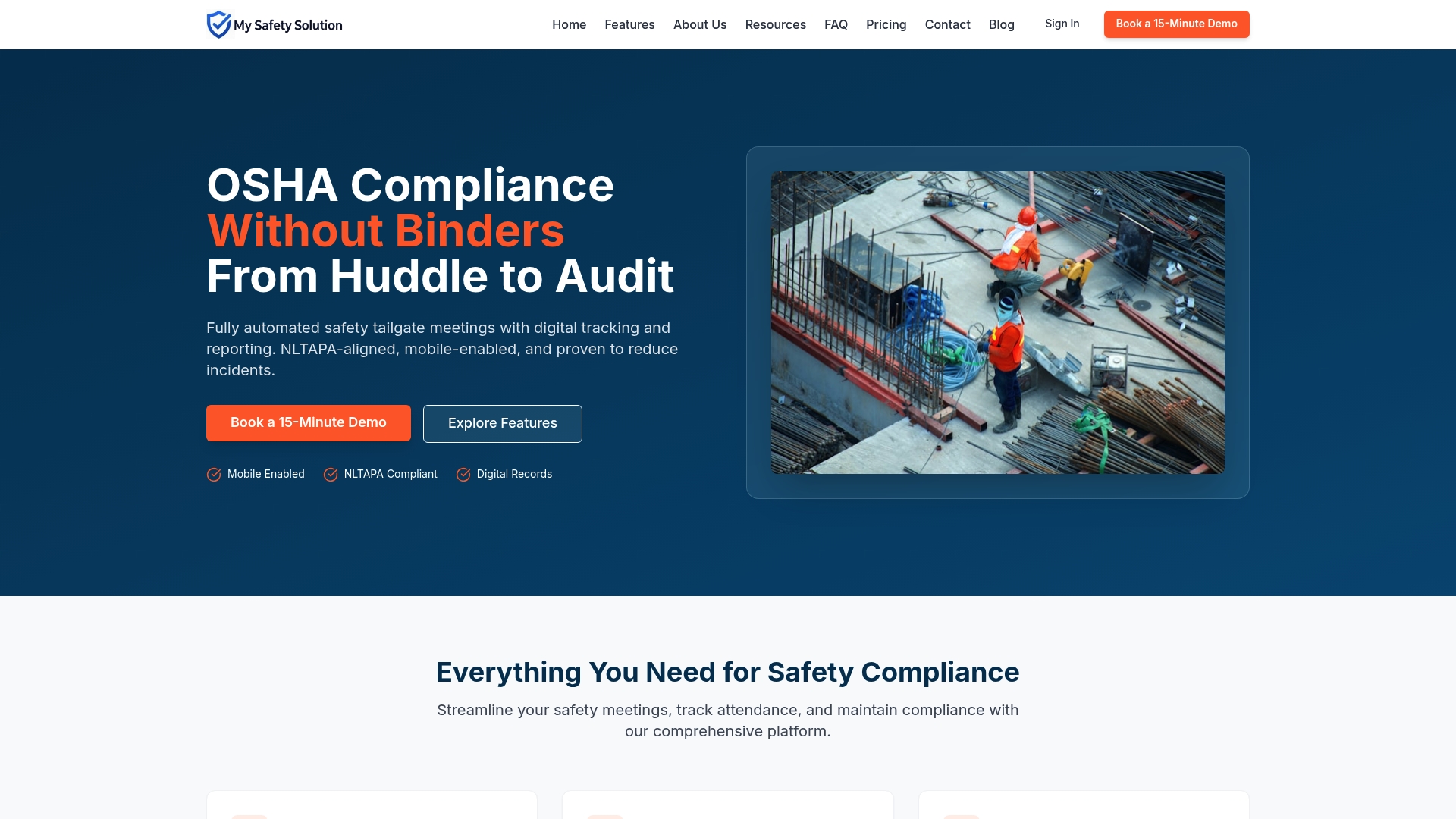
- Planning, delivery, and recordkeeping run through one dashboard instead of three separate tools.
- Attendance and action items are captured on-site, on a phone, at the moment they happen.
- Reports are generated automatically, ready for an inspector rather than assembled the night before one.
Construction and transportation crews can see how this applies to their own operations on the trucking and transportation safety page, and any team ready to move past spreadsheets can review plans and pricing starting at a low monthly rate for the Starter tier.
Sources
- OSHA: Workplace Health and Safety Facilitator Manual
- Toolbox talk effectiveness and templates (CDC/peer-reviewed summary)
FAQ
What are the 5 E’s of workplace safety?
Definitions vary across organizations, and no single OSHA-recognized framework by that exact name applies universally. Safety programs more commonly reference specific pillars like engineering controls, education, enforcement, and engagement rather than a fixed “5 E’s” model.
How do you conduct a good safety meeting?
A good session sets a clear objective tied to a recent hazard or task, uses small-group discussion rather than lecture, and closes with documented attendance and assigned action items. OSHA’s facilitator guidance recommends worker-to-worker exchange over one-way instruction to improve retention.
How can you make safety meetings more engaging?
Open with a near-miss story instead of a fact list, since narrative formats have been shown to increase knowledge gain over facts-only delivery. Breaking the crew into small groups for a few minutes of discussion before reporting back also keeps attention higher than a straight lecture.
What are the three C’s of safety?
This phrase is used informally across different safety programs without one consistent definition, and no primary regulatory source ties it to a specific set of terms. Common versions reference concepts like communication, cooperation, and commitment, but treat these as general principles rather than an official standard.