
A safety meeting sign-in sheet documents who attended a safety meeting, when and where it happened, what topic was covered, and who confirmed their presence with a signature. It’s the paper trail that turns a verbal toolbox talk into an auditable record. Below you’ll find downloadable templates in PDF, Word, and Excel formats, along with the fields and habits that make them hold up under regulatory review.
TL;DR:
- Sign-in sheets should clearly record the meeting date, location, facilitator, specific topic, attendees’ printed names, signatures, and roles to meet audit standards.
- Properly prepared sheets are more reliable if filled out before the meeting, with signatures collected at arrival and departure, and questions or follow-ups noted during the session.
- Retain signed records for at least three years, including attendee details, meeting times, location, and discussion topics, to comply with OSHA requirements.
- Digital tracking offers timestamped and geolocated records, reducing loss risks, but paper sheets remain useful for isolated sites or low-tech environments.
- The overall goal is to foster a safety culture with consistent recordkeeping, making attendance tracking routine and integrating it into the safety management system.
Table of Contents
- What Should a Safety Meeting Sign-In Sheet Include?
- How Do You Properly Fill Out a Sign-In Sheet?
- What Makes a Sign-In Sheet Audit-Ready?
- Should You Use Paper or Digital Sign-In Sheets?
- Sign-In Sheet Field Checklist
- Why Sign-In Sheets Belong to Safety Culture, Not Just Paperwork
- Skip the Clipboard Chase With Digital Attendance Capture
- Sources
What Should a Safety Meeting Sign-In Sheet Include?
Not every sign-in sheet is built the same way, and the format you choose should match the meeting type. A five-minute toolbox talk on a job site needs something faster to fill out than a monthly safety committee meeting with formal minutes.
Three template variants cover most situations:
- Simple sign-in sheet — date, site, topic, and a column for printed name and signature. Fast to use for daily huddles.
- Toolbox talk / tailgate sign-in sheet — adds facilitator name, crew or shift identifier, and a line for materials discussed. A toolbox talk sign-in sheet typically records the time, date, topic, and attendees, which gives you documented proof the meeting actually occurred.
- Meeting minutes with sign-off — used for formal safety committee sessions, this format pairs a narrative summary with an attached attendance page and a supervisor signature block.
On file format: PDF works best when you’re printing stacks of sheets for field distribution, since layout stays fixed regardless of the device opening it. Word (DOCX) suits teams that want to customize a template before printing, adding a company logo or adjusting columns for a specific crew. Excel (XLSX) is the better pick when you’re tracking attendance across many meetings and want to sort, filter, or roll data into a monthly compliance report.
Whatever format you use, leave enough room per line for a legible signature, not just an initial. Add a narrow column for employee ID or role if your crew includes subcontractors or temporary labor, since “who” matters as much as “how many” when OSHA or an insurance auditor asks questions later.

How Do You Properly Fill Out a Sign-In Sheet?
The sheet itself does nothing if it’s filled out sloppily or after the fact. A short, consistent routine protects you far more than a fancy template does.
- Prepare it before the meeting starts. Fill in the date, site or job location, facilitator name, and topic ahead of time so attendees only need to add their own information.
- Collect signatures as workers arrive. Watch for illegible entries. If handwriting is a problem, keep a printed roster nearby so workers can just check a box next to their name.
- Capture role or employee ID for mixed crews. On sites with subcontractors, temps, or multiple companies, a name alone doesn’t tell you who someone works for.
- Get a second confirmation at the end. Either collect a closing signature or have the facilitator note that all listed attendees stayed for the full meeting. This matters more than it sounds. A sheet signed only at the start can’t prove anyone stuck around.
- Record what happened, not just who showed up. Note any questions raised, near-miss discussions, materials handed out, and assign follow-up actions with a name and date attached.
Pro Tip: Keep a clipboard with a laminated instruction card taped to the back listing exactly which fields are mandatory. New supervisors skip fields not because they’re careless, but because nobody told them which ones actually matter to an auditor.
What Makes a Sign-In Sheet Audit-Ready?
Auditors and regulators aren’t looking for a perfect form. They’re looking for evidence that a specific meeting happened, on a specific date, with specific people, covering a specific topic. Miss any one of those and the record’s value drops fast.
State-level OSHA programs are explicit about this. Oregon OSHA’s guide on safety committees and safety meetings recommends that construction, utility, and manufacturing employers keep written meeting records for three years, including attendee names, the meeting date, and the issues discussed. That retention window isn’t arbitrary. It covers the typical lookback period for incident investigations and insurance claims.
A defensible sign-in sheet generally includes:
- Meeting date, start and end time, and physical location
- Facilitator name and, ideally, title or role
- Topic discussed, described specifically rather than as “general safety”
- Attendee printed names and legible signatures
- A field for questions or feedback raised during the session
That last item matters more than most supervisors realize. Recording that a worker asked a question about a specific hazard demonstrates two-way engagement, not a monologue nobody absorbed. Pair that with a supervisor acknowledgement line, and you’ve converted a routine attendance sheet into something closer to a training record, which carries more weight if a corrective-action investigation ever traces back to that meeting.
Should You Use Paper or Digital Sign-In Sheets?
Paper sign-in sheets are the fastest option to deploy. No app, no login, no signal required. That makes them the default choice for isolated sites or crews without company-issued devices.
They also have a real weakness: paper gets lost, damaged, or left in a truck cab overnight. Digital tracking solves that failure mode directly by attaching a timestamp and often a geolocation tag to each entry, and it exports cleanly when an auditor asks for six months of records at once.
A hybrid approach works well for teams not ready to go fully digital:
- Fill out a paper sheet on-site, then photograph it and upload it to a shared drive before the shift ends.
- Or collect signatures on paper and transcribe entries into a spreadsheet at day’s end, keeping the original as backup.
If you’re evaluating a digital system, look for time-stamped entries, secure export options (PDF or CSV at minimum), and role-based permissions so field supervisors can log attendance without editing historical records. A dedicated safety meeting software platform for construction crews handles all three natively.
Pro Tip: If you’re mid-transition from paper to digital, run both for one full month before retiring the paper sheets. It’s the only way to catch gaps in the new workflow before an audit does.
Sign-In Sheet Field Checklist
Before printing or distributing any template, run it against this list.
Required fields:
- Meeting date and time
- Job site or location
- Facilitator name
- Topic discussed
- Attendee printed name and signature
- Employee ID or role (for mixed or subcontracted crews)
Fields that strengthen the record:
- Questions or feedback raised
- Follow-up action items with owner and due date
- Supervisor sign-off
- Materials or handouts distributed
Leave adequate space for signatures, prompt for legibility, and note where the completed sheet gets filed once the meeting ends.
Why Sign-In Sheets Belong to Safety Culture, Not Just Paperwork
Treat the sign-in sheet as evidence of a habit, not a form to survive. Crews that see attendance tracked consistently tend to take the meetings themselves more seriously, and that consistency is exactly what protects you legally if an incident investigation ever asks “did this crew receive this training?”

Small changes compound: keep blank sheets in every truck, digitize once your meeting volume outgrows a clipboard, and make the closing signature as routine as the opening one.
“Paper sign-in sheets get lost, damaged, or filled out after the fact. MySafetySolution replaces fragile paperwork with real-time digital rosters and secure timestamps that guarantee audit integrity.”
— Matthew Hoffman, President - MySafetySolution
Skip the Clipboard Chase With Digital Attendance Capture
My Safety Solution replaces the clipboard entirely for teams running frequent toolbox talks across multiple sites, capturing attendance on a phone instead of chasing down a stack of paper at the end of the week.
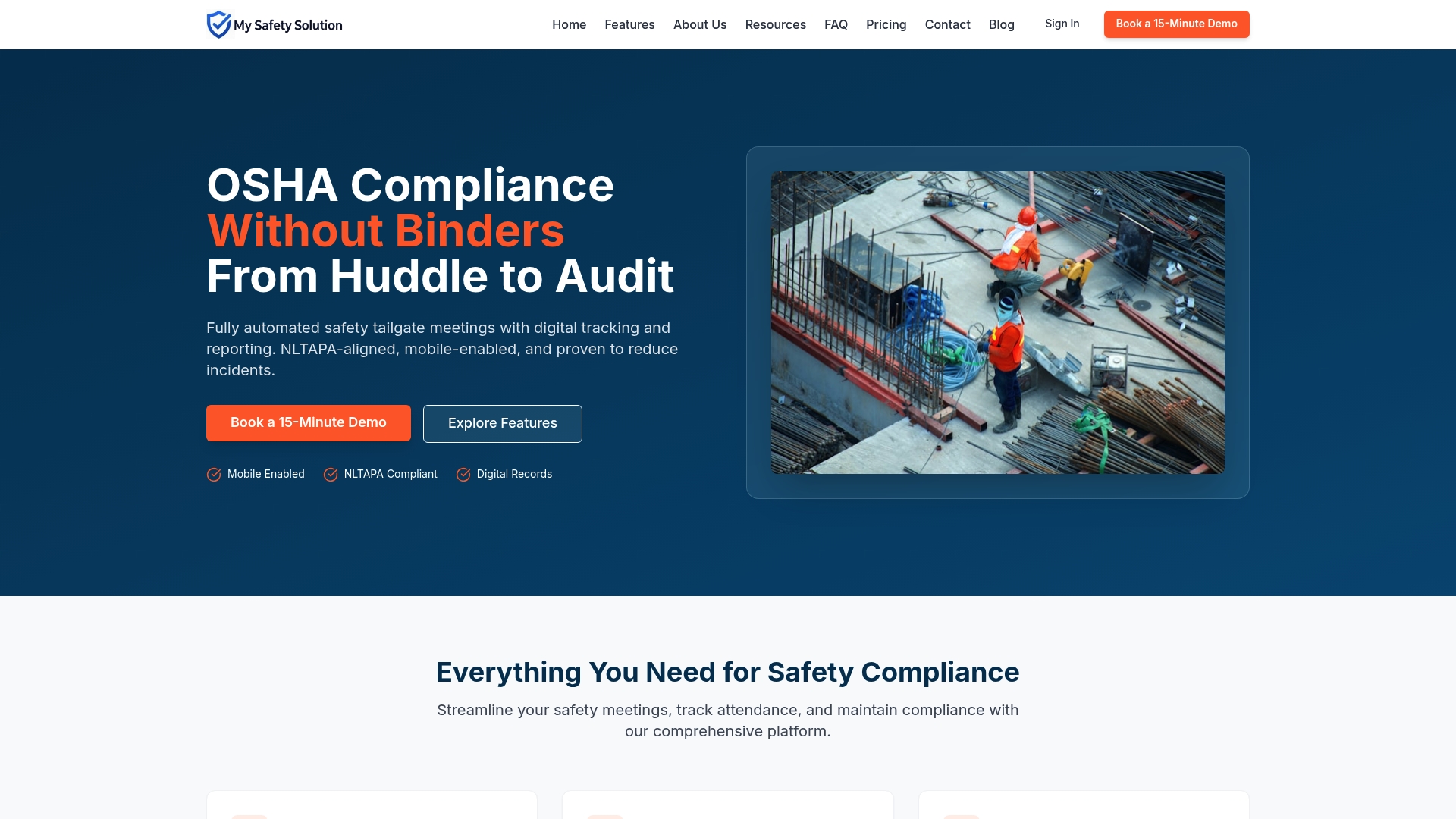
The platform logs each attendee with a timestamp, generates exportable compliance reports on demand, and suggests AI-powered safety topics tailored to your crew’s actual risk exposure instead of a generic monthly checklist. If you’re running one meeting a week on a single site, a printed template still gets the job done. Once you’re managing multiple crews, subcontractors, or enough meeting volume that reconstructing a compliance history from paper takes hours instead of minutes, that’s the point to switch. See how the full platform handles attendance and compliance reporting and decide whether your current volume justifies the move.