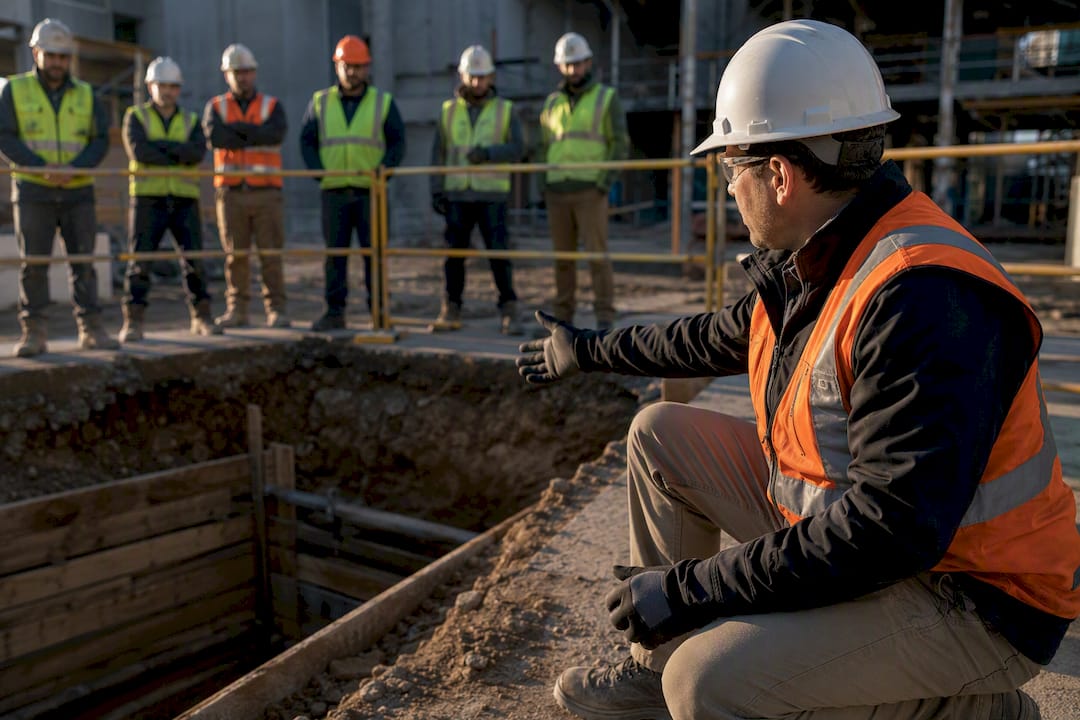
Mobile toolbox talks are the right choice for most multi-site, deskless crews, and the decision hinges on one thing: whether the app captures signatures, photos, and notes offline and syncs later. Done right, mobile delivery produces audit-ready records, speeds up distribution across sites, and makes follow-up on hazards traceable instead of forgotten. Paper still works for a single small crew, but once you add sites or inspectors start asking for proof, mobile stops being optional.
TL;DR:
- Mobile toolbox talks require offline signature, photo, and note capture to ensure compliance in dead zones or challenging site conditions.
- Proper documentation should include timestamps, signatures, hazard details, and follow-up actions, retained at least for the project’s duration.
- Key features to ensure compliance are offline data sync, signature and photo capture, scheduling, export formats, and multilingual support.
- Skipping a step or using talks as substitute for full hazard analysis leads to weak records and potential inspection failures.
- Piloting mobile tools on one crew for 30 days allows measuring improvements in record keeping and follow-up, guiding wider implementation.
Table of Contents
- What Are Mobile Toolbox Talks, and Why Do They Work Better?
- What OSHA Standards Apply to Toolbox Talk Documentation?
- Which Mobile Features Actually Matter for Compliance?
- How Do You Run and Document a Mobile Toolbox Talk?
- What Templates and Topics Work Best for Mobile Talks?
- What Goes Wrong When Sites Switch to Mobile?
- Does Mobile Adoption Actually Change Anything on Site?
- How My Safety Solution Handles the Checklist Above
- Where to Verify the Standards and Templates
- Sources
- FAQ
What Are Mobile Toolbox Talks, and Why Do They Work Better?
A toolbox talk is a short, focused safety conversation, typically 5 to 15 minutes, covering a single hazard tied to the day’s work. Mobile toolbox talks move that same conversation onto a phone or tablet so the supervisor can pull up a template, deliver the talk at the point of work, and capture proof of attendance before the crew scatters.
The format matters because attention spans on a job site are short and hazards change daily. A single topic, delivered near the actual equipment or condition, sticks better than a lecture read from a clipboard. Mobile delivery adds three concrete advantages over paper:
- Faster distribution across multiple sites or shifts from one dashboard
- Immediate evidence capture: signatures and photos logged the moment the talk ends
- Consistent content, so every crew hears the same core message even when different supervisors run it
Crew size and site count decide when the switch is worth it. A single crew running one talk a week can survive on paper. Once you manage several sites, rotate supervisors, or face regular audits, documented toolbox talks become a lot easier to track through a mobile system than a folder of signed sheets in a truck.
What OSHA Standards Apply to Toolbox Talk Documentation?
OSHA does not require a program called “toolbox talks” and sets no fixed frequency. What it does require is hazard-specific instruction, and that obligation shows up across several standards that toolbox talks routinely satisfy.
29 CFR 1926.21 covers safety training and education in construction, requiring employers to instruct workers in recognizing and avoiding unsafe conditions. 29 CFR 1910.132 governs general requirements for personal protective equipment, including hazard assessment and worker training on proper use. 29 CFR 1910.147 addresses the control of hazardous energy, commonly known as lockout/tagout, and requires documented training before workers perform servicing on energized equipment. A brief talk on PPE fit or lockout procedure, properly logged, can serve as evidence that training occurred under any of these three.
A minimum documentation record should include:
- Date, time, location, and job site or crew identifier
- Topic covered and the specific hazard it addressed
- Prevention steps or controls discussed
- Attendee names with signatures
- Notes on questions raised, near-misses mentioned, and any follow-up actions assigned
Retention practices vary by employer and site, but a consistent rule of thumb is to keep toolbox talk records for at least as long as the associated project or the relevant OSHA standard’s training documentation period. During an inspection, a compliance officer who cannot find training records has no way to confirm training happened. A signed, timestamped talk record is often the fastest way to close that gap.
Statistic in focus: OSHA treats documented, hazard-specific instruction as a primary way to demonstrate compliance. That places the burden of proof squarely on your paperwork, not your memory of what you covered last Tuesday.
Which Mobile Features Actually Matter for Compliance?
Not every feature in a toolbox talk app earns its place. Some are cosmetic. A few are the difference between a defensible record and a gap in your files.
Offline capture with auto-sync ranks first. Job sites routinely sit in dead zones, basements, or steel structures that block signal. An app that only works with a live connection will fail you exactly when you need it most. Offline functionality lets crews capture signatures, photos, and notes on the spot, then sync the record once a connection returns.
Signature, photo, and timestamp capture tied directly to each talk creates the audit trail inspectors expect. A photo of the hazard discussed, paired with a timestamp and a signature block, turns a vague claim of “we covered it” into evidence.
Scheduling and export formats determine how much admin time the tool saves. Recurring calendars mean you are not manually assigning the same talk every week, and PDF or CSV export means records land in a format your safety files, or an auditor, can actually use.
Multilingual content and push distribution matter on crews where English is not everyone’s first language, and on multi-site operations where a safety consultant needs to send the same content to five foremen at once rather than build five separate talks.
- Offline data capture and automatic sync when reconnected
- Signature and photo capture tied to a timestamp
- Recurring scheduling and PDF/CSV export
- Action assignment for follow-up items
- Multilingual templates and centralized push distribution
Pro Tip: Test any app’s offline mode by putting your phone in airplane mode before your next talk. If it cannot save a signature and photo without a signal, it will fail you on the site where you need it most.
How Do You Run and Document a Mobile Toolbox Talk?
Running a mobile toolbox talk well comes down to sequence. Skip a step and you either lose engagement or lose your documentation.
- Prebrief. Pick one hazard tied to today’s actual work, not a generic topic from a rotation list, and load the matching template on your device before the crew gathers.
- Deliver. Stand at or near the hazard itself. Point at the equipment, the edge, the trench, whatever it is. Ask one open-ended question rather than a yes-or-no prompt, and keep the whole talk between 5 and 15 minutes.
- Document. Capture attendee signatures on the device, add a photo if the hazard or control is visual, and let the app timestamp the session automatically. Note any questions raised or near-misses mentioned in the record.
- Close. Assign follow-up actions to specific owners with deadlines, then export the completed talk as a PDF into your safety records before you move to the next task.
A few habits make this sequence stick:
- Rotate who delivers the talk so it does not become one supervisor’s monologue
- Ask a question specific to today’s task, not a rehearsed “any questions?”
- Assign follow-ups to a name and a date, never to “the crew” in general
The workflow takes maybe two extra minutes over a paper sheet. What you get back is a record that syncs to your files automatically instead of sitting in a truck cab until someone remembers to file it.
What Templates and Topics Work Best for Mobile Talks?
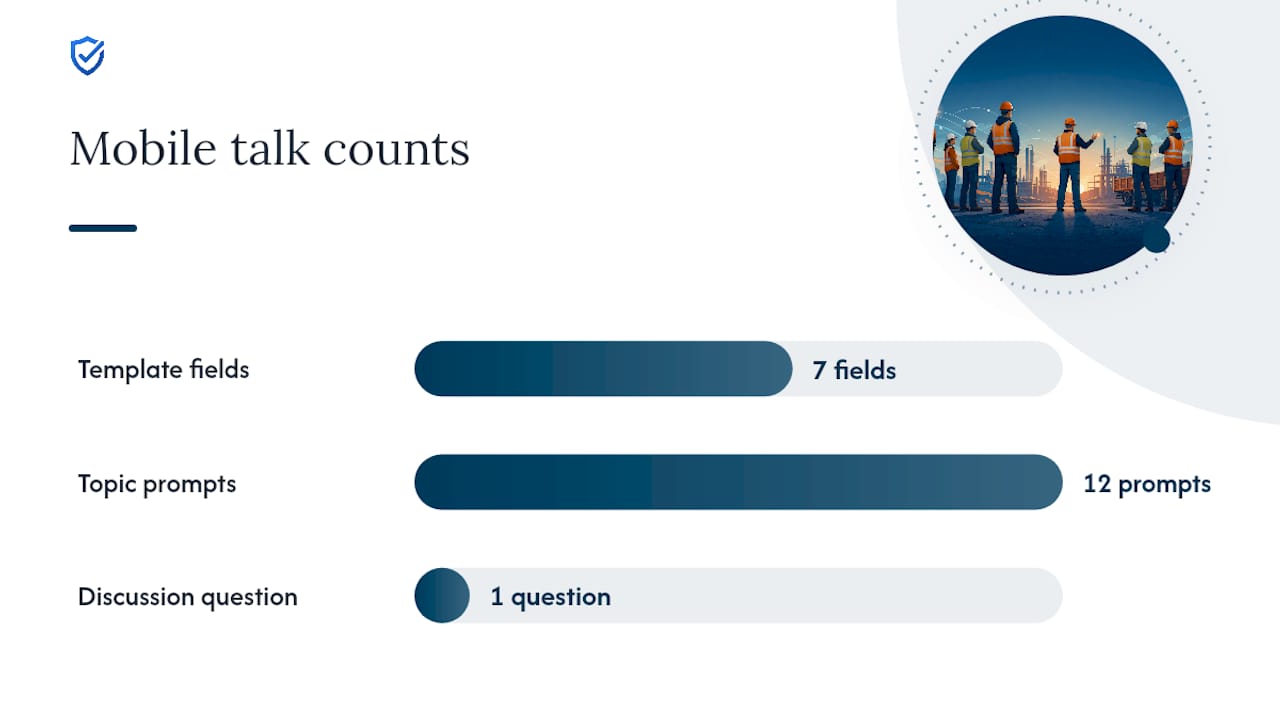
A usable template needs seven fields, and most effective templates share the same structure: header (date, site, crew), hazard, controls or prevention steps, a demonstration or photo, one discussion question, an attendee list with signatures, and a follow-up action line. Copy those seven fields into whatever mobile form builder you use and you have a defensible record every time.
Twelve topic prompts to rotate through a seasonal calendar:
- Fall protection at height
- Ladder inspection and setup
- Lockout/tagout before servicing equipment
- Heat stress and hydration (summer months)
- Cold stress and layered clothing (winter months)
- Trenching and excavation hazards
- Struck-by hazards near mobile equipment
- Hand and power tool safety
- Confined space entry procedures
- Housekeeping and slip/trip hazards
- PPE fit and inspection
- Near-miss reporting and communication
For multilingual crews, keep the discussion question simple enough to translate without losing meaning, and confirm the app supports the language before the talk, not during it. Night shift talks benefit from extra lighting cues in the photo field, since a hazard photo taken in daylight will not match what the crew sees at 2 a.m.
What Goes Wrong When Sites Switch to Mobile?
Three mistakes account for most failed mobile rollouts. Each has a straightforward fix.
Reading the script verbatim, or covering three topics in one talk. This kills engagement fast. Fix it by rotating presenters and enforcing a strict one-topic rule per session, even when the app makes it easy to bolt on extra content.
Weak records that would not survive an inspection. A talk with no signature or no timestamp is barely better than no talk at all. Require signature and photo capture as mandatory fields, and automate the PDF export so nobody has to remember to file it.
Treating the talk as a substitute for a pre-task plan. A five-minute toolbox talk is not a job hazard analysis, and using one to replace the other leaves real gaps in your controls. Keep the roles distinct: the talk raises awareness on one hazard, the pre-task plan covers the full scope of the work.
Pro Tip: If your crew can recite next week’s topic before you announce it, your rotation has gone stale. Swap in a near-miss from the past month instead of the next item on the calendar.
- Rotate presenters and hold the one-topic line
- Make signatures and photos mandatory, not optional
- Keep toolbox talks and pre-task plans separate in scope
Does Mobile Adoption Actually Change Anything on Site?
Pilots that measure real outcomes, not just satisfaction surveys, tend to show the clearest results. A safety manager running one crew on mobile for 30 days typically sees the admin burden drop first: signatures logged instantly instead of transcribed later, records searchable instead of stacked in a binder. Audit readiness improves almost as a side effect, since the export already exists.
My advice and it is not a complicated one: pilot one crew for 30 days before rolling out fleet wide. Track two numbers only, talk completion rate and follow-up closure rate. If both improve, scale it. If neither moves, the problem is probably your templates or your presenters, not the app.
— Matthew Hoffman
How My Safety Solution Handles the Checklist Above
My Safety Solution is built around the exact checklist this article just walked through, not a general-purpose form builder retrofitted for safety talks. It automates the documentation burden a paper system or a spreadsheet leaves on your desk, with digital attendance recording that timestamps signatures automatically, a preloaded content library, and AI-powered topic generation that adapts to your industry instead of handing you a generic script.
For a safety manager weighing a pilot, the Starter plan runs $99 per month and gives one crew everything needed to test the 30-day approach described above: run the talks, capture the records, and measure completion and follow-up closure without committing to a fleet-wide rollout. If you manage multiple sites or oversee several client companies as a consultant, the Growth and Business plans add multi-company dashboards and push distribution built for that scale. Visit the pricing page to compare plans, or explore what the platform includes before you start your pilot crew.
Where to Verify the Standards and Templates
- OSHA’s 29 CFR 1926.21 lays out the hazard-instruction requirement that toolbox talks help satisfy.
- CDC/NIOSH Construction Toolbox Talks offers free, downloadable PDFs with hazard explanations and discussion prompts.
- The Toolbox Talks app on the App Store demonstrates real-world signature capture and PDF reporting features to evaluate against your own checklist.
Sources
- OSHA — 29 CFR 1926.21
- Toolbox Talks | Construction | CDC
- Toolbox talk template: build one that actually gets used | SafetyFolio
- Toolbox Talks app — App Store
FAQ
What Are Some Good Toolbox Talk Topics?
Strong topics tie directly to the day’s actual task: fall protection, lockout/tagout, ladder setup, heat or cold stress, and trenching hazards all work well because crews can immediately connect the discussion to what they are about to do.
What Is a 5-Minute Safety Talk?
A five-minute safety talk is a condensed version of the standard 5 to 15 minute toolbox talk format, covering one hazard, one prevention step, and one quick discussion question before the crew starts work.
What Are the Hottest Safety Topics for 2026?
Heat stress prevention, struck-by hazards near mobile equipment, and near-miss reporting continue to top most crews’ rotation lists, alongside standard fall protection and lockout/tagout refreshers tied to seasonal work.
Can You Give Me an Example of a Toolbox Talk?
A typical talk covers ladder inspection: the supervisor points to a ladder on site, reviews the three-point-contact rule, asks the crew when they last checked their own ladder for damage, then logs attendance and signatures through a platform like My Safety Solution before work begins.