
A defensible safety meeting record includes the date, time, and a topic specific enough to name the exact hazard discussed, the presenter’s name and signature, every attendee’s printed name and signature, and any corrective actions with an assigned owner and due date. Federal OSHA requires employers to instruct construction workers in recognizing and avoiding unsafe conditions under 29 CFR 1926.21, and documentation is what proves that instruction happened. Signatures and topic specificity are the two elements inspectors scrutinize first.
TL;DR:
- Signatures and specific hazard topics tied to real site conditions are critical for OSHA compliance documentation.
- Formal safety meetings require detailed records, including materials distributed and credentials, unlike short toolbox talks.
- Documentation must prove instruction was effective, emphasizing signed attendance, same-day entry, and follow-up actions.
- Digital recordkeeping enhances accuracy and accessibility through timestamped, searchable files with digital signatures.
- Use OSHA’s regulations and audit tools as references, but focus on actual evidence of hazard recognition and corrective measures.
Table of Contents
- What Belongs in a Construction Safety Meeting Record?
- Toolbox Talks vs. Formal Safety Meetings: What’s the Difference?
- What Does OSHA Actually Require for Safety Meeting Records?
- How Do You Make Attendance and Follow-Up Records Irrefutable?
- Should You Go Digital With Safety Meeting Records?
- Documentation Is a Leading Indicator, Not Paperwork
- How My Safety Solution Turns Documentation Into a Workflow
- Where to Verify OSHA Requirements and Find Templates
- Sources
- FAQ
What Belongs in a Construction Safety Meeting Record?
A field-ready record is not a formality. It’s the evidence trail that separates a program an inspector trusts from one they flag for a closer look. Every safety meeting document, whether it’s a five-minute toolbox talk or a full training session, should capture the same core fields.
- Date, time, and location. This establishes when instruction occurred and ties it to the conditions on-site that day.
- A specific topic tied to a site hazard. “Fall protection” is weak. “Guardrail removal procedure for the third-floor slab pour, October 14” is strong. Auditors weigh specificity heavily because a generic topic suggests the talk was recycled rather than delivered.
- Presenter name, credentials, and signature. Whoever led the meeting owns the content. Their signature confirms they delivered it and stands behind what was said.
- Printed name and signature for every attendee. A typed roster proves nothing. A signature proves presence.
- Employer and trade for each attendee. Critical on multi-employer sites where crews from different subcontractors rotate through the same area.
- Duration of the meeting. A three-minute entry for a respirator fit-testing session tells an inspector the training was rushed, regardless of what the topic line says.
- Materials distributed. Handouts, safety data sheets, or manufacturer instructions referenced during the talk.
- Questions or comments raised. A note that a worker asked about ladder inspection frequency shows engagement, not just attendance.
- Photos attached. Images of a demonstration, a hazard being pointed out, or a corrected condition add weight that text alone doesn’t.
Each field exists because it answers a question an OSHA compliance officer or an attorney in an incident investigation will eventually ask. Who was there? What exactly were they told? Who told them? Did anyone follow up? A record missing any of these fields invites the assumption that the meeting either didn’t happen or didn’t cover what it claims to.
The gap between a weak and strong record usually comes down to one sentence. Compare “discussed PPE” against “reviewed cut-resistant glove requirement for rebar tying crew after near-miss on October 9, demonstrated proper glove inspection.” The second version does three things the first can’t: it names the hazard, ties it to a real event, and proves the content matched an actual site condition.
Toolbox Talks vs. Formal Safety Meetings: What’s the Difference?
Not every safety conversation needs the same paperwork, but every safety conversation needs some. The distinction between a toolbox talk and a formal training session determines how much documentation is appropriate, not whether documentation is required at all.
- Toolbox talks, tailgate meetings, and pre-shift briefings run 5 to 15 minutes and typically happen daily or weekly, led by a foreman or crew lead rather than a safety manager. Industry guidance recommends treating these short sessions with the same documentation discipline as formal training, just condensed. A single focused topic, signed attendance, and a brief note on any demonstration or discussion is enough to make a toolbox talk audit-defensible.
- Formal safety meetings run longer, often 30 minutes to several hours, and cover topics requiring deeper instruction: confined-space entry procedures, respirator fit testing, fall protection certification, or new equipment operation. These sessions warrant fuller documentation, including materials distributed, competent-person credentials where applicable, and sometimes a written test or acknowledgment.
- Know when to escalate. A topic outgrows the toolbox-talk format when it involves a new hazard the crew hasn’t encountered before, any task requiring certified training (respirator fit tests, crane signaling, confined-space entry), or a corrective action from a near-miss that needs more than a five-minute mention. If a five-minute talk keeps growing into a fifteen-minute Q&A every time it’s covered, that’s a signal the topic belongs in a formal session with its own agenda.
The mistake most crews make isn’t skipping documentation. It’s treating every toolbox talk like a bureaucratic checkbox instead of a genuine training moment worth a signature and a sentence of substance.
What Does OSHA Actually Require for Safety Meeting Records?
OSHA does not mandate a single universal form for safety meetings. What it requires, under 29 CFR 1926.21, is that employers instruct each construction employee in recognizing and avoiding unsafe conditions specific to their work. Documentation exists to demonstrate that instruction happened, not to satisfy a paperwork quota.
Inspectors draw on a few specific sources when evaluating whether a program meets that standard:
- 29 CFR 1926.21 instruction requirements, which set the baseline obligation to train workers on hazard recognition.
- OSHA’s recommended practices for safety and health programs in construction (OSHA3886), which outline core program elements employers can use to structure and document an effective safety program.
- The Safety and Health Program Audit Tool, which lists recordkeeping, hazard identification, and corrective-action tracking as specific areas inspectors review.
- OSHA’s citation policy under Instruction STD 3-1.1, which explains how inspectors evaluate whether training and instruction were adequate under 1926.20 and 1926.21.
None of these require a specific template. What they collectively expect is evidence that instruction was effective, not just that it occurred. A note on questions asked during a talk, or confirmation that a demonstration was performed and understood, carries more weight with an inspector than a bare attendance line with no context. That distinction shows up repeatedly in OSHA’s own Safety Manager Workbook, which frames documentation as proof of effectiveness rather than proof of attendance alone.
How Do You Make Attendance and Follow-Up Records Irrefutable?
Attendance records deserve the same rigor as payroll. Nobody would accept a typed list of names as proof someone worked a shift, yet plenty of crews still treat a typed attendee roster as sufficient proof of training. It isn’t. Legible printed names paired with actual signatures, plus a presenter signature confirming date and time, close that gap.
- Require printed name plus signature from every attendee, not a checkbox or initials alone.
- Have the presenter sign and date the record immediately after the meeting ends, not at the end of the week.
- Document every corrective action with a named owner, a deadline, a verification method, and evidence of completion, whether that’s a photo or an initialed sign-off.
- Link corrective actions to an incident ID or near-miss report when the topic originated from a real event on-site.
- Add employer and trade columns for every attendee on multi-employer sites so the record preserves its evidentiary value when crews rotate across contractors on a shared job site.
- Never backdate an entry. Scan or upload same-day, and keep a log showing when each record was created and by whom.
Pro Tip: Set a hard rule that no meeting record leaves the supervisor’s hands until it has a presenter signature and a full attendee count matching the crew roster for that shift. A record with three signatures for a twelve-person crew raises more questions in an audit than no record at all.
Retroactive entries are the fastest way to turn a strong safety program into a liability during an investigation. Practitioner guidance consistently points to same-day scanning and signed attendance as the two habits that most reduce the risk of records being treated as fabricated after the fact.

Should You Go Digital With Safety Meeting Records?
Paper binders kept in a job trailer are one lost box away from a compliance gap. Digital capture, done right, closes that risk while cutting the time supervisors spend chasing signatures.
A workable digital system needs a few non-negotiables. Same-day scanning turns a paper sign-in sheet into a searchable file before the ink is even fully dry, and a consistent filename structure, something like YYYYMMDD_project_topic, means anyone can find a specific record in seconds rather than digging through folders.
- Capture presenter name, attendee count, location, and any attachments (safety data sheets, photos, corrective-action links) as searchable metadata, not buried in a scanned image.
- Timestamp every record at creation, not at upload, to prevent disputes over when a meeting actually happened.
- Retain general training records for a reasonable window, but extend retention for anything tied to chemical exposure or medical monitoring, since 29 CFR 1910.1020 governs access to employee exposure and medical records and can require longer holds than a standard toolbox-talk log.
- Store originals when a client contract or state requirement calls for it, even after digitizing.
Digital capture with tamper-evident timestamps and automatic backups also solves the disaster-proofing problem paper never could. A flooded job trailer or a lost binder used to mean losing months of training history; a cloud-stored digital recordkeeping system means that risk disappears entirely. Capturing each digital signature on the worker’s own phone, time-stamped at the meeting itself, strengthens the record’s credibility far more than a typed summary added after the fact.
Documentation Is a Leading Indicator, Not Paperwork
Most supervisors treat safety meeting records as a compliance chore. That’s backwards. A consistent, specific record is one of the clearest signals of management commitment an inspector or an executive can find, and it builds a find-and-fix loop that catches recurring hazards before they become incidents.
Three small changes produce outsized results: swap a vague topic template for one that forces a hazard-specific entry, make presenter signatures mandatory rather than optional, and require same-day scanning with no exceptions. Crews that adopt these three habits close corrective actions faster and see fewer repeat incidents tied to the same hazard, because the paperwork now points directly at what needs fixing instead of just proving someone showed up.
“Documentation is a leading indicator of an organization's safety discipline. MySafetySolution ensures every tailgate talk is captured with exact timestamps, attendee signatures, and documented action items before work begins.”
— Matthew Hoffman, President - MySafetySolution
How My Safety Solution Turns Documentation Into a Workflow
My Safety Solution replaces the scanned-binder scramble with a workflow built for exactly what inspectors look for: digital signatures with timestamps, searchable records you can export as PDF, and hazard and near-miss reports kept alongside your meeting records.
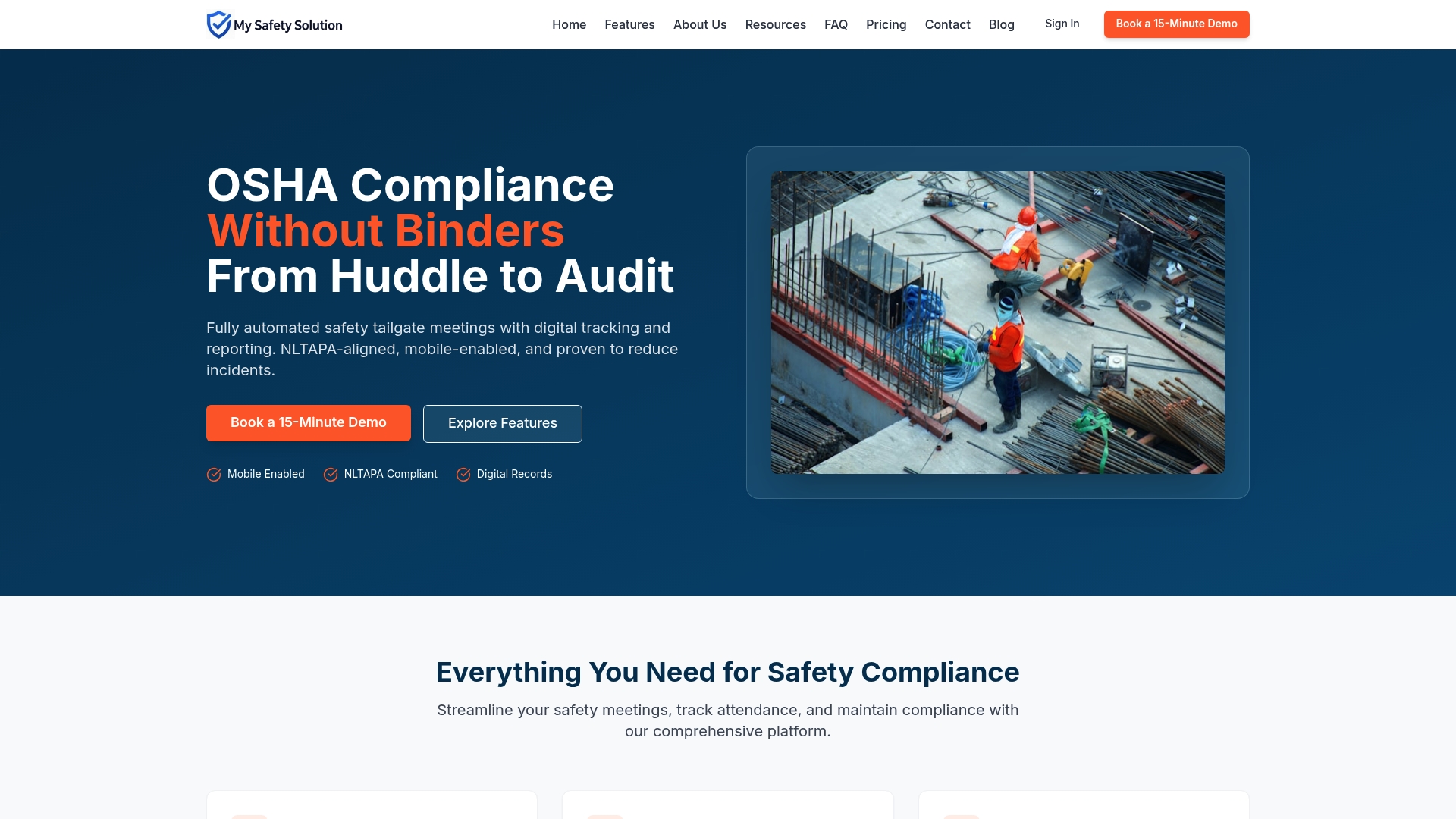
Instead of chasing paper signatures or reconstructing a filing system after a citation lands, crews sign in on their own phones by QR code or link at the toolbox talk itself, or the leader records the sign-off, time-stamped the moment it happens. That single change removes the biggest vulnerability in most safety programs: the gap between when a meeting occurred and when it got written down. A library of 2,500+ talks across 262 trades, with schedules ranked by real OSHA injury and citation data for your trade and state, replaces recycled generic talks, which addresses the exact weakness auditors flag most often. For consultants and agencies juggling several client companies, the platform manages each company separately from one account.
Plans are priced by headcount, and every plan includes the same features. See the pricing page for the plan that matches your crew count, or start your 15-day free trial and begin building an audit-ready record today.
Where to Verify OSHA Requirements and Find Templates
For the regulatory language itself, review 29 CFR 1926.21 on instruction requirements and the recommended practices document (OSHA3886) directly from OSHA.
- Use the Safety and Health Program Audit Tool to self-check your program before an inspector does.
- Start with a 5 to 15 minute OSHA-ready safety meeting checklist and sign-in sheet for daily toolbox talks.
- Review OSHA training documentation requirements to understand what employers must keep and for how long.
Sources
- 29 CFR 1926.21 — Safety training and education
- Recommended practices for safety and health programs in construction (OSHA3886)
- Safety and health program audit tool
FAQ
What Documents Count as Construction Safety Records?
Core construction safety documents include signed meeting attendance sheets, toolbox-talk logs, corrective-action tracking sheets, incident and near-miss reports, training certification records, and safety data sheets referenced during instruction. Together, these form the audit trail OSHA and internal auditors review when evaluating a program’s effectiveness.
What Are Good Safety Topics for Construction Meetings?
Strong topics tie directly to a hazard present on the current job site: fall protection near an open edge, trenching and excavation before a dig begins, or hot work procedures ahead of welding tasks. Generic topics disconnected from that day’s work carry far less weight with inspectors than site-specific ones, and tailored topic guides can help match content to actual conditions.
What Does OSHA Require for Safety Meetings?
OSHA doesn’t mandate a specific meeting frequency or form, but 29 CFR 1926.21 requires employers to instruct workers in recognizing and avoiding unsafe conditions related to their work. Documentation exists to prove that instruction happened and was effective, which is what inspectors actually evaluate.
What Are the 5 E’s of Workplace Safety?
Definitions of the “5 E’s” vary across safety programs and are not a formal OSHA standard, so there’s no single canonical version to cite. Rather than rely on a mnemonic, focus documentation on what OSHA does specify: instruction in hazard recognition, verified through complete, signed records.
How Long Should Safety Meeting Records Be Kept?
General toolbox-talk and meeting records should be retained for a reasonable window that covers project duration plus a buffer for potential claims, while records tied to chemical exposure or medical monitoring fall under 29 CFR 1910.1020 and may require significantly longer retention. When in doubt, keep exposure-related records longer rather than shorter.
Can Software Like My Safety Solution Handle This Documentation?
Yes. My Safety Solution handles mobile sign-in, digital signatures, timestamps, and searchable records you can export as PDF, so records are audit-ready without manual filing. Plans are priced by headcount; see the pricing page for details.