
Why digital recordkeeping for safety meetings is no longer optional
Paper sign-in sheets and spreadsheet patchworks cannot hold up under an OSHA inspection. Digital recordkeeping for safety meetings replaces that fragile system with timestamped, searchable, legally defensible records that prove your program is running the way it should.
The core value is control. When an inspector asks for attendance records from a tailgate meeting held six months ago, a digital system retrieves that record in seconds. A filing cabinet does not.
- Timestamped entries confirm exactly when each meeting occurred and who attended
- Digital signatures replace illegible paper sign-ins with verifiable acknowledgments
- Cloud storage keeps records accessible from any device, at any time
- Automated reporting reduces the manual work of preparing for audits
- Real-time dashboards give safety managers visibility into participation gaps before incidents occur
OSHA’s recordkeeping requirements do not mandate a specific format for every safety meeting, but they do require that records be accurate, complete, and retrievable. Digital systems satisfy all three conditions simultaneously.
What OSHA actually requires for workplace safety meeting records
OSHA’s recordkeeping framework centers on three forms: the OSHA 300 Log of Work-Related Injuries and Illnesses, the OSHA 300A Annual Summary, and the OSHA 301 Incident Report. Every covered employer must maintain these records for five years.
The electronic submission mandate expanded significantly in 2024. Establishments with 250 or more employees, plus certain high-risk industries regardless of size, must now submit Form 300A data electronically through OSHA’s Injury Tracking Application each year.
Who must comply:
- Establishments in industries covered by OSHA recordkeeping rules that meet certain size criteria
- Establishments in designated high-risk industries (construction, manufacturing, utilities, and others) regardless of size
- State-plan states may impose additional or equivalent requirements
What incidents are recordable:
- Work-related fatalities
- Work-related injuries or illnesses requiring medical treatment beyond first aid
- Days away from work, restricted duty, or job transfer cases
- Loss of consciousness or diagnosis of a significant injury by a licensed healthcare professional
Key deadlines:
- OSHA 300A must be posted at the worksite annually during the appropriate reporting period
- Electronic submission of 300A data is due annually by the required deadline following the calendar year covered
- Incident reports (Form 301) must be completed promptly after learning of a recordable case
Oregon OSHA, as one example of a state program, requires employers in construction, utility work, and manufacturing to keep safety meeting minutes according to state regulations, often for multiple years. Safety managers operating across multiple states should verify each jurisdiction’s specific retention rules.
Benefits and best practices for digital safety meeting documentation
Digital attendance tracking does more than satisfy a checkbox. Effective tracking focuses on visibility and proactive intervention, giving safety managers the data to identify engagement gaps before they become incident reports.
Core benefits:
- QR code check-ins and mobile kiosks reduce meeting documentation time from minutes to seconds
- Timestamped records and digital signatures create an audit trail that holds up during inspections and litigation
- Secure cloud storage eliminates the risk of lost or damaged paper records
- Integration with safety management systems connects attendance data to corrective actions and training schedules
Best practices for safety managers:
- Require digital signatures from every attendee, not just a supervisor sign-off
- Store records with the meeting topic, date, location, and a list of hazards discussed
- Set retention policies that meet or exceed your state’s minimum, typically three years for construction and manufacturing
- Run monthly compliance reports to catch attendance gaps before an audit surfaces them
- Integrate your recordkeeping platform with your incident reporting system so related records link automatically
Pro Tip: Do not treat attendance data as a headcount metric. The real value is pattern recognition. If the same crew consistently misses tailgate meetings, that gap is a leading indicator worth investigating before an incident forces the conversation.
Comparing leading U.S. digital recordkeeping software providers
Three platforms stand out for safety managers evaluating purpose-built solutions for OSHA compliance meeting software in the U.S. market.
| Provider | Compliance features | Digital attendance tracking | AI-powered automation | Industry specialization | Ease of use | Rating |
|---|---|---|---|---|---|---|
| BIS Safety Software Inc. | OSHA compliance reporting, certification management, digital field documentation | Yes, with structured digital forms | AI-powered Safety Acceleration Software™ with predictive compliance | Regulated industries requiring speed and reliability | Purpose-built interface for field teams | 4.8★ (94 reviews) |
| HSI | Unified EHS, risk management, chemical management, automated workflows | Yes, integrated with training management | HSI Intelligence AI-powered safety insights | EHS and training professionals in regulated industries | All-in-one platform, recognized on G2 and Capterra | 4★ (4 reviews) |
| RecordKeeper Systems | Custom compliance documentation, CRM and ERP integration | Custom-built per client requirements | Not a core feature | Organizations needing custom FileMaker Pro or hybrid cloud solutions | Highly configurable, requires implementation support | 5★ (2 reviews) |

BIS Safety Software Inc. built its platform around the concept of Safety Acceleration Software™, a coordinated system designed to move regulated industries from compliance lag to compliance readiness. The AI-powered automation handles predictive compliance monitoring, certification tracking, and digital field documentation in one place. For safety managers in construction or manufacturing who need to close the gap between a meeting happening and a record being filed, BIS Safety Software’s workflow architecture addresses that directly.
HSI takes the broadest approach of the three, unifying EHS software, workforce training, risk management, and chemical management under one platform. Its HSI Intelligence layer applies AI to surface safety insights across the organization. HSI was named a leader in the Verdantix 2025 EHS Software Green Quadrant Report, a meaningful signal for compliance officers evaluating enterprise-grade solutions. The platform suits organizations that want training management and EHS compliance handled by a single vendor.
RecordKeeper Systems operates differently from the other two. Rather than offering a fixed product, it builds custom FileMaker Pro and hybrid cloud solutions tailored to each client’s workflows, including apprenticeship tracking and industry-specific CRM and ERP integration. Organizations with complex, non-standard documentation requirements will find more flexibility here than in either of the packaged platforms. The tradeoff is implementation time and the need for ongoing technical support.
AI-enabled tools across all three categories are increasingly automating documentation and improving proactive compliance monitoring, reducing the manual burden on safety teams.
How to implement digital recordkeeping that holds up under OSHA scrutiny
Getting a digital system deployed is straightforward. Getting it deployed correctly, so records are defensible and staff actually use it, requires a deliberate process.
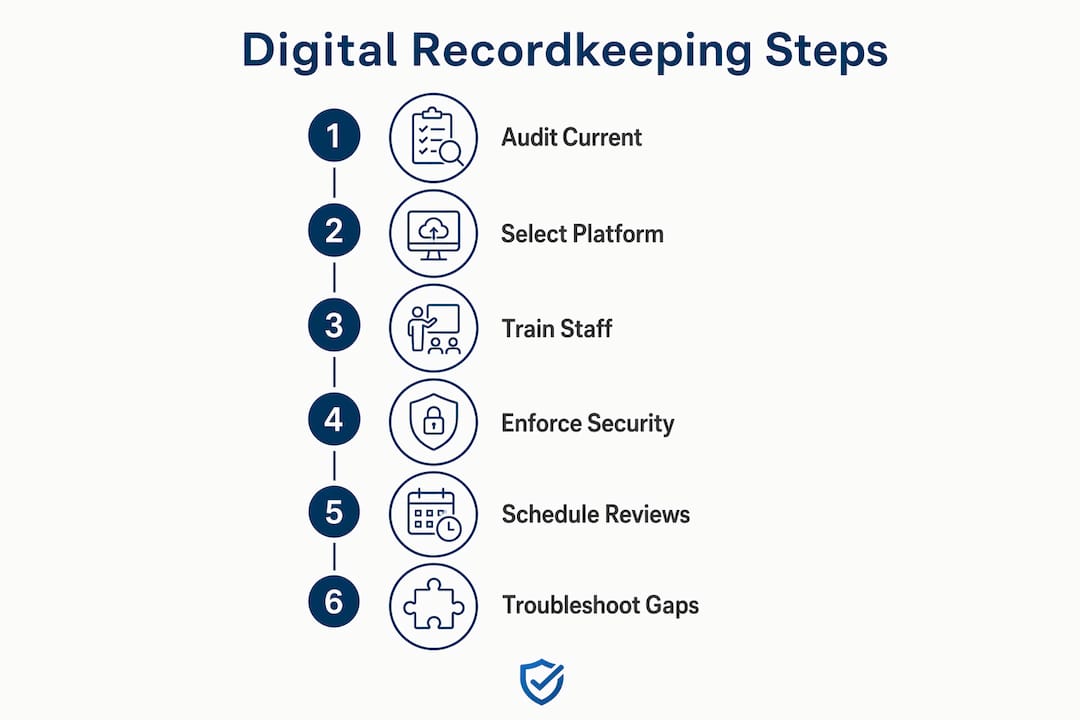
Step 1: Audit your current state. Map every point where safety meeting records are currently created, stored, and retrieved. Identify where records are incomplete, illegible, or missing entirely. That gap analysis becomes your requirements list.
Step 2: Select a platform based on compliance fit, not just features. Verify that any system you evaluate captures the specific data OSHA requires: date, attendees, topics discussed, and hazards identified. Confirm it supports digital signatures and timestamping for every record.

Step 3: Train staff before go-live, not after. Run a pilot with one crew or one site. Collect feedback on friction points, fix them, then roll out broadly. Staff who understand why the system matters adopt it faster than staff who receive a mandate with no context.
Step 4: Establish data security and access controls. Limit editing rights after a meeting is closed and approved. Encryption at rest and in transit protects sensitive employee data. Verify your vendor’s security certifications before signing a contract.
Step 5: Build audit readiness into your routine. Schedule quarterly record reviews rather than waiting for an inspection notice. Custom digital solutions that integrate with existing workflows make this review faster and more consistent.
Step 6: Troubleshoot adoption gaps early. If attendance records show incomplete sign-ins or missing topics, address it at the supervisor level immediately. A pattern of incomplete records is harder to explain to an inspector than a single missing entry.
For construction site safety meetings specifically, mobile-first platforms that work without reliable internet connectivity are worth prioritizing, since many job sites operate in areas with limited signal.
My Safety Solution covers what the compared platforms do not
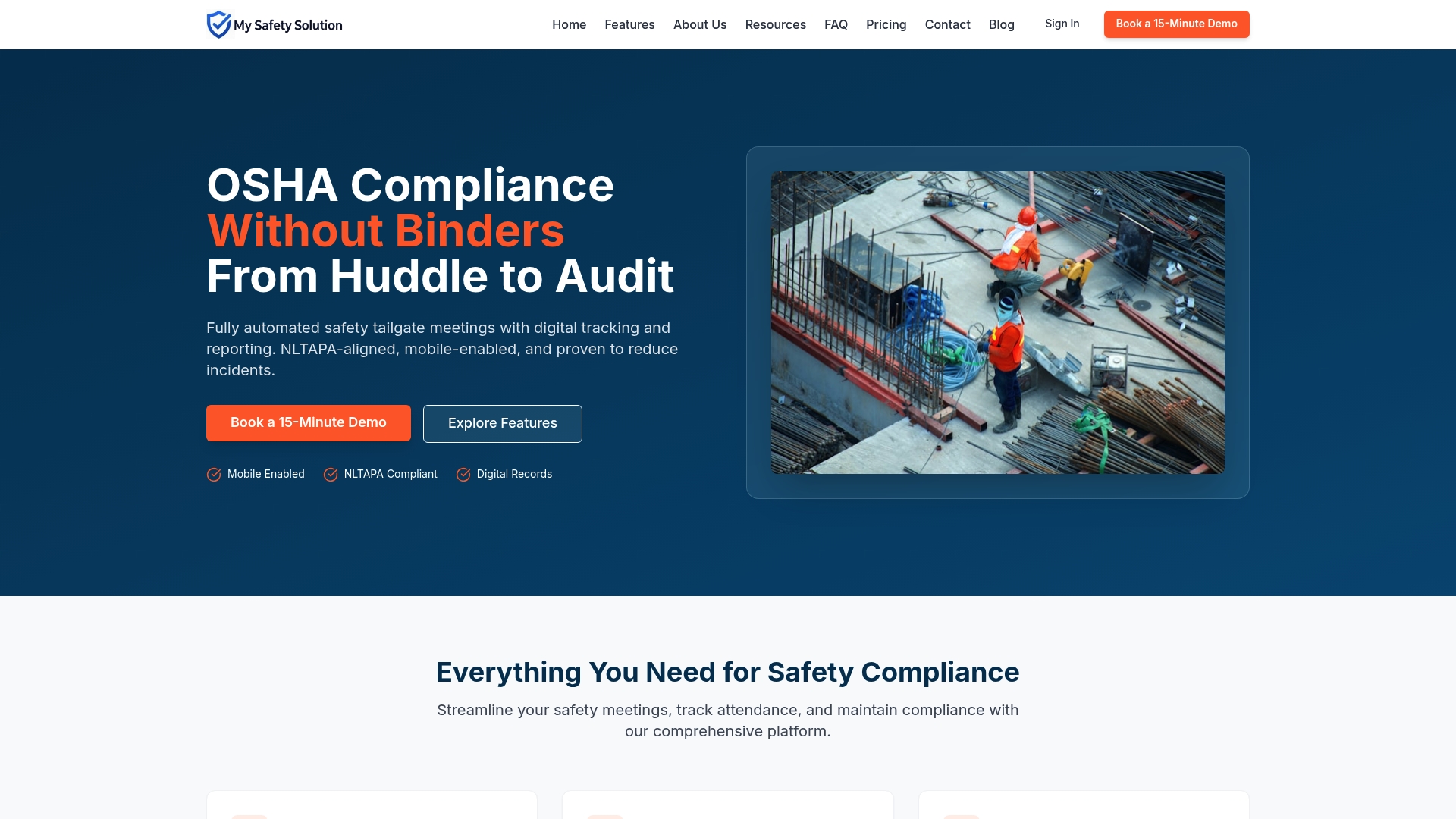
The three platforms compared above serve organizations with established IT infrastructure, dedicated EHS staff, or custom development budgets. My Safety Solution was built for a different reality: deskless workforces in construction, manufacturing, utilities, and trucking, where the safety manager is often also the one running the tailgate meeting.
My Safety Solution automates the entire meeting cycle, from AI-generated safety topics pulled from an NLTAPA-aligned content library, to digital attendance with signatures and timestamps, to compliance reports ready for OSHA review. There is no paper to chase, no spreadsheet to reconcile, and no separate system to log into after the meeting ends. Safety consultants managing multiple companies get a multi-company dashboard that keeps every client’s records organized and accessible in one place.
For safety managers who need OSHA compliance software that works the way their crews actually work, My Safety Solution is worth a direct look.
Key Takeaways
Digital recordkeeping for safety meetings is the most reliable way to meet OSHA’s accuracy, completeness, and retrievability standards while reducing administrative burden on safety teams.
| Point | Details |
|---|---|
| OSHA electronic submission | Establishments with 250+ employees must submit Form 300A data electronically by March 2 each year. |
| Retention requirements | Construction, manufacturing, and utility employers in many states must keep safety meeting minutes for five years. |
| Digital signatures matter | Timestamped digital signatures create a legally defensible audit trail that paper sign-ins cannot match. |
| Platform selection | BIS Safety Software Inc., HSI, and RecordKeeper Systems each serve distinct needs; match the platform to your compliance requirements and workforce type. |
| My Safety Solution | Purpose-built for deskless, high-risk workforces, with automated attendance, AI-generated topics, and OSHA-ready reporting in one mobile platform. |