
Client-level safety reporting means generating audit-ready meeting, attendance, and incident records organized by individual client or company, not by site alone or by generic company-wide totals. For safety managers and consultants running multiple accounts, this structure turns scattered paperwork into searchable, exportable evidence that satisfies OSHA recordkeeping requirements and supports proactive risk management. Platforms like My Safety Solution build this structure into daily operations rather than leaving it to manual reconciliation.
TL;DR:
- Per-client safety reports streamline audit responses and help identify emerging risks through consistent tracking of meetings, trainings, and incidents.
- Complete records require signatures, timestamps, hazard photos, and relevant metadata to meet OSHA and OSHA-like standards.
- Automation tools like My Safety Solution reduce manual work by capturing signatures digitally, organizing records by client, and providing a library of industry- and trade-specific safety talks.
- Maintaining records for five years and reporting injuries within seven days remain critical deadlines, with privacy measures needed for sensitive information.
- Tracking proactive indicators such as meeting frequency and hazard reports helps predict incidents before they occur, supporting a risk-based safety approach.
Table of Contents
- What per-client safety reporting actually includes
- Why audit-ready, per-client reporting matters
- Core components of an audit-ready client report
- Capturing complete records in the field
- Meeting OSHA’s timelines, retention, and privacy expectations
- Metrics that predict risk before it becomes an incident
- A 30/60/90 rollout for client-level reporting
- What experience teaches about per-client automation
- How My Safety Solution keeps every client’s records audit-ready
- Sources
- FAQ
What per-client safety reporting actually includes
Per-client safety reporting means every meeting, training session, and incident tied to a specific company or account gets logged, timestamped, and stored under that client’s own record set. This is distinct from payroll-based employer reporting or patient safety documentation used in healthcare settings, which follow entirely different rules and serve different purposes. In a construction or manufacturing context, the goal is simple: when an auditor or client asks for proof, the answer sits in one organized file rather than a shared spreadsheet.
A complete per-client record typically contains:
- Attendee identity and job role for every safety meeting
- Signature and timestamp confirming attendance
- The specific safety topic covered, with supporting materials
- A written incident narrative when applicable
- Photos documenting hazards or post-incident conditions
- Site or project identifier linking the record to a location
Why audit-ready, per-client reporting matters
Compliance is the immediate driver. When OSHA or a client’s insurance auditor requests documentation, records organized by company let a safety manager produce exactly what is asked for without digging through unrelated sites. That matters more as consultants take on multiple accounts, since a mixed record set creates delay and, in the worst case, the appearance of missing documentation.
The safety value runs deeper than compliance. NIOSH’s guidance on leading indicators finds that proactive measures such as safety meeting frequency and training effectiveness checks carry predictive value when tracked reliably, helping organizations catch risk before it becomes an incident. Reliable indicators require consistent capture, and consistent capture requires structure.
- Per-client organization speeds up audit responses and insurance reviews
- Consistent meeting cadence supports early detection of emerging risk
- Multiple-client dashboards reduce the coordination burden on consultants
Leading indicators, tracked reliably, provide predictive value that lagging metrics alone cannot offer, according to NIOSH’s bulletin on leading indicator practice. That single point separates reactive safety programs from ones that catch problems early.
Core components of an audit-ready client report
An audit-ready report is only as strong as its weakest field. Four categories of documentation need to be present, complete, and traceable back to a specific client and project.
- Attendance and training records. These need signatures, trainer identity, a timestamp, and job-site context. OSHA standard 1926.503 requires written certification for construction fall protection training that identifies the trained employee, the training date, and the instructor or employer signature.
- Incident reports mapped to OSHA content. Injury classification, medical treatment provided, witness information, and photos should mirror what OSHA Forms 300 and 301 expect, so the record converts cleanly if it needs to be submitted or referenced.
- Meeting content proof. This includes the topic covered, materials distributed, and some evidence that attendees acknowledged or understood the content, not just that they were present.
- Metadata and versioning. Client ID, project ID, who exported the record and when, and the retention date all need to travel with the file itself.
Pro Tip: Store retention metadata inside the record, not in a separate log. When an exported file already carries its own retention date, nobody has to reconstruct the timeline later.
Capturing complete records in the field
Deskless environments make data capture harder than it sounds. Workers move between sites, paper gets lost, and a signature collected on a clipboard rarely makes it into a permanent file the same day. Mobile-first capture solves the timing problem: signatures, job-site details, and photos upload the moment a meeting ends rather than waiting for someone to transcribe them later.
- Standardized templates produce OSHA-equivalent forms without extra formatting work
- Built-in required fields prevent a supervisor from submitting an incomplete record
- Anonymous near-miss and hazard reporting channels encourage honest input from workers
- Centralized dashboards with per-client folders make exports fast when an audit request lands
A shop-floor parallel exists in manufacturing job travelers, where structured recordkeeping tools capture revision history and context without relying on paper. The same discipline applies to safety documentation: capture once, correctly, and the export takes care of itself.
Meeting OSHA’s timelines, retention, and privacy expectations
Auditors check specific dates, not general good faith. Covered employers must enter recordable injuries on Forms 300 and 301 within 7 calendar days, keep those records for 5 years, and post Form 300A between February 1 and April 30 each year, according to OSHA’s recordkeeping rule. Per-client organization makes hitting those windows realistic across dozens of active accounts instead of one.
Certain establishments must also submit injury and illness data electronically to OSHA’s Injury Tracking Application during the designated annual window in early calendar year, with thresholds that vary by industry code and establishment size under 29 CFR 1904.41. Consultants managing several clients benefit from records already segmented by company when this submission window opens.
- Enter recordable injuries within 7 calendar days of the event
- Retain injury and illness records for 5 years
- Submit ITA data during the January 2 to March 2 window where thresholds apply
Privacy matters just as much as timing. Names should be redacted for sensitive medical cases, and full unredacted records should go only to employees, their representatives, and authorized auditors, consistent with the privacy guidance in OSHA’s equivalent-forms standard.
Metrics that predict risk before it becomes an incident
A short list of per-client indicators, tracked consistently, does more for prevention than a long list tracked sporadically. The goal is to catch drift in one account before it turns into a recordable injury.
- Safety meeting frequency per client, compared against the required cadence
- Near-miss and close-call reporting rate, since a drop often signals underreporting rather than improvement
- Hazard observations completed per site or crew
- Training retention checks, confirming workers still understand material weeks after a session
Recordable injuries and lost-time incidents remain useful as lagging context, but they arrive too late to change the outcome they describe. When near-miss reports climb for a single client while meeting frequency stays flat, that combination is a clear signal to schedule targeted retraining before a more serious event occurs.
A 30/60/90 rollout for client-level reporting
Getting per-client reporting live does not require a long transition. The first week should confirm the basics are solid before scaling to a full client roster.
- Week one: Build standard meeting and incident templates, pilot them on one site, and confirm the format is OSHA-equivalent.
- Day 30: Enroll additional clients, configure dashboard access by account, and verify export formatting matches audit needs.
- Day 60: Run retention checks across every active client to confirm records carry proper dates and metadata.
- Day 90: Execute a mock audit export for at least one client to confirm the full chain, from signature to storage, holds up under scrutiny.
Pro Tip: Assign one person per client to verify records weekly rather than reviewing everything at audit time. Small errors caught early cost minutes; the same errors caught during an actual audit cost credibility.
Access permissions, export cadence, and a named record verifier for each client keep the system accountable as the roster grows.

What experience teaches about per-client automation

Fragmented formats cause more audit trouble than any single missing document. A safety meeting logged on paper at one site, in a spreadsheet at another, and not at all at a third leaves a consultant guessing when a client finally asks for a full year of records. Missing timestamps and inconsistent near-miss capture follow close behind as recurring pain points across deskless industries.
Automation does not remove the need for judgment, but it removes the administrative drag that keeps safety managers from applying that judgment where it counts. A digitized, per-client record set gives auditors exactly what they expect to see and gives safety managers back the hours they used to spend reconstructing history from memory.
“Managing safety across multiple clients shouldn't mean drowning in segregated paperwork. MySafetySolution gives safety consultants clean multi-tenant dashboards and one-click reporting tailored to each client's specific requirements.”
— Matthew Hoffman, President - MySafetySolution
How My Safety Solution keeps every client’s records audit-ready
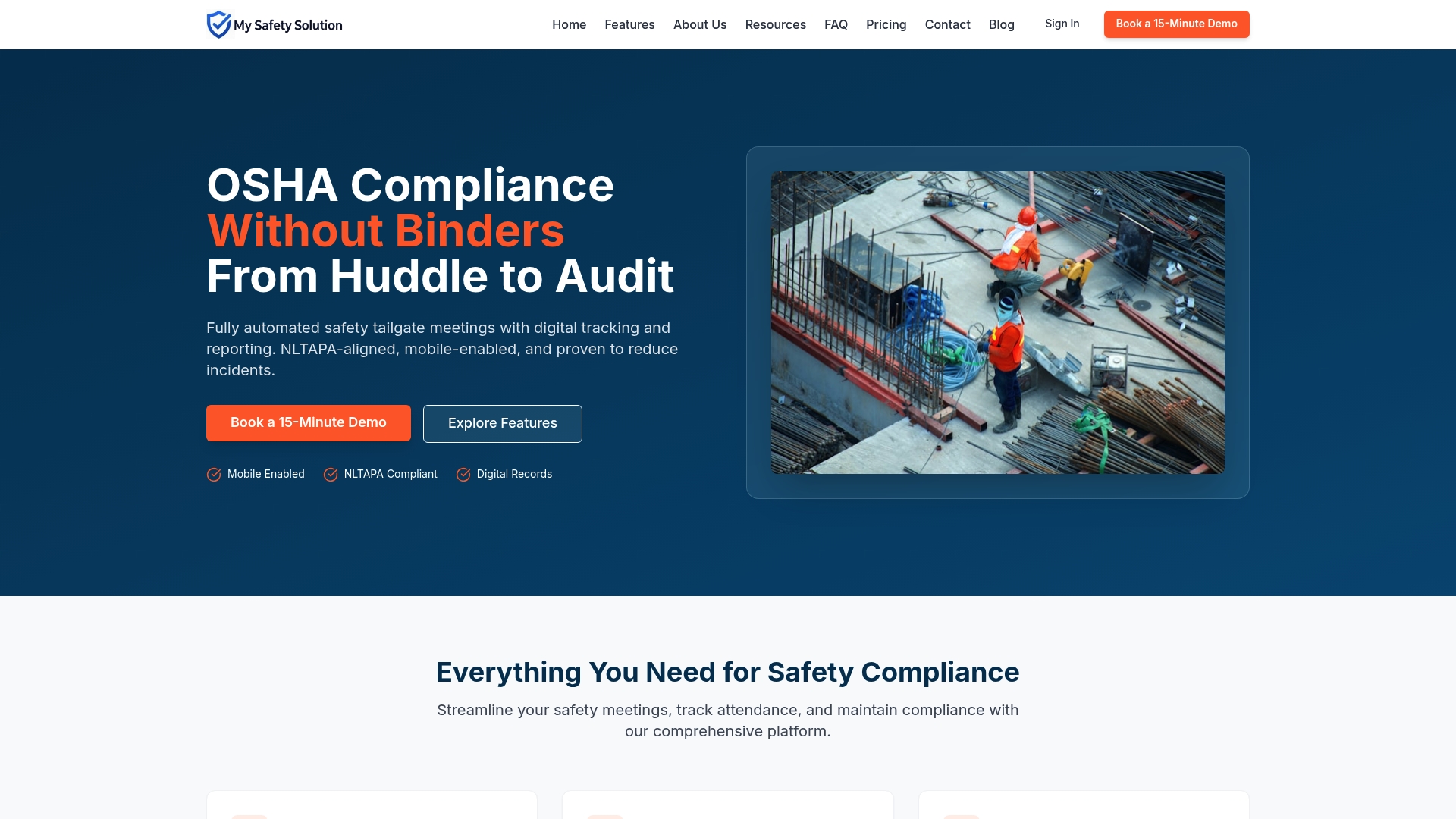
Manually reconciling attendance sheets, training certificates, and incident narratives across multiple clients turns an already demanding job into a paperwork exercise. My Safety Solution automates the capture side of that work: digital attendance with signatures and timestamps, a library of 2,500+ talks across 22 industries and 262 trades, and multi-company management that keeps every meeting and hazard report organized by client from the moment it happens.
- Automated meeting capture removes reliance on paper sign-in sheets
- Separate client companies keep every account’s records apart and exportable as PDF on demand
- Schedules ranked by OSHA injury and citation data match content to the risks each client’s trade actually faces
Plans are priced by headcount, and every plan includes the same features, including multi-client management and a 15-day free trial. Review the pricing page or start with an overview of the platform to see how automated, per-client reporting fits your next audit cycle.
Sources
- Recording | Occupational Safety and Health Administration
- How to Put Leading Indicators into Practice | NIOSH Science Bulletin
FAQ
What is client-level safety reporting?
Client-level safety reporting organizes safety meeting, attendance, and incident records by individual client or company rather than mixing them across sites. This structure lets safety managers and consultants produce complete, audit-ready evidence for a single account without sorting through unrelated records.
How long must OSHA injury records be kept?
Covered employers must retain injury and illness records for the minimum required number of years by regulation and enter recordable injuries within 7 calendar days, according to OSHA’s recordkeeping rule. Form 300A must also be posted between February 1 and April 30 each year.
What counts as a leading indicator in safety reporting?
Leading indicators are proactive measures, such as safety meeting frequency, hazard observations, and training retention checks, that help predict risk before an incident occurs. NIOSH’s guidance on leading indicators recommends starting with existing measures like meeting counts and evolving toward effectiveness checks such as post-training quizzes.
How does My Safety Solution support per-client reporting?
My Safety Solution automates attendance capture with signatures and timestamps, schedules topics from a library ranked by OSHA data, and keeps each client company’s records separate for easy PDF export during audits. Pricing details are available on the pricing page.
Do all establishments need to submit data to OSHA electronically?
Only establishments meeting specific industry and size thresholds under 29 CFR 1904.41 must submit data through OSHA’s Injury Tracking Application, typically between January 2 and March 2. Smaller or exempt establishments still must maintain OSHA-equivalent records even without an electronic submission requirement.