
“This is to certify that [Full Name] attended [Event Name] on [Date] from [Start Time] to [End Time] at [Location]; certified by [Name, Title, Organization].” That single line is the backbone of most valid attestations. To hold up under review, your attendance attestation wording needs five things: the attendee’s full name, the event or activity, the exact date and time span, a signature, and the certifier’s printed title. Everything else is formatting. The templates below cover certificates, tables, letters, and email confirmations for the cases where one sentence isn’t enough.
TL;DR:
- Certificates must include the attendee’s full name, event title, precise dates and times, location, and a verifiable signature with certifier details.
- For multi-session events, a table format with total hours and a verification statement simplifies review and reduces errors.
- Official letters require on-letterhead documentation, exact attendance dates, and contact details for verification, especially in school and court cases.
- Digital verification methods like QR codes and timestamped signatures strengthen authenticity and streamline audit processes.
- Automated systems can generate and manage large volumes of attestations, preserving accuracy, authenticity, and compliance across multiple teams and sessions.
Table of Contents
- Copy-Ready Sample Wordings and Short Templates
- Mandatory Fields: What to Include and Why Each One Matters
- Formal Phrasing: Dos and Don’ts for Attestation Wording
- Verification and Authentication Best Practices
- Special Cases: Court, School, and Virtual Attendance Notes
- Audit-Ready Documentation in Practice
- Certificate or Attestation Letter: Which One Do You Need?
- Turning Templates Into a System With My Safety Solution
- Sources
- FAQ
Copy-Ready Sample Wordings and Short Templates
The right format depends on what happened, not just who was there. A single afternoon workshop needs different attendance verification phrases than a six-week course with a dozen sessions. Here are four formats that cover most real-world situations.
1. Single-session certificate wording
For a one-time event, keep the sentence declarative and load it with specifics:
“This certifies that Maria Chen was present for the entirety of Forklift Safety Refresher held on March 12, 2026, from 9:00 AM to 12:00 PM at 4400 Industrial Parkway, Warehouse B, Denver, CO. Total instructional time: 3.0 hours.”
Below that sentence, place the signature block with three lines: signer name, title, and date signed. Never leave the signature floating without a printed name underneath it. A scrawled signature alone tells an auditor nothing if the printed name and title aren’t right there beside it.
2. Multi-session table row wording
When attendance spans multiple dates, narrative sentences get clunky fast. A table format is easier to scan and verify, which is why it’s the standard for recurring training or safety meetings:
Add a closing line beneath the table: “Total hours completed: 3.5. Attendance verified and certified by the undersigned on March 18, 2026.” That closing sentence does the legal lifting the table alone can’t.
3. Attestation letter paragraph for HR or school offices
Letters carry more narrative weight than certificates. They’re the right call when someone needs a written statement confirming status rather than just hours. On official letterhead, a standard paragraph reads:
“This letter confirms that [Full Name] was enrolled and in attendance at [Institution/Organization Name] during the period of [Start Date] through [End Date]. Attendance records on file show [他 was present for/completed] [X] of [Y] scheduled sessions. This letter is issued upon request for [purpose, if stated] and may be verified by contacting [Registrar/HR Office] at [phone/email].”
That bracketed structure isn’t filler. Each blank forces the writer to supply a fact an auditor or admissions office will actually check.
4. Quick email verification phrasing
Not every attendance confirmation needs a formal document. A short, unambiguous email line works for internal HR requests or quick third-party checks:
“Confirming that [Name] attended [Event] on [Date] from [Start Time] to [End Time]. Contact [Name/Title] at [email] for verification.”
One sentence, no ambiguity, and a name attached to back it up if someone follows up. This is the fastest version of a work attendance confirmation, and it still carries the same core elements as the formal templates: who, what, when, and who’s vouching for it.
Across all four formats, the sentence structure barely changes. What changes is the level of detail the situation demands. A school attendance statement for a parent’s request can be shorter than a court-ordered attestation, but the skeleton of name, event, date, time, and signature never disappears.
Mandatory Fields: What to Include and Why Each One Matters
Every field on an attendance attestation exists because someone, somewhere, might challenge it. Auditors, judges, and HR compliance teams don’t read attestations for tone. They read them for facts they can cross-check against another record. Skip a field, and you’ve handed a reviewer a reason to reject the whole document.
- Full legal name. Use the name that matches government ID or enrollment records, not a nickname. “Mike Johnson” on an attestation and “Michael R. Johnson” on a court docket creates a mismatch someone has to resolve later.
- Event title, stated precisely. “Safety Training” is vague. “OSHA 10-Hour Construction Safety Training” is specific enough that a third party can confirm it against a curriculum or a vendor’s course catalog.
- Exact dates, not ranges when precision matters. “March 3 through March 17, 2026” works for a course. A single incident or court-mandated session needs the exact date, not “early March.”
- Start and end times, plus total hours. A certificate of attendance confirms presence at a specific event, and the format that satisfies reviewers pairs clock times with a summed hour total, formatted as “9:00 AM to 12:00 PM (3.0 hours)” rather than just “morning session.”
- Location, physical or virtual. A street address for in-person events; for remote sessions, the platform name and an explicit note that attendance was virtual.
- Host organization details. Full legal or operating name, plus a contact method, so a skeptical reviewer has somewhere to verify the claim.
- Certifier information. Printed name, official title, signature, and ideally a certificate ID number for tracking.
Common attendance certificate templates back this list up almost field for field, listing participant name, event title, date, location, and hours as baseline requirements across continuing-education formats.
Pro Tip: Write dates in a format that can’t be misread across systems, like “March 12, 2026” instead of “3/12/26.” Numeric-only dates get flipped between month and day formats more often than you’d expect, especially when documents cross between US and international reviewers.
Formal Phrasing: Dos and Don’ts for Attestation Wording
Vague verbs are the fastest way to get an attestation kicked back. “Participated in the training” tells a reviewer someone showed up to something, at some point, for some duration. It doesn’t tell them what they need to know.
Use these conversion patterns:
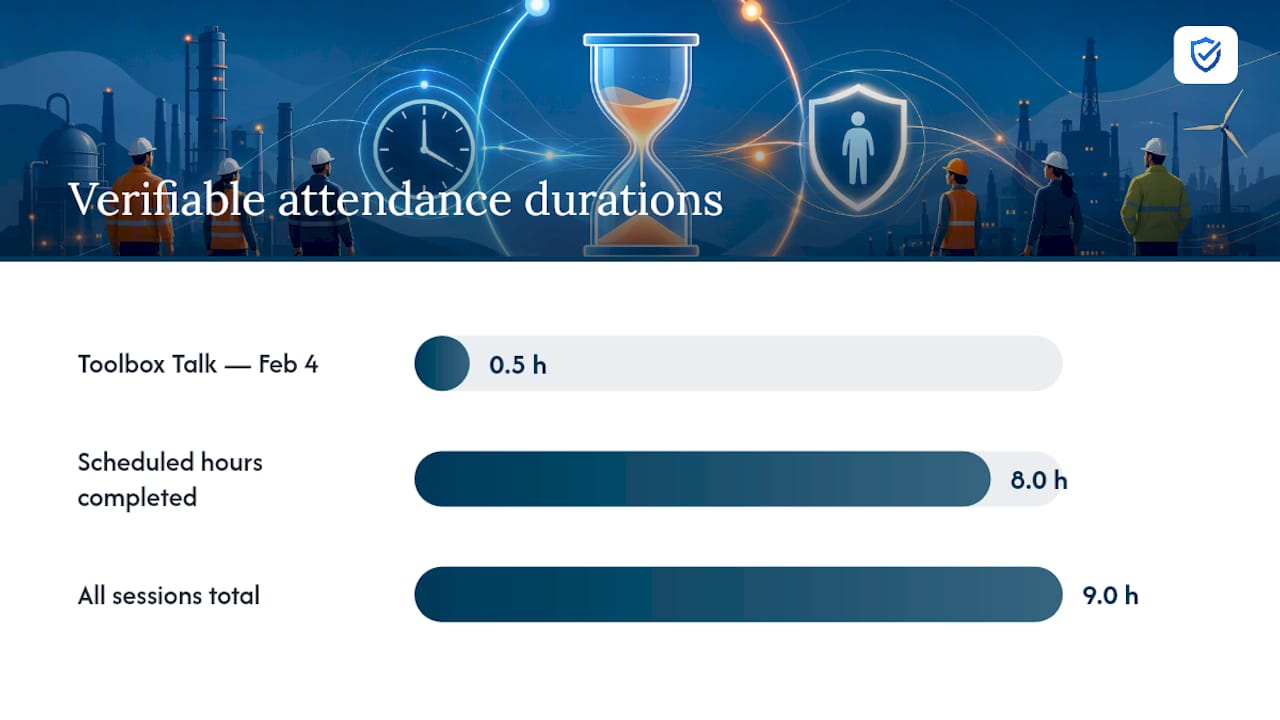
- Weak: “John participated in the safety meeting.” Strong: “John Martinez was present for the full Toolbox Talk: Ladder Safety session on February 4, 2026, from 7:00 AM to 7:30 AM (0.5 hours).”
- Weak: “Attendance was satisfactory.” Strong: “Attendee completed 8.0 of 8.0 scheduled hours with no absences recorded.”
- Weak: “She did well in the course.” Strong: “She attended all six sessions totaling 9.0 hours, as recorded in the sign-in log dated January 6 through February 10, 2026.”
Notice the pattern: strong wording always resolves to a checkable fact. Subjective language like “performed well,” “engaged actively,” or “satisfactory” has no place in an attendance attestation, because attendance and performance are different claims entirely. A certificate of attendance confirms presence, not achievement, so mixing evaluative language into it muddies exactly what you’re certifying.
Stick to declarative verbs: “attended,” “was present for,” “completed X hours,” “was enrolled during.” These verbs commit to a fact a records check can confirm or deny. Softer verbs like “took part in” or “engaged with” leave too much room for interpretation, especially in a document someone might present to a court, a licensing board, or an employer questioning payroll hours.
One more distinction worth holding onto: match the certificate type to what you can actually verify. A certificate of attendance, a completion certificate, and a participation certificate aren’t interchangeable. If you can only confirm someone showed up, don’t imply they met every requirement. That gap is exactly where challenges start.
Verification and Authentication Best Practices
An attestation without a way to verify it is just a claim on paper. The strongest attendance verification phrases mean nothing if the document itself can’t be checked against a real record.
Start with signature authority. The certifier’s name, title, and a reliable signature, whether wet-ink or a validated e-signature, need to appear together, along with contact information a reviewer can actually use. A signature with no printed name and title next to it is functionally anonymous.
- Require a printed certifier name and organizational title alongside every signature line.
- Add a unique certificate ID number to every document issued, so duplicates or forgeries are easier to flag.
- Use a QR code that resolves to a hosted verification page showing a timestamped log of the original issuance.
- Keep e-signature metadata (IP address, timestamp, device) as backup evidence if the signature is challenged later.
- Retain copies and audit logs for as long as your industry’s compliance rules require, and check OSHA training documentation requirements if the attestation ties to workplace safety training.
Modern documentation standards increasingly recommend a verification mechanism, whether a certificate ID or a QR code, specifically to cut down on tampering and fraudulent copies. That’s not a bureaucratic flourish. Paper certificates are trivially easy to photocopy and alter; a QR code tied to a live, timestamped record isn’t.
Templates that build in verification options tend to move faster through administrative review, because they reduce the back-and-forth a reviewer would otherwise need to confirm authenticity. If your attestation gets rejected once for lacking a verification method, you’ll add one for every document afterward. Building it in from the start saves that cycle entirely.
Special Cases: Court, School, and Virtual Attendance Notes
Three contexts routinely reject generic attendance wording: court-ordered programs, school records, and virtual attendance. Each has its own non-negotiable fields.
- Court-ordered attestations. Include the case number, the presiding judge or court division, and exact clock-in and clock-out times, not approximate hours. Courts frequently reject vague statements that lack granular timestamps, so “approximately three hours” won’t clear review the way “1:00 PM to 4:00 PM” will. Confirm the accepted form with the court clerk before submitting, since some jurisdictions require their own template.
- School attestation letters. These must sit on official letterhead, not a plain printout, and include the registrar or administrative office’s direct contact information. Exact dates of attendance, or the school’s specific attendance codes, matter more than a general summary. Sample school attestation letters commonly require letterhead as a baseline for institutional acceptance.
- Virtual attendance records. State the platform used (a named video conferencing tool, a learning management system), include the timezone tied to the listed times, and specify the verification method, whether that’s a login timestamp, a participant ID, or a moderator’s manual log.
Skipping any of these three sets of extra fields is the most common reason an otherwise well-written attestation gets bounced back for revision.
Audit-Ready Documentation in Practice
Paper attestations rely on trust. Digital ones rely on evidence. When a safety meeting attendance record carries an e-signature with a timestamp and a QR code pointing to a hosted verification page, an auditor doesn’t have to take anyone’s word for it. The log exists independently of the paper.
That’s the gap between a signed form in a filing cabinet and a system built for review. My Safety Solution’s own guides on QR code attendance and e-signature attendance checks walk through how those mechanics work for safety meeting documentation specifically, including what OSHA reviewers tend to look for. For teams building recurring records rather than one-off certificates, a safety meeting sign-in sheet built for multi-year retention solves a problem templates alone can’t.
Certificate or Attestation Letter: Which One Do You Need?
Pick a certificate when you’re confirming a fact: presence, hours, dates. Pick an attestation letter when you need narrative context, like enrollment status or a written explanation for a third party. The workflow stays the same either way: collect precise data first, drop it into the right template, then apply a verification method before it goes out the door. And never issue either one without an authorized signer attached. A document nobody can be held accountable for isn’t worth the paper.
— Matthew Hoffman
Turning Templates Into a System With My Safety Solution
Copying and pasting a template gets you one clean attestation. What happens when you need fifty of them a month, across multiple crews, without anyone forgetting a signature block or a certificate ID? My Safety Solution replaces manual attendance paperwork with automated digital records built specifically for high-risk, deskless teams in construction and manufacturing, so the fields covered above get captured automatically instead of retyped by hand.

The platform captures signatures and timestamps at the point of attendance, generates unique records for each safety meeting, and keeps a digital audit trail that holds up when OSHA compliance is on the line. Instead of building a table row template from scratch for every multi-session training, the system does it automatically and keeps every record retrievable later. Plans run from the Starter tier at $99 per month up through Growth, Business, and Enterprise, scaled to how many workers and how much automation your safety program needs. If your team is still assembling attestations by hand, take a look at the My Safety Solution product overview and see how much of this process runs itself.
Sources
For deeper reference material, the LegalClarity guide on proof of attendance forms covers court-specific requirements in detail. LawInsider’s clause library shows contract-style attendance clause wording, and the sample school attestation letter demonstrates required letterhead formatting.
- How to Fill Out and Submit a Proof of Attendance Form - LegalClarity
- Certificate of Attendance: Format + Examples – SendCertificates Blog
- SAMPLE LETTER FROM SCHOOL (Must be on letterhead)
FAQ
What Is the Format of an Attendance Certificate?
A standard attendance certificate includes the attendee’s full name, the event or course title, the date and location, the total hours or duration, and a signature block with the certifier’s printed name and title. Many templates also add a certificate ID or QR code so the document can be verified against a hosted record.
How Do I Write Remarks on Attendance?
Keep remarks factual and tied to a specific number: “Attended 3.0 of 3.0 scheduled hours” rather than “attended well” or “good attendance.” Declarative, checkable language holds up under review far better than subjective commentary about how someone showed up.
What Does a Certificate of Attendance Prove?
It proves presence at a specific event on a specific date, nothing more. A certificate of attendance confirms someone was there; it does not evaluate performance, confirm learning outcomes, or certify that requirements were completed, which is what a completion certificate is for instead.
Can I Create My Own Certificate of Attendance?
Yes, as long as it includes the required fields: name, event, date, hours, location, and a signature from someone with the authority to certify the record. For workplace safety training specifically, a platform like My Safety Solution can generate these automatically with built-in e-signature and verification support, which removes the risk of a missing field getting a self-made document rejected.