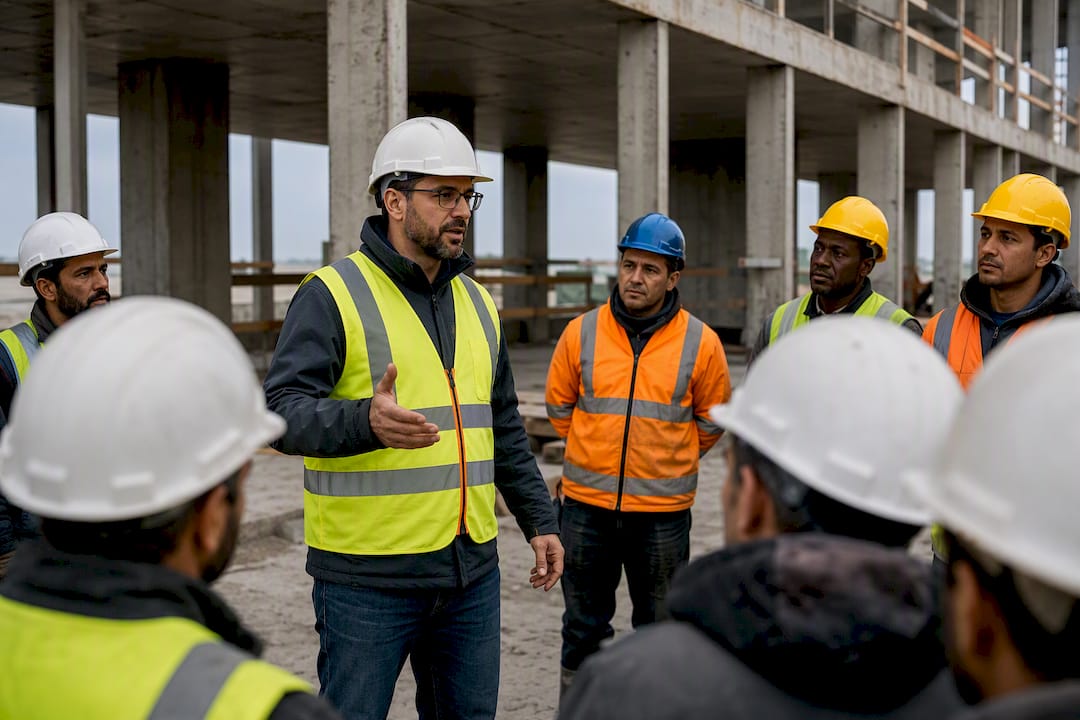
Run toolbox talks in the language your crew actually understands, confirm comprehension with teach-back, and write down what happened. OSHA’s training standards require instruction workers can genuinely follow, not just a translated handout stapled to the file. A bilingual presenter, a qualified interpreter, or a translated session paired with teach-back are the three practical paths to get there. Skip any one of the three components and the talk stops counting as real training.
TL;DR:
- Employ a qualified interpreter or a bilingual presenter to ensure technical safety topics are accurately conveyed in multiple languages on site.
- Use site-specific hazards and teach-back questions tailored to actual conditions to improve comprehension and accurate documentation.
- Keep toolbox talks concise, lasting five to ten minutes, and incorporate demonstrations and clear teach-back to verify understanding.
- Maintain detailed records including the language used, interpreter credentials, teach-back results, and photographic or chat evidence to satisfy OSHA compliance.
- Implement mobile tools with language flags, tailored content, and automated audit exports to streamline documentation and verify effective multilingual safety communication.
Table of Contents
- What Are Multilingual Toolbox Talks and Why Do They Matter?
- How Do You Choose a Delivery Method for Bilingual Safety Meetings?
- What Delivery Tactics Improve Comprehension Across Languages?
- Where Can You Find Templates for Language-Specific Toolbox Talks?
- How Do You Make Every Toolbox Talk Site-Specific?
- What Does OSHA Expect for Compliance Documentation?
- How Can Mobile Tools Simplify Multilingual Safety Training?
- A Practitioner’s Take on Language and Compliance Culture
- Run Multilingual Toolbox Talks Without the Paper Trail
- Sources
- FAQ
What Are Multilingual Toolbox Talks and Why Do They Matter?
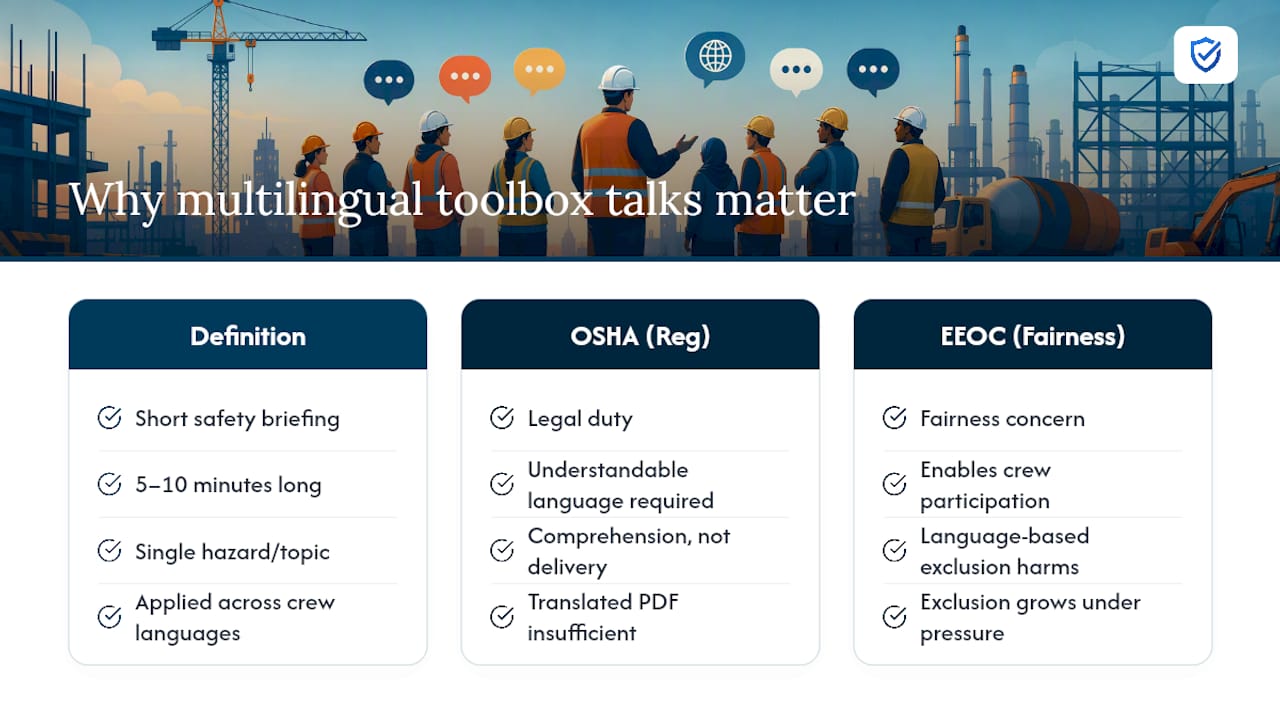
A toolbox talk is a short, focused safety briefing delivered before or during a shift, usually five to ten minutes, covering one hazard relevant to that day’s work. Multilingual toolbox talks apply that same format across a crew that speaks more than one language on site, which describes many construction and industrial crews, not just a minority.
The stakes are regulatory, not just cultural. OSHA’s training guidance on language comprehension makes clear that employees must receive instruction in a language and vocabulary they can understand. A translated PDF handed out at sign-in does not satisfy that bar if nobody checks whether the worker absorbed it. The same standard shows up in OSHA’s employer responsibilities language, where verbs like “train” and “instruct” are interpreted to require actual comprehension, not just delivery.
Treating language access purely as a compliance checkbox misses the bigger point. Workplace inclusion guidance from the EEOC on prohibited employment practices frames language-based exclusion as a fairness issue too. A worker who cannot follow the safety brief is also a worker who cannot fully participate in the crew, and that gap tends to widen under pressure, not shrink.
How Do You Choose a Delivery Method for Bilingual Safety Meetings?
The right delivery option depends on who is on site that day, not on a fixed company policy. Four approaches cover most scenarios, and each has a clear use case.
- Bilingual presenter: works best when a supervisor or lead is genuinely fluent in the second language and understands the safety topic well enough to explain it, not just translate words.
- Trained interpreter: necessary when the vocabulary gets technical, such as lockout/tagout steps or confined-space entry procedures. Verify the interpreter actually knows the subject matter, because a fluent interpreter with no construction background can mistranslate a critical control.
- Separate language sessions: practical when you have large, distinct sub-crews, say a Spanish-speaking framing crew and an English-speaking electrical crew, where running two short talks beats one confusing combined one.
- Primary-language talk with translation support: the fallback when staffing is thin. Deliver in the dominant language, use a phone translation app or bilingual card for support, and lean hard on teach-back to catch comprehension gaps.
Before picking, run a quick mental checklist: which languages are actually present today, what’s the literacy level within each language, how hazardous is today’s task, and how often does this topic repeat. A high-hazard task with a language you rarely encounter earns the interpreter, not the app.
What Delivery Tactics Improve Comprehension Across Languages?
Effective multilingual training lives or dies on delivery, not on how polished the handout looks. A few tactics separate talks that land from talks that get signed and forgotten.
- Keep it to 5 to 10 minutes and anchor it to one hazard specific to today’s site, not a generic topic pulled from a calendar rotation.
- Use plain language and short sentences, then back them up with a physical demonstration. Showing someone how to don a harness beats describing it in any language.
- Run teach-back before you close the talk. Ask a direct question like “Show me where you’d clip in on that scaffold” or “Point to the lockout point on this panel.” A nod is not proof of understanding; a demonstrated action is.
- Avoid pulling an untrained coworker in to translate on the fly. It’s tempting when time is short, but an informal translator can drop safety-critical nuance without anyone noticing until after an incident.
- Match your toolbox talk language to your SWMS, SOPs, and jobsite signage. If the written procedure says “isolate” and the talk says “shut off,” you’ve created a mismatch that confuses workers switching between spoken and written instructions.
Pro Tip: Write your teach-back question before the talk starts, not during it. A prepared prompt like “Show me the control point” takes ten seconds to plan and produces far better evidence than an improvised question you think up on the spot.
Research on multilingual safety communication backs this up directly: site-specific, discussion-led talks with teach-back consistently outperform generic translated handouts for actual comprehension.
Where Can You Find Templates for Language-Specific Toolbox Talks?
You don’t need to write every multilingual talk sheet from scratch. Several sources already exist, and adapting them takes less time than starting cold.
- State toolbox-talk libraries. Washington State’s Department of Labor & Industries maintains a multilingual toolbox talk collection covering common construction hazards, already translated and formatted for field use.
- OSHA-aligned template sets built around the standards employers already have to meet, which reduces the risk of a talk drifting away from what your written procedures actually say.
- Digital chat-based translation tools. Some crews run their daily briefing through a group chat app with built-in translation, letting one voice or text message reach every language on the thread while creating a timestamped record automatically.
Whatever source you pull from, run it through a short adaptation pass: simplify any remaining jargon, swap in your actual site hazards instead of generic ones, add a teach-back prompt at the bottom, and mark which language the sheet was delivered in. That last step matters more than it sounds. Six months from now, an auditor asking “how do you know this worker understood the talk” needs that language flag to make sense of the record. Printable quick-cards laminated for field use work well as a low-tech backup when phones and signal aren’t reliable.
How Do You Make Every Toolbox Talk Site-Specific?
A talk pulled from a generic library becomes real training the moment you connect it to something that happened on your site that week. The workflow is short enough to run before every shift.
- Pre-shift: pick the day’s topic from an actual hazard, a near-miss, or a task starting that morning, then choose your delivery method and language based on who’s present. Prepare one teach-back prompt tied to that specific hazard.
- During the talk: state the hazard in one or two plain sentences, demonstrate the control physically if possible, then ask one worker to explain or show the control back to you. Note the outcome on the spot.
- Post-talk: log a quick record: which language was used, who delivered it, and what the teach-back result was, pass or fail. If someone struggled, flag it for follow-up training rather than letting it slide.
This loop is what separates a real safety talk from a script read out loud. Practitioner guidance on multilingual crews finds that near-miss-driven, site-specific topics hold attention far better than a rotating calendar of unrelated subjects, largely because workers recognize the hazard from their own shift rather than a hypothetical one.
What Does OSHA Expect for Compliance Documentation?
OSHA’s expectation is comprehension, not paperwork volume. The Training Standards Policy Statement and related guidance interpret “train” to mean instruction delivered in a language and vocabulary the employee can actually follow, and a practical guide to language training requirements lays out what auditors tend to ask for when they check that box.
Auditors generally want to see the delivery language used, who interpreted (and whether that person had relevant subject-matter knowledge), some evidence of teach-back or demonstration, and standard attendance records. A signed sheet alone answers only one of those questions.
Weak records list names and a date. Strong records add:
- The language the talk was delivered in
- The interpreter’s name and relevant qualification, if one was used
- A one-line teach-back note (who demonstrated, pass or fail)
- A photo of the demonstration, where practical
- An exported chat transcript, if delivery happened through a translation app
A toolbox talk SOP resource makes the point bluntly: signed attendance alone is weak evidence of comprehension. The value of the talk sits almost entirely in the discussion and the teach-back that follows it, and that’s exactly what a thin record fails to capture.
How Can Mobile Tools Simplify Multilingual Safety Training?
Running this workflow on paper across multiple languages and multiple crews gets unwieldy fast, which is exactly the gap mobile meeting software is built to close. Look for a few specific capabilities when evaluating any tool for this job:
- Language flags on each meeting record, so you can prove which language a talk was delivered in months later without relying on memory.
- AI-assisted topic tailoring that adapts a base talk to the day’s actual hazard instead of forcing a generic script.
- Timestamped attendance paired with teach-back notes, not attendance alone.
- One-tap audit export, so a compliance review doesn’t turn into a week of digging through paper files.
Before rolling a tool out crew-wide, run a short pilot: import a handful of existing talk templates, set your language options for the crews you actually run, and test the full loop on one morning shift before scaling it.
A Practitioner’s Take on Language and Compliance Culture
Most language gaps on a jobsite don’t get exposed in a training file. They get exposed after an incident, when someone admits they nodded along without following the instruction. That’s the real argument for teach-back: it forces the gap to show up on a Tuesday morning instead of in an incident report. Supervisors who build a five-second teach-back check into every talk, regardless of language, tend to catch confusion long before it becomes a claim number.
— Matthew Hoffman
Run Multilingual Toolbox Talks Without the Paper Trail
Some mobile platforms replace the folder of translated handouts and signed sheets with software designed for this workflow. Features often include language flags on meeting records, topic generation tailored to site hazards, and attendance capture paired with teach-back notes, providing audit-ready evidence in one export.
Getting started takes less setup than most supervisors expect. Import a few existing talk templates, set the language options your crews actually need, and run one morning pilot before rolling it out site-wide. If you’re managing crews across multiple languages and want to see how OSHA compliance meeting software handles the documentation side automatically, start a trial and run it against tomorrow’s shift. For crews focused on broader workforce inclusion alongside language access, diversity hiring practices in the trades offer a useful companion resource for building a more communicative crew from the hiring stage forward.
Sources
- OSHA Training in a Language Workers Understand (OSHA guidance)
- PMC article on multilingual safety communication and site-specific briefings
- Toolbox Talks (Washington L&I) — multilingual resources
- OSHA training in a language workers understand — practical guide
FAQ
What Are Multilingual Toolbox Talks?
They’re short, site-specific safety briefings delivered in the language and vocabulary a mixed-language crew actually understands, typically paired with teach-back to confirm comprehension.
Does OSHA Require Training in a Worker’s Native Language?
OSHA requires training delivered in a language and vocabulary employees can comprehend, which in practice often means the worker’s native or strongest language, according to OSHA’s training guidance.
Is a Signed Attendance Sheet Enough Proof of Training?
No. A signed sheet only proves someone attended, not that they understood; auditors increasingly look for teach-back evidence, interpreter qualifications, and language records alongside attendance.
How Long Should a Bilingual Safety Meeting Last?
Five to ten minutes is typically enough for a focused, single-hazard talk with time left for a short teach-back demonstration.
Can Software Help Manage Multilingual Toolbox Talks?
Yes. Platforms like My Safety Solution can flag the delivery language, capture teach-back notes alongside attendance, and export the full record for an audit in one step.