
LTAP safety training gives local road agencies access to state-delivered courses and technical assistance, often at low or no cost. Every state operates a Local Technical Assistance Program center that trains equipment operators, flaggers, inspectors, and supervisors on work-zone safety, MUTCD compliance, and traffic incident management. The result: safer work zones, fewer compliance gaps, and a direct path to state certifications without hiring outside trainers.
TL;DR:
- Most work-zone safety training from LTAP centers focuses on practical skills like cone spacing, sign placement, and MUTCD compliance, essential for reducing incidents.
- Primary courses include work-zone safety, MUTCD guidance adapted for states, national TIM responder training, and flagger certification, covering about 80% of a crew’s needs.
- Follow-up practices such as field drills, laminated checklists, and designated training champions are crucial to make training outcomes stick in daily operations.
- Most LTAP courses are free or low-cost, with fees increasing only for multi-day certifications or onsite trainers, which can often be offset by grants or funding.
- Sustaining safety habits requires integrating recurring toolbox talks and automated follow-up tools to reinforce lessons and maintain compliance long-term.
Table of Contents
- What State LTAP Centers Actually Offer
- Core Courses Worth Prioritizing First
- Finding and Registering With Your State LTAP Center
- Turning LTAP Coursework Into Daily Field Habits
- What LTAP Training Actually Costs
- National Reach and Why It Matters
- Making Training Stick: A Practitioner’s View
- Keeping LTAP Lessons Alive Between Courses
- Where to Start Looking
- Sources
- FAQ
What State LTAP Centers Actually Offer
Every state LTAP center runs a mix of delivery formats built for agencies that cannot pull an entire crew off the road for a week of classroom instruction. Webinars and self-paced eLearning modules cover the basics. Live workshops handle hands-on skills. Some centers send instructors onsite when an agency needs equipment-specific or site-specific training.
Beyond scheduled courses, most centers provide technical assistance that goes well past a training calendar: sample templates, toolkits for building local safety programs, and even direct support for pilot projects testing new traffic control layouts.
The staff who benefit span nearly every role in a public works department:
- Equipment operators learning safe setup and breakdown procedures
- Flaggers and traffic control technicians
- Roadway inspectors and maintenance supervisors
- Project engineers overseeing contractor work zones
- First responders who need traffic incident management skills
A state LTAP program page, like Ohio’s, typically lists which of these formats are active and who can register.
Core Courses Worth Prioritizing First
Not every course carries equal weight for a small public works crew with limited training hours. Four categories consistently deliver the most practical return.
- Work-zone safety and temporary traffic control. These workshops cover cone spacing, sign placement, and inspection routines that directly reduce struck-by incidents.
- MUTCD overview, state-adapted. LTAP centers translate the federal Manual on Uniform Traffic Control Devices into state-specific guidance, since FHWA’s own outreach materials are designed for states to adapt rather than adopt word for word.
- National TIM Responder Training. This is a 4-hour course, offered in-person or online, that brings law enforcement, fire, EMS, and DOT staff onto the same page for clearing incidents safely. More than 630,000 responders had completed it by 2022, and a Train-the-Trainer track lets agencies build internal capacity instead of scheduling outside instructors every cycle.
- Flagger certification and the Road Safety Champion Program. RSCP bundles modules on traffic safety culture, reading the roadway, and safety analysis, and the Road Safety Champion Program awards a certificate after completing the required webinars, most of them free.
That combination covers roughly 80 percent of the training a typical maintenance crew needs before touching a live work zone.
Finding and Registering With Your State LTAP Center
Start with the FHWA LTAP/TTAP Clearinghouse, which lists every state center along with contact information and, in most cases, a link to that state’s training calendar. From there, the process is straightforward but has a few details worth checking before you commit staff hours.
- Confirm whether the course carries continuing education credit through NHI or a state Road Scholar program, since requirements vary by state rather than following one national standard.
- Ask whether pre-course eLearning is required or recommended before the live session.
- If you need onsite, tailored training, contact the center directly. Most ask for lead time of several weeks and want to know your crew size, equipment types, and specific hazards on your routes.
Agencies that call ahead with specifics, rather than a generic request for “safety training,” tend to get instructors who show up with material that actually matches the roadway conditions your crew works.
Turning LTAP Coursework Into Daily Field Habits
A workshop certificate does not automatically change what happens on Tuesday morning when a crew sets up a lane closure. Closing that gap takes deliberate follow-through.
Pair every eLearning module with a short field drill within a week or two, while the material is still fresh. Tailor the generic course content to your own equipment, roadway classifications, and seasonal patterns; a work-zone module built around interstate ramps needs adjusting before it fits a two-lane county road with heavy agricultural traffic. Many LTAP centers will also help you use their technical assistance service to build agency-specific standard operating procedures, toolbox talks, and inspection checklists rather than relying on generic templates.

Pro Tip: Assign one crew member as a “training champion” for each course topic. That person runs the follow-up field drill and fields questions on-site, which keeps the lesson alive long after the workshop ends.
A few habits make the difference between training that sticks and training that becomes a line item nobody remembers:
- Schedule the field drill before the workshop ends, not weeks later
- Convert workshop handouts into laminated pocket checklists for trucks
- Rotate toolbox talks so the same lesson resurfaces from a different angle
For agencies building out a library of toolbox talk topics tied to LTAP lessons, a resource like tailgate meeting topics that reduce incidents can help translate course material into short, recurring briefings.
What LTAP Training Actually Costs
Most eLearning modules and webinars, including the Road Safety Champion Program’s core courses, are free. In-person workshops usually carry a modest fee, often set to cover materials and instructor travel rather than to turn a profit.
Fees climb when a course involves multi-day certification tracks or when an agency requests a specialized trainer to travel a long distance for a single onsite session. Several funding paths can offset that cost:
- State DOT training budgets set aside specifically for local agency support
- FHWA-assigned grant funding tied to work-zone or safety programs
- Local transportation fund allocations
- Cost-sharing with neighboring agencies to split onsite trainer fees
National Reach and Why It Matters
The scale of the LTAP network is easy to underestimate until you see the numbers. There are 51 centers nationally, one in every state plus Puerto Rico, and the FHWA Center for Local Aid Support coordinates the network to reach thousands of local agencies that would otherwise have no direct line to federal transportation guidance.
LTAP centers exist to translate federal rules into state-specific curricula, not just to run generic safety seminars. That translation work, tied to FHWA’s work-zone practices guidance developed alongside NTSB, NHTSA, and IACP, is what lets a two-person county crew apply the same MUTCD principles a state DOT uses on a six-lane interstate.
That coordination role, quietly done, is the actual engine behind LTAP’s national footprint.
Making Training Stick: A Practitioner’s View
The biggest failure point in LTAP training has nothing to do with course quality. It is the gap between attendance and behavior change on the job. A crew can sit through a four-hour work-zone workshop and still set up a lane closure incorrectly the following week, because sitting in a room and changing muscle memory are different skills.
Training champions and paired field drills close that gap faster than repeating the same workshop. Audit-ready attendance records matter too, not for bureaucratic cover, but because they force agencies to notice who has not been trained yet before an incident forces the question. LTAP training pays off over years, not after one session.
“Local road and public works crews require robust, practical training records. MySafetySolution helps public agencies easily log training hours, verify worker attendance, and export standardized reports for state and federal compliance.”
— Matthew Hoffman, President - MySafetySolution
Keeping LTAP Lessons Alive Between Courses
LTAP workshops teach the skills. What happens between courses determines whether those skills survive contact with a real work zone six months later. My Safety Solution is built for exactly that gap: scheduled, recurring safety meetings that keep MUTCD refreshers, flagger reminders, and TIM coordination points in front of your crew long after the certificate gets filed away.
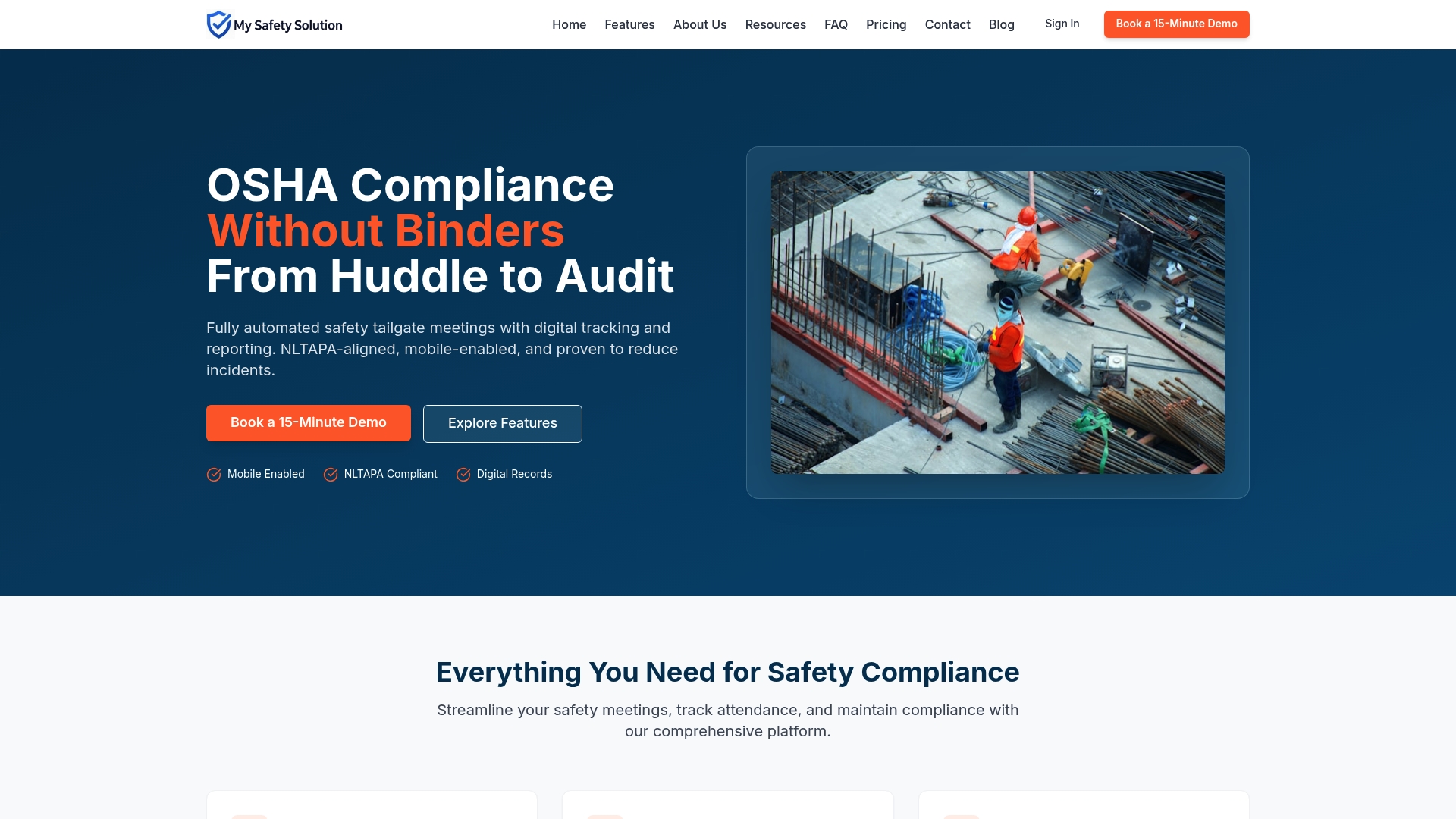
Instead of relying on a supervisor’s memory to schedule a follow-up toolbox talk, the platform handles recurring meeting scheduling, attendance tracking with signatures and timestamps, and a library of 2,500+ talks across 262 trades, with schedules ranked by real OSHA injury and citation data for your crew’s actual work, whether that is highway maintenance, utility work, or landscaping along public rights-of-way. Every session gets logged in searchable records, which means your OSHA compliance records stay audit-ready without anyone chasing paper sign-in sheets. It complements what LTAP centers teach rather than replacing them: LTAP delivers the course, My Safety Solution keeps the lesson circulating in the field.
Plans are priced by headcount, and every plan includes the same features. Check the pricing page to see which plan fits your agency’s size, or explore what the platform includes before you start your 15-day free trial.

Where to Start Looking
Begin with the FHWA LTAP/TTAP Clearinghouse for center listings and national materials. For responder-focused work, check the National TIM Responder Training page. State hubs like Ohio’s LTAP program show what a typical calendar and onsite request process looks like in practice.
Sources
- FHWA Center for Local Aid Support — LTAP/TTAP
- FHWA — National TIM Responder Training
- FHWA — Work Zone practices factsheet
- Road Safety Champion Program — TTAP / UTK
FAQ
What Is LTAP Certification?
LTAP itself does not issue federal certifications; centers coordinate delivery of state-mandated certifications, such as flagging or maintenance of traffic, and award program-specific certificates like the one from the Road Safety Champion Program after required modules are complete. Requirements vary by state, so check with your local center for the exact credential your role needs.
How Many LTAP Centers Are There?
There are 51 LTAP centers nationally, covering every state plus Puerto Rico. Each center serves as the primary training and technical assistance contact for local road agencies in its jurisdiction.
What Are Some Good Safety Courses Available in the USA?
Work-zone safety workshops, MUTCD overview courses, and the National TIM Responder Training rank among the most practical for local agency staff. The Road Safety Champion Program adds a structured, certificate-based path covering roadway safety analysis and traffic safety culture.
Is LTAP Free?
Much of LTAP training is free or low-cost, particularly webinars and eLearning modules like those in the Road Safety Champion Program. Fees typically apply only for multi-day certification courses or specialized onsite trainer travel, and several state and federal funding sources can offset those costs.
How Do I Keep LTAP Training Fresh After the Course Ends?
Pairing course material with short field drills and recurring toolbox talks is the most reliable way to prevent skill decay. Tools like My Safety Solution support that follow-through by scheduling recurring safety meetings and logging attendance, so the lessons from an LTAP workshop keep resurfacing on the job instead of fading after one session.