
OSHA requires documented training only when a specific standard mandates it. There is no single, universal training-record rule that applies across every workplace. The Occupational Safety and Health Administration ties recordkeeping obligations to individual standards, such as 1910.1030 (Bloodborne Pathogens) and 1926.1207 for permit-required confined spaces. Once you know which standards apply to your operation, the compliance picture gets a lot simpler.
Three things to do this week:
- Identify which OSHA standards actually apply to your operations and check each one for a training or certification clause.
- Pull existing training records into one place, even if that “place” is currently three filing cabinets and a shared drive.
- Default to keeping records for the duration of employment unless a standard specifies otherwise.
Key Takeaways
OSHA training documentation requirements depend entirely on which standards govern your work, and inspection-ready records need centralized storage, standard-specific retention tagging, and fields that go beyond a name and a date.
| Point | Details |
|---|---|
| No universal rule | Check the specific OSHA standard governing your work; documentation duties vary by standard, not by blanket policy. |
| Core record fields | Capture employee name, training date, trainer identity, and a topic summary at minimum. |
| Retention varies | Bloodborne Pathogens requires 3 years; Asbestos requires one year beyond employment; default to duration-of-employment when a standard is silent. |
| Electronic records count | Digital records satisfy OSHA as long as they’re accurate, authentic, and quickly producible during an inspection. |
| Automate the capture | My Safety Solution timestamps attendance and tags records by triggering standard, cutting inspection response from days to minutes. |
Table of Contents
- Which OSHA Standards Require Training Records?
- What Belongs in a Training Record?
- How Long Should You Keep OSHA Training Records?
- Are Electronic Training Records Acceptable to OSHA?
- What Do OSHA Inspectors Look for in Training Records?
- A Practical Training-Record Template You Can Use Today
- What Are the Penalties for Missing OSHA Training Records?
- Why Clean Records Signal a Mature Safety Program
- Let My Safety Solution Handle Your Training Documentation
Which OSHA Standards Require Training Records?
Not every OSHA standard demands paperwork, but a meaningful subset does. More than 100 standards contain some form of training requirement, according to OSHA 3824, the agency’s guidance on developing and delivering effective worker training. Only some of those standards go further and explicitly require you to document who was trained, when, and by whom.
Standards that commonly require documented training include:
- Bloodborne Pathogens (1910.1030), covering healthcare, sanitation, and other exposure-risk roles.
- Asbestos (1910.1001), applicable to construction and renovation work involving asbestos-containing materials.
- Permit-Required Confined Spaces (1926.1207), which spells out training obligations for construction crews.
- Powered Industrial Trucks (1910.178), governing forklift operator certification.
- Fall Protection (1926.503), covering training for workers exposed to fall hazards.
Standards usually flag the requirement with language like “certification” or “the employer shall maintain.” Take 1926.1207: it requires you to keep records containing each employee’s name, the trainer’s name, and the training dates, and to make that documentation available for inspection for as long as the employee works for you. That’s a clear, specific bar, and it’s worth reading the exact text of any standard that governs your industry rather than assuming a generic policy covers you.
What Belongs in a Training Record?
A compliant training record doesn’t need to be complicated, but it does need the right fields. At minimum, most standards expect:
- Employee name
- Date of training
- Trainer’s identity
- A summary of the topic or content covered
Some standards ask for more. Powered industrial truck certification, for example, often expects trainer qualifications on file. Practical-evaluation standards want the date of the hands-on assessment noted separately from the classroom date. Confined-space training under 1926.1207 wants trainer name and dates locked in, full stop.
One misconception trips up a lot of employers: the assumption that an employee’s signature is always mandatory. It isn’t, unless a specific standard says so. A signature is a smart practice, since it documents that the employee was present and acknowledges the content, but treating it as a universal requirement can create false confidence in records that are missing the fields OSHA actually checks.
Pro Tip: Build your record template around the strictest standard your workforce faces, then apply that same template everywhere. It’s easier to over-document than to explain a gap during an inspection.
How Long Should You Keep OSHA Training Records?
There’s no single retention clock. OSHA’s training recordkeeping guidance confirms that retention periods vary standard by standard, and plenty of standards don’t specify a period at all.
Examples worth knowing:
- Bloodborne Pathogens: 3 years from the date the training occurred.
- Asbestos: one year beyond the employee’s last date of employment.
- OSHA Outreach Training Program records: 5 years from the class end date.
- OSHA 300 injury and illness logs: 5 years, though this isn’t a training record, it’s a common companion document during audits.
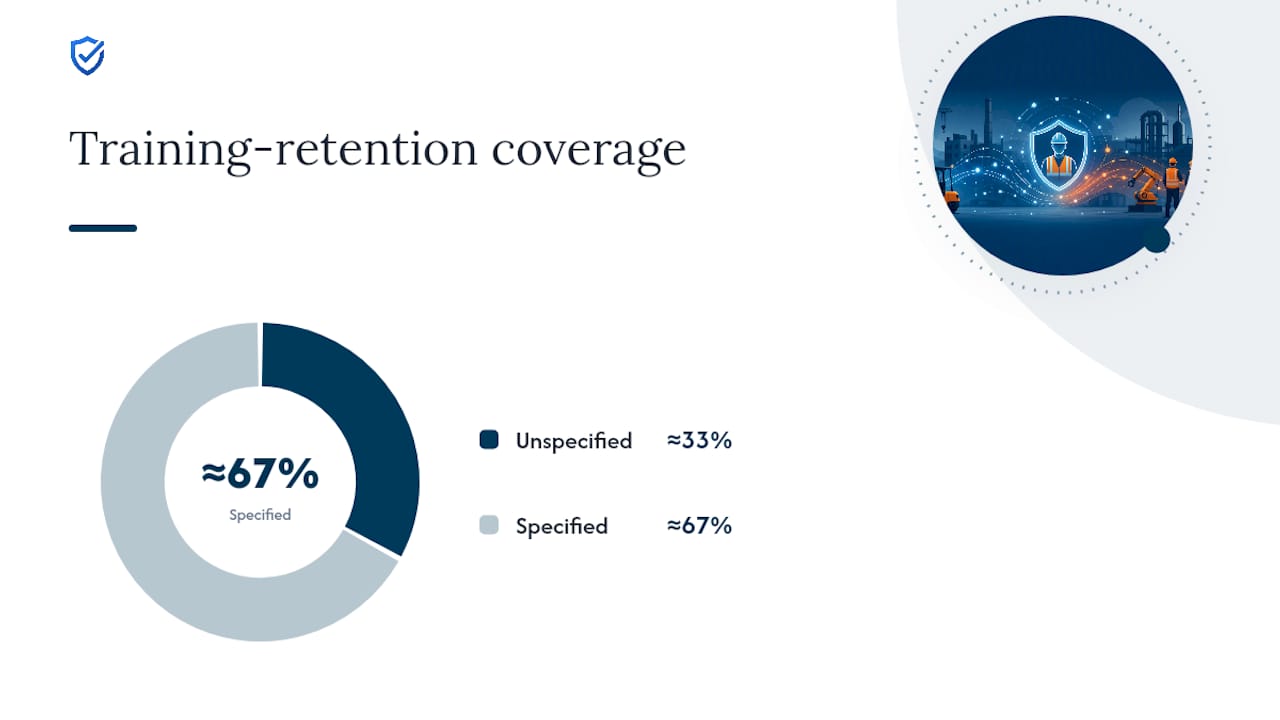
Roughly a third of the standards with training requirements say nothing about retention at all, which is exactly where employers get tripped up guessing at a policy. When a standard is silent, industry compliance guidance recommends retaining records for the duration of employment. That’s the conservative move, and it beats guessing wrong in either direction. Categorize each record by the standard that triggered it. A blanket “shred after two years” policy might destroy a document you were legally required to keep, while hoarding everything indefinitely just makes the eventual audit harder to navigate.
Are Electronic Training Records Acceptable to OSHA?
Yes. OSHA’s own interpretation letters on electronic recordkeeping confirm that digital records satisfy documentation requirements as long as they’re accurate, authentic, and can be produced when asked. Paper isn’t the standard, accessibility is.
That said, “electronic” doesn’t automatically mean “compliant.” A record scattered across old emails, a departed manager’s laptop, and a shared drive nobody can find fast enough during an inspection creates real exposure, even if the underlying training happened exactly as required.
Build your system around these safeguards:
- One centralized repository, not a patchwork of folders and inboxes.
- Export and print capability, so a printed packet can be handed over on request.
- An audit trail showing who entered or edited each record.
- Verified identity tied to each entry (trainer ID, timestamp, session details).
- An offline backup you can access without depending on live IT support during a site visit.
Pro Tip: If retrieving a specific employee’s training history takes more than a few minutes, that friction is itself a compliance risk. Inspectors notice delays as much as gaps.
What Do OSHA Inspectors Look for in Training Records?
Inspectors ask for records that are complete, legible, and clearly mapped to the standard that governs the work being performed. They’re not grading on effort. They’re checking whether the paperwork proves the training happened and covered the right content.
The mistakes that show up most often during inspections:
- Missing trainer identity. A record naming the employee but not who trained them fails the basic bar most standards set.
- No content summary. “Safety training, 45 minutes” tells an inspector nothing about what was actually covered.
- Inconsistent retention. Some records get purged early, others linger for years, with no policy explaining either.
- Inaccessible digital files. Records that exist but can’t be produced quickly are treated the same as records that don’t exist.
The fix is straightforward: build an index that maps every record type to the standard requiring it, keep one export-ready format, and rehearse pulling a random employee’s file before an inspector ever asks. A construction safety management system built around this kind of mapping turns a scramble into a five-minute retrieval. Guidance on inspection documentation practices for manufacturers covers similar organizational habits worth borrowing regardless of your sector.
A Practical Training-Record Template You Can Use Today
A usable template needs specific fields, not vague categories. Build yours around: employee name, job title, training date, trainer name and qualifications, topic summary, evaluation results (where applicable), retention category, storage location, and export instructions.
Tag each record by two things: the standard that triggered it and the retention action tied to that standard. A Bloodborne Pathogens record gets tagged “3-year retention.” A confined-space record gets tagged “duration of employment.” That tagging is what turns a folder of documents into an audit-ready system.
Automated capture is where this stops being a paperwork exercise. My Safety Solution timestamps attendance at the moment a safety meeting happens, tags each record by the standard it satisfies, and generates export-ready reports formatted for inspection, without a safety manager rebuilding a spreadsheet from memory.
Manual systems can hit every one of these fields too. The difference shows up the day an inspector asks for six months of records in one sitting.
What Are the Penalties for Missing OSHA Training Records?
Missing documentation carries real financial exposure. Following the January 2025 penalty adjustment, other-than-serious violations can reach up to $16,550, while willful or repeated violations climb as high as $165,514 per violation.

Here’s the detail that catches employers off guard: OSHA treats an inability to produce a required record the same way it treats a failure to provide the training in the first place. Verbal assurance that “everyone got trained” means nothing without paper or a digital record to back it up.
The mitigation is direct: audit your current records against the standards that apply to your workforce, centralize what’s scattered, and write down a retention policy so a citation for gaps doesn’t compound into a citation for policy failure. Reviewing broader OSHA citation trends shows how often documentation gaps, not training failures themselves, drive the penalty.
Why Clean Records Signal a Mature Safety Program
Organized training documentation isn’t just a defense against citations. It’s a signal that a safety program is proactive rather than reactive, and that distinction shows up in how quickly a team responds when something actually goes wrong. Tools like My Safety Solution make that organization automatic instead of aspirational, capturing records as training happens rather than reconstructing them under deadline pressure. The real value isn’t inspection defense. It’s using those records to spot which topics need repeating and which crews need more attention, before an incident forces the question.
“Clean, timestamped records signal to regulators that safety is an operational priority. MySafetySolution automates every recordkeeping requirement under OSHA standards, transforming documentation from a burden into a defensive asset.”
— Matthew Hoffman, President - MySafetySolution
Let My Safety Solution Handle Your Training Documentation
My Safety Solution replaces the scattered spreadsheets and paper sign-in sheets most crews rely on with one system that captures training the moment it happens.
Every safety meeting gets timestamped, attendance is logged automatically with digital signatures, and each record gets tagged to the standard it satisfies, whether that’s Bloodborne Pathogens, confined spaces, or your own internal program. The platform’s construction safety features were built for deskless crews who don’t have time to fill out forms between tasks, and the same automated capture works for utility field teams and trucking and transportation fleets facing their own documentation requirements. When an inspector asks for six months of records, you export a report instead of rebuilding one. See how the full platform works or start a trial to see your own records go inspection-ready from day one.