
The fastest fix for logistics safety tracking gaps is this: implement continuous, lane-stratified monitoring, pair it with human-centered exception alerts, and anchor every corrective action to a digital, timestamped record your OSHA inspector can pull in minutes.
Immediate next actions:
- Map every point where shipment visibility drops to zero (3PL handoffs, port boundaries, modal transfers, yard-to-jobsite moves)
- Enable per-lane alert thresholds rather than global defaults across your entire network
- Pilot one high-risk corridor this quarter before scaling to the full network
- Connect every exception alert to a safety meeting trigger so corrective actions generate an audit-ready record automatically
When this system runs correctly, your time-to-detect a safety-relevant event drops from days to minutes, and your audit file is complete before the inspector arrives.
Table of Contents
- Why Milestone-Based Tracking Misses Safety Risks
- What an Effective Safety Tracking System Actually Requires
- How to Implement: Audit, Pilot, Validate, Scale
- Designing Alerts That Build Buy-In, Not Resentment
- KPIs to Track and How to Build OSHA-Ready Records
- How to Evaluate Technologies and Build the Right Stack
- Your Concrete 30/60/90 Pilot Plan
- Key Takeaways
- The Cultural Work Nobody Budgets For
- Safety Meeting Automation Closes the Compliance Loop
- Useful Sources and Further Reading
Why Milestone-Based Tracking Misses Safety Risks
Milestone updates tell you a shipment was picked up and delivered. Everything in between is a blind spot, and that gap is exactly where safety-relevant events occur.
Continuous, real-time monitoring is the standard that replaces milestone dependency. The most common dark spots safety managers encounter include:
- 3PL handoffs: Custody transfers between carriers produce no sensor data for hours
- Port and customs boundaries: Dwell time inside a terminal is invisible to your TMS
- Modal handoffs: A container moving from rail to truck loses GPS continuity during transfer
- Low-tech regional last-mile carriers: Many regional operators still use manual scan-only systems
- Yard-to-jobsite transfers: Once freight leaves a distribution center gate, most tracking stops entirely
The incident timeline that makes this concrete: A temperature-sensitive pharmaceutical shipment crosses a 3PL handoff at 2:00 PM. The cold-chain breach begins at 2:45 PM. The next milestone scan arrives at 8:00 AM the following day. By then, the cargo is compromised, the corrective-action window has closed, and the safety record shows nothing happened. That is what addressing logistics safety tracking challenges actually looks like in practice — a preventable loss made invisible by a gap in the monitoring stack.
Six risk categories define the full monitoring surface: lane and corridor disruptions, carrier and 3PL volatility, cold-chain breaches, cargo theft, SLA and compliance exposure, and weather-driven disruption. Milestone tracking misses all six between checkpoints.
What an Effective Safety Tracking System Actually Requires
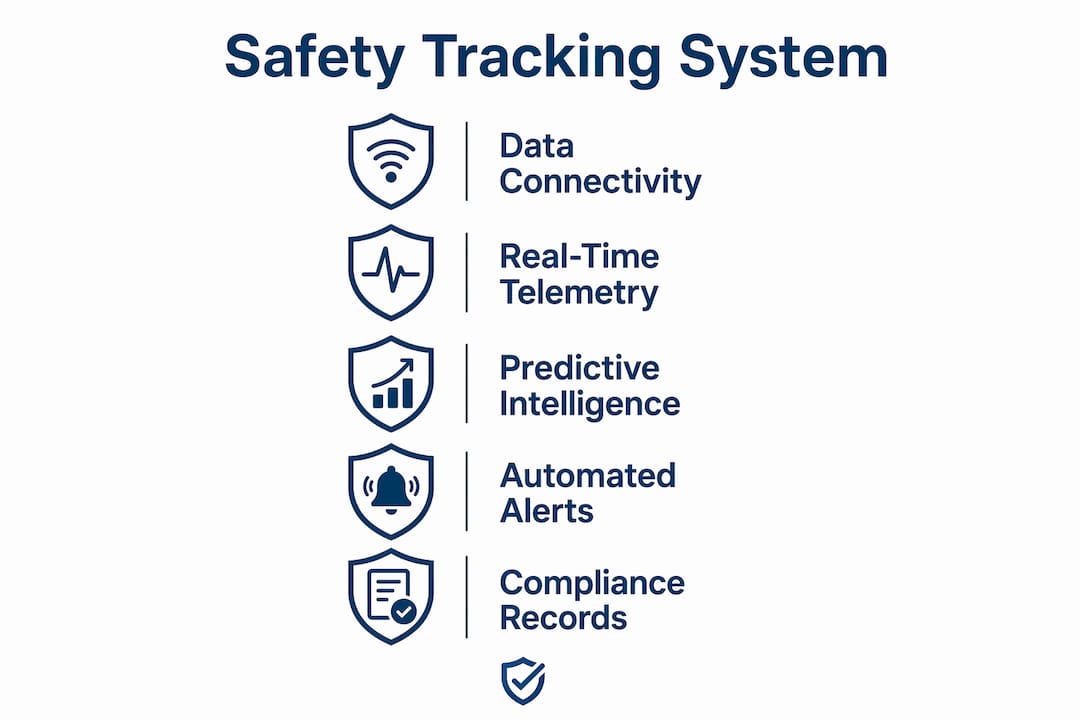
A working logistics safety-tracking system runs five layers: data connectivity, real-time telemetry, predictive intelligence, rules-based exception management, and audit-ready records; each layer depends on the one below it.

| Data Source | Safety Purpose | Example Technology Class |
|---|---|---|
| TMS | Shipment identity, SLA windows, carrier assignments | Any major TMS with API access |
| Telematics / fleet GPS | Real-time vehicle location, speed, idle events | GPS telematics platforms (e.g., Teletrac Navman) |
| ELD / driver logs | Hours-of-service compliance, fatigue risk | ELD-compliant hardware per FMCSA mandate |
| Container / condition sensors | Temperature, humidity, shock, door-open events | BLE/container sensor labels |
| WMS | Yard dwell, dock assignment, inbound receipt | Warehouse management system |
| Manual field reports | Jobsite incidents, near-misses, inspection findings | Mobile forms, digital checklists |
Teletrac Navman-class GPS asset tracking adds preventive maintenance scheduling and utilization transparency, which reduces equipment failure risk at critical moments. For shipments that cross carrier boundaries, Samsara’s single-use Bluetooth Tracking Label closes the gap by leveraging a wide-area Bluetooth network across millions of connected devices, delivering near-real-time location without requiring carrier involvement.
Integration priorities that cannot be skipped:
- Time-series timestamps on every event (not just status changes)
- Unified shipment and asset identifiers across all carrier systems
- Cross-carrier chain-of-custody records with no manual re-entry gaps
Pro Tip: Set alert thresholds by shipment type and lane, not as global defaults. A refrigerated pharmaceutical lane and a dry-goods pallet route carry different risk profiles. One threshold policy applied to both will either flood your team with false positives or miss real events.
ELOKON’s guidance on warehouse safety reinforces the same principle: combining active safety technologies with site-specific planning and training produces better outcomes than technology alone.
How to Implement: Audit, Pilot, Validate, Scale
Sequence matters. Audit first, then prioritize, then define rules, then pilot one corridor before scaling.
- Map dark spots — Walk every handoff point and document where tracking data stops. Accept no assumptions.
- Run a Pareto lane and SKU risk analysis — Focus high-fidelity monitoring on the lanes that generate the most disruption cost. Applying expensive sensors universally is unsustainable.
- Inventory existing data feeds — Confirm which TMS, telematics, ELD, and WMS systems have API access and what timestamp fidelity each provides.
- Define alert thresholds by lane — Set detection latency targets (e.g., breach detected within 15 minutes) per lane and shipment type.
- Assign exception owners — Every alert class needs a named owner before go-live. Unowned alerts become noise.
- Build playbooks for each exception type — A playbook converts an alert into a closed corrective action. Without it, detection does not equal resolution.
- Pilot one corridor — Choose the lane in the top tier of disruption cost. Run for 30 days before expanding.
- Scale with validated thresholds — Use pilot data to refine thresholds, then roll out to additional lanes.
Roles and responsibilities:
| Role | Owns |
|---|---|
| Safety Manager | Exception rules, playbook approval, OSHA record updates |
| Operations Lead | Alert response, carrier communication, corrective-action closure |
| IT / Integration | Data feed connections, API uptime, timestamp validation |
| Frontline Supervisor | On-site playbook execution, crew communication, attendance records |
30/60/90 timeline:
| Phase | Activities | Expected Deliverable |
|---|---|---|
| Day 1–30 | Map dark spots, connect core feeds, define lane thresholds | Pilot corridor live, baseline KPIs established |
| Day 31–60 | Run playbooks, collect exception data, refine thresholds | % of exceptions with completed playbooks tracked |
| Day 61–90 | Audit export review, scale to additional lanes, train remaining staff | OSHA-ready audit file prepared, scale plan approved |
Success criteria: time-to-detect under 15 minutes on the pilot lane, more than 80% of exceptions resolved with a completed playbook, and a full audit export ready without manual compilation.
Designing Alerts That Build Buy-In, Not Resentment
Alerts must be human-first: owned, specific, and framed around worker protection, not surveillance. Poorly designed alerting is the most common reason monitoring programs fail after launch.
Pro Tip: Tier your alerts by severity (informational, warning, critical) and assign each tier a response SLA. A critical cold-chain breach needs a 15-minute response. An informational dwell-time flag can wait for the morning stand-up. Mixing them at the same urgency level trains your team to ignore everything.
Practical alert design principles:
- Every alert names a specific owner, not a group inbox
- Message language focuses on the shipment condition, not the worker’s behavior
- Escalation ladders are pre-defined: supervisor first, then operations lead, then safety manager
- Alerts are reviewed transparently in toolbox talks so crews understand what triggers them
Sample message templates:
- Supervisor to crew (warning): “Shipment #4821 has been stationary at the yard gate for 90 minutes. Please confirm handoff status and update the tracking log.”
- Dispatcher to driver (critical): “Temperature alert on trailer #7 — cargo temp above threshold. Pull over safely and call dispatch immediately.”
ELOKON’s work on warehouse safety technologies reinforces that assistance systems reduce accidents most effectively when paired with training and transparent communication, not deployed as monitoring tools workers distrust. Leadership floor rounds and recognition tied to safety behaviors are the cultural levers that make the technology stick. For construction and manufacturing teams managing deskless workforces, this cultural layer is as important as the technical one.
KPIs to Track and How to Build OSHA-Ready Records
Measure both leading and lagging indicators. Every exception must generate a timestamped record exportable for OSHA review.
| KPI | Type | Target |
|---|---|---|
| Time-to-detect (safety exception) | Leading | Under 15 minutes on pilot lane |
| Time-to-first-action | Leading | Under 30 minutes from alert |
| % exceptions with completed playbook | Leading | 80%+ |
| Attendance / timestamp compliance (safety meetings) | Leading | Fully digital, no manual gaps |
| Chain-of-custody completeness | Leading | Zero unlogged handoffs |
| Recordable incident rate | Lagging | Downward trend quarter-over-quarter |
OSHA audit-export checklist:
- Attendance records with digital signatures and timestamps for every safety meeting
- Corrective-action logs with assigned owner, open date, and closure date
- Exception event logs with sensor data segments and response timestamps
- Chain-of-custody records covering every carrier handoff
- Retention: OSHA generally requires records to be kept for a minimum of three to five years depending on record type; confirm current requirements at OSHA.gov
Digital, timestamped attendance and corrective-action logs remove the friction that manual processes create during inspections. For warehousing and distribution teams, the gap between a paper sign-in sheet and a tamper-resistant digital record is the difference between passing an audit and scrambling to reconstruct one. Manual signatures frequently produce incomplete or illegible records that fail under scrutiny.
How to Evaluate Technologies and Build the Right Stack
Evaluate tool classes by their role in the architecture, not by feature checklists. The five roles are: data source, transport network, analytics engine, exception management, and compliance recorder.
| Tool Class | Primary Role | Key Capability |
|---|---|---|
| Real-time GPS telematics (e.g., Teletrac Navman) | Data source | Vehicle location, speed, maintenance triggers |
| BLE tracking labels (e.g., Samsara Tracking Label) | Transport network | Near-real-time shipment location across carrier boundaries |
| Predictive analytics platforms (e.g., FarEye) | Analytics + exception engine | Risk scoring, lane-specific thresholds, SLA breach prediction |
| Safety-meeting automation (e.g., My Safety Solution) | Compliance recorder | Attendance, corrective-action logs, OSHA audit exports |
Evaluation checklist:
- Does the platform expose open APIs with documented timestamp fidelity?
- Can it support chain-of-custody records across multiple carriers?
- What is the SLA for detection latency on a critical alert?
- Does it include escalation and workflow support, or only alerting?
- Can field staff use it offline on mobile devices?
- What is the data retention period and export format?
Red flags: alert-only products with no playbook support, platforms that generate high false-positive rates without threshold calibration, and systems that silo carrier data behind proprietary formats.
My Safety Solution fits the compliance recorder role: it automates attendance capture, generates corrective-action records, and produces OSHA-ready audit exports without manual compilation. For teams managing risk management workflows across multiple sites, that automation closes the loop between a logistics exception and a defensible compliance record. Automation also increases asset value by freeing safety staff to focus on higher-risk decisions rather than paperwork, a principle that applies equally to manufacturing environments.
Your Concrete 30/60/90 Pilot Plan
Pilot one high-risk corridor — the lane in the top tier of your disruption cost — before scaling. That single constraint keeps the pilot manageable and the results credible.
| Phase | Activities | Owner | Time Estimate |
|---|---|---|---|
| Days 1–30 | Connect TMS, telematics, ELD feeds; define lane thresholds; assign exception owners | IT + Safety Manager | 3–5 hours/week |
| Days 31–60 | Run playbooks on live exceptions; collect KPI data; refine thresholds; conduct first audit export | Operations Lead + Safety Manager | 2–3 hours/week |
| Days 61–90 | Review audit export with compliance team; train additional supervisors; approve scale plan | Safety Manager + IT | 2 hours/week |
Expected outcomes by phase:
- Day 30: Pilot corridor live, baseline time-to-detect established
- Day 60: 80%+ of exceptions resolved with completed playbooks, first audit export drafted
- Day 90: Scale plan approved, OSHA-ready file complete, second corridor ready to onboard
For trucking and transportation teams, the pilot corridor is typically the highest-volume lane between a distribution hub and a major jobsite, where 3PL handoffs and driver fatigue risk overlap.
Key Takeaways
Continuous, lane-stratified monitoring paired with human-centered alerts and digital OSHA-ready records is the most direct path to closing logistics safety tracking gaps and passing compliance audits without scrambling.
| Point | Details |
|---|---|
| Map dark spots first | Audit every handoff point before buying technology — unlogged handoffs are where safety events hide. |
| Set lane-specific thresholds | Global alert defaults generate noise; per-lane thresholds calibrated to shipment type keep alerts actionable. |
| Pilot one corridor in 90 days | Focus on the lane with the highest disruption cost; use that data to validate thresholds before scaling. |
| Digital records beat paper every time | Timestamped, tamper-resistant attendance and corrective-action logs are what OSHA inspectors expect and what manual processes cannot reliably produce. |
| My Safety Solution closes the compliance loop | The platform automates attendance, corrective-action capture, and OSHA audit exports, converting logistics exceptions into defensible records without manual effort. |
The Cultural Work Nobody Budgets For
The technology side of logistics safety monitoring is solvable. The harder problem is cultural, and most pilot plans underestimate it by a wide margin.
Safety managers who have run these programs know that the first wave of alerts almost always triggers defensiveness from frontline crews. Workers assume the monitoring is about catching mistakes, not preventing them. That assumption, left unaddressed, produces exactly the behavior you are trying to avoid: ignored alerts, incomplete playbooks, and attendance records that get signed in bulk at the end of the week rather than in real time.
The fix is not a memo. It is visible leadership behavior. When supervisors review alert data in toolbox talks and frame it as “here is what the system caught so nobody got hurt,” the narrative shifts. Recognition tied to safety behaviors, not just incident-free streaks, reinforces that the tools exist for protection. Transparent escalation reviews, where crews can see that alerts led to process changes rather than disciplinary action, build the trust that sustains long-term buy-in.
The other underestimated factor is cross-functional ownership. Safety managers who try to run these programs alone burn out. Operations leads, IT, and frontline supervisors each own a piece of the system. When that ownership is explicit from day one of the pilot, the program survives personnel changes and scaling pressure. When it is not, it collapses the moment the safety manager is out of the office.
Start the pilot. Assign the owners. Show the crew what the alerts are for. The technology will do its job if the culture supports it.
Safety Meeting Automation Closes the Compliance Loop
When a logistics exception fires, the corrective action should not live in a dispatcher’s inbox. It should generate a safety meeting record, capture attendance with digital signatures and timestamps, assign a corrective action to a named owner, and produce an audit-ready export without anyone manually compiling a spreadsheet.
My Safety Solution does exactly that. The platform is built for deskless, high-risk workforces in construction, manufacturing, warehousing, and transportation. It automates OSHA-compliant safety meeting management, captures attendance with tamper-resistant timestamps, and generates corrective-action logs that hold up under inspection. When a visibility exception triggers a meeting, the record is created, signed, and stored before the next shift starts.
For safety managers running a 30/60/90 pilot, My Safety Solution removes the manual documentation burden so you can focus on the monitoring and response work that actually reduces incidents. Start your free trial and see how quickly your audit file comes together.
Useful Sources and Further Reading
- OSHA Recordkeeping and Reporting Requirements — Primary source for retention schedules, required fields, and inspection standards
- Supply Chain Visibility and Risk Monitoring | FarEye — Framework for continuous monitoring, six risk categories, and lane-specific threshold guidance
- Improving Efficiency with GPS Asset Tracking | Teletrac Navman — Asset tracking for preventive maintenance and utilization transparency
- Logistics Safety Solutions | ELOKON — Active safety technologies and the case for combining tech with training and audits
- Samsara Tracking Label and Shipment Center — BLE-based shipment visibility across carrier boundaries
- Cargo theft and the $35B visibility gap | FreightWaves — Industry context on cargo theft costs and the case for near-real-time tracking
- Top 5 Safety Challenges in Logistics | Astutis — Structured overview of vehicle, handling, fatigue, and culture-related safety risks
This article provides general operational guidance for safety managers. Confirm current OSHA recordkeeping requirements and retention schedules directly with OSHA or a qualified compliance professional for your specific situation.