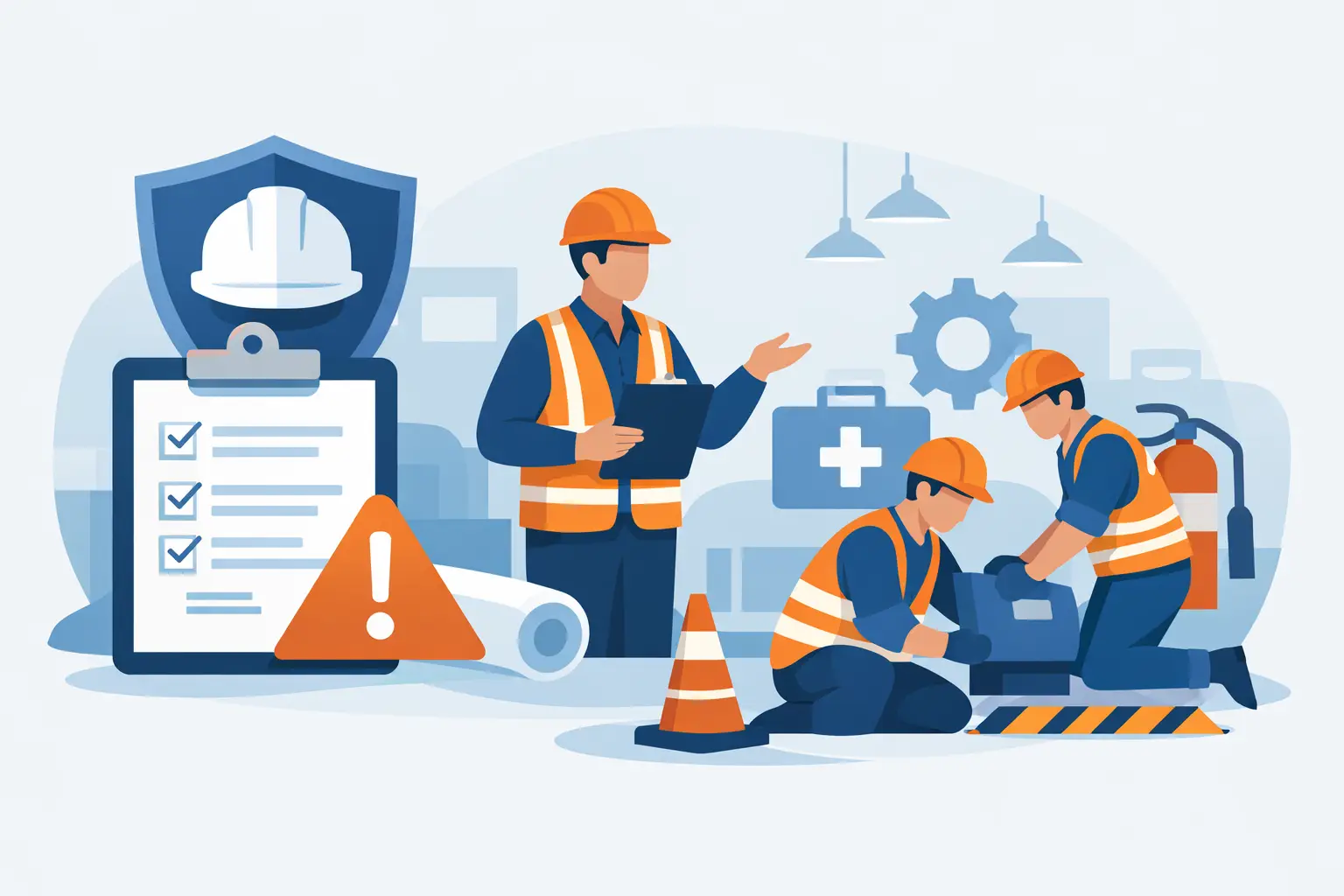
A missed inspection, an outdated training record, or an unreported near miss can create more than administrative friction. It can expose your business to preventable incidents, regulatory gaps, and operational disruption. If you are evaluating how to manage safety in the workplace, the answer is not a single policy or a one-time training session. It is a controlled system that makes safety visible, repeatable, and accountable across daily operations.
For companies managing multiple teams, shifting job conditions, or several locations, safety breaks down when it depends on memory, paper forms, or disconnected spreadsheets. Strong safety performance comes from structure. The organizations that improve outcomes usually do the same thing well: they treat safety management as an operating discipline, not a side task.
How to manage safety in the workplace as a system
The most effective safety programs are built like other critical business functions. They have defined ownership, documented workflows, review cycles, and clear records. That matters because workplace safety is rarely weakened by a lack of intent. More often, it is weakened by inconsistency.
A supervisor handles inspections one way. HR tracks training in another system. Incident reports sit in email. Corrective actions are assigned verbally and never closed out formally. On paper, each activity exists. In practice, control is limited.
Managing safety well means connecting five core areas: hazard identification, training, inspections, incident management, and corrective action tracking. When those pieces operate together, leaders can see where risk is building, where compliance is slipping, and where process discipline needs to improve.
This is also where many businesses face a trade-off. A simple operation with one site may be able to run on manual processes longer than a distributed organization can. But as headcount, sites, and regulatory exposure increase, manual oversight becomes less reliable. What works for 20 employees in one facility often fails at 200 employees across several locations.
Start with ownership and accountability
Safety programs lose momentum when responsibility is broad but undefined. Everyone may be told that safety matters, but no one is clearly accountable for inspections, training completion, incident reviews, or document control.
Start by assigning ownership at both the strategic and operational levels. Senior leadership should own policy direction, resourcing, and performance expectations. Site leaders and supervisors should own execution in the field. Safety managers or compliance leads should own administration, oversight, and follow-up.
That division is important because safety cannot sit only with the safety department. If front-line leaders are not responsible for identifying hazards, correcting unsafe conditions, and enforcing process standards, the program becomes reactive. At the same time, if there is no central oversight, local practices drift and documentation becomes unreliable.
Clear accountability should answer practical questions. Who reviews open corrective actions each week? Who confirms required training is complete before employees perform certain tasks? Who signs off on inspections? Who maintains records for audits or investigations? If those answers are vague, the system is not fully under control.
Build repeatable processes, not isolated tasks
Organizations often have safety activities in place but still struggle with performance because each activity happens in isolation. A toolbox talk is delivered, but attendance is not recorded properly. An incident is reported, but root cause analysis is weak. An inspection finds issues, but there is no formal follow-up.
To manage safety effectively, standardize the workflow behind each task. Hazard reporting should follow one submission process. Inspections should use consistent forms and schedules. Incidents should move through a defined review path with documented findings and assigned actions. Training should be tracked against roles, requirements, and due dates.
Standardization does not mean every site must look identical in every detail. It means the control points are consistent. A construction team and a warehouse team may have different hazards, but both need a reliable way to document inspections, assign corrective actions, and verify closure.
This is where technology can significantly reduce risk. A centralized platform helps ensure the process is followed the same way every time, records are not lost, and managers can see performance across teams without chasing information. For organizations trying to reduce administrative burden while improving oversight, that shift is often operationally necessary, not optional.
Focus on hazard identification before incidents occur
Many safety efforts become incident-centered. Companies act quickly after someone gets hurt, equipment is damaged, or a regulator asks questions. That response matters, but incident response alone is not strong safety management.
A better approach is to create frequent, structured opportunities to identify risk early. Regular inspections, near-miss reporting, job hazard analyses, and employee observations all help surface conditions before they turn into injuries or compliance failures.
The challenge is participation. Employees are more likely to report hazards when the process is simple and when they see follow-through. If reports disappear into a backlog, reporting slows down. If issues are logged, assigned, and resolved visibly, trust grows.
Not every hazard carries the same urgency, so prioritization matters. A blocked exit, machine guarding failure, or fall exposure requires a faster response than a housekeeping issue with limited risk. Good safety management depends on treating findings according to severity, likelihood, and exposure, rather than processing everything with the same level of response.
Make training operational, not ceremonial
Training is often treated as a completion exercise. Employees attend a session, sign a sheet, and return to work. That may satisfy a recordkeeping requirement, but it does not always improve safe behavior.
Effective training is tied to actual job demands. It should reflect the tasks employees perform, the equipment they use, and the hazards they face in specific environments. New hire onboarding matters, but so do refresher cycles, task-specific instruction, and retraining after incidents or process changes.
There is also a control issue here. Many organizations struggle because training records are fragmented across HR files, spreadsheets, email reminders, and local manager notes. That creates risk when certifications expire, when audits occur, or when employees transfer between roles.
A stronger approach is to map training requirements by role and track them centrally. That gives managers a current view of who is qualified, what is overdue, and where compliance exposure exists. For businesses with recurring training obligations, this can prevent a common failure point: assuming training is complete because no one has noticed otherwise.
Use incident management to improve the system
Incidents should be investigated for more than immediate cause. If a worker slips, the question is not only what happened at that moment. It is also whether inspections were effective, whether the hazard had been reported before, whether housekeeping standards were enforced, and whether corrective actions from similar events were ever completed.
This is where incident management becomes a source of operational insight. Patterns in incident data can reveal weak supervision, recurring equipment issues, site-specific exposure, or gaps in training. Near misses are especially useful because they show where controls failed without waiting for a serious outcome.
The quality of the review process matters more than the form itself. If investigations stop at employee error, the organization misses system failures. If they examine process breakdowns, communication gaps, and missing controls, they become useful for prevention.
Measure what leaders can act on
Safety metrics are valuable when they support decisions. Lagging indicators such as incident rates still matter, but they are not enough on their own. By the time they move, the exposure has already existed.
Operational leaders usually need leading indicators they can influence directly: inspection completion rates, overdue corrective actions, training compliance by role, open high-risk hazards, and recurring incident types by site. These measures make it easier to intervene early.
That said, more data is not always better. If reporting becomes bloated or difficult to interpret, managers stop using it. The better approach is to focus on a smaller set of indicators tied to accountability and follow-up.
How to manage safety in the workplace at scale
As businesses grow, safety management becomes harder for a simple reason: complexity increases faster than visibility. More employees, more shifts, more sites, and more documentation requirements create more chances for something to be missed.
At that stage, scale requires centralization. Policies, records, inspections, corrective actions, and training workflows need to be visible in one operating system rather than scattered across teams. That does not remove local responsibility. It gives leadership a way to verify that local execution is actually happening.
For many organizations, this is the point where a platform such as My Safety Solution fits naturally into the operation. The value is not just digitizing forms. It is creating one source of truth for safety activities so leaders can monitor compliance, close gaps faster, and maintain consistency across the business.
Safety management works best when it is built into the rhythm of operations. If your process depends on reminders, manual follow-up, and disconnected records, control will always be weaker than it should be. The practical shift is to make safety easier to execute correctly every day, for every site, by design.