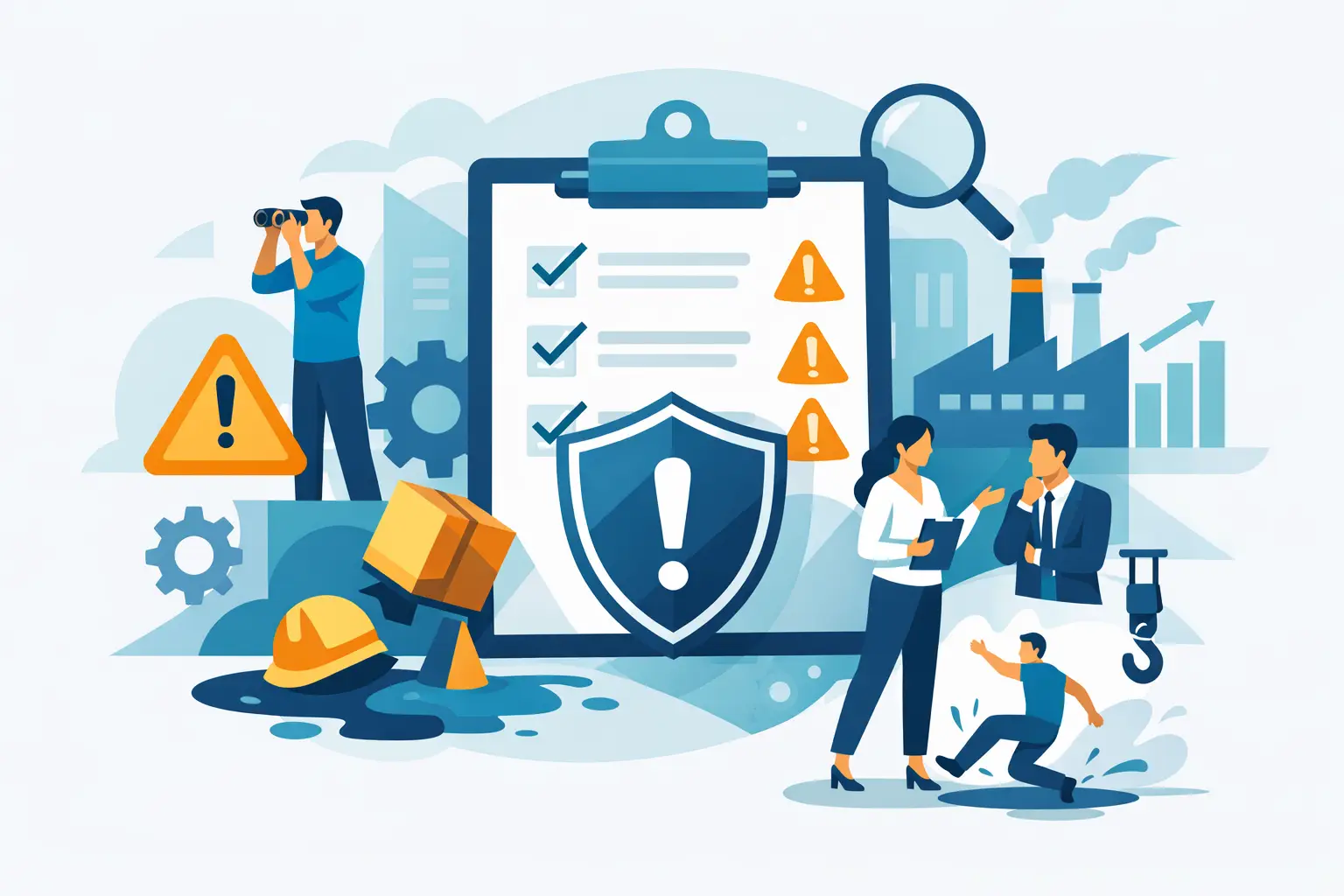
A missed inspection at one site, outdated training records at another, and an unresolved near-miss that never made it past a supervisor’s inbox - that is how safety exposure builds. What is workplace risk management? In practical terms, it is the system a business uses to identify hazards, evaluate exposure, apply controls, and monitor whether those controls are actually working across day-to-day operations.
For companies in construction, manufacturing, logistics, warehousing, and field services, this is not a side process. It sits inside operations. It affects scheduling, staffing, equipment use, contractor oversight, training, documentation, and regulatory readiness. When risk management is handled inconsistently, the result is usually more than paperwork problems. It creates gaps in accountability, weakens decision-making, and increases the chance that a known issue turns into an injury, citation, or costly disruption.
What is workplace risk management in practice?
Workplace risk management is the structured process of controlling threats to employee safety, business continuity, and compliance performance. That includes physical hazards such as falls, machine guarding failures, chemical exposure, and vehicle incidents. It also includes operational risks tied to poor documentation, missed corrective actions, expired certifications, and inconsistent procedures across teams or sites.
The key word is management. Risk does not disappear because a company has a safety policy or conducts occasional training. It has to be tracked, assigned, reviewed, and corrected through a repeatable process. In mature organizations, risk management is not treated as a once-a-year assessment. It is built into inspections, incident investigations, job hazard analyses, training workflows, and corrective action follow-up.
This is why workplace risk management should be understood as an operating discipline, not just a compliance task. Compliance matters, but regulatory alignment is only one output. The larger objective is control - knowing where risks exist, how serious they are, who owns the response, and whether the issue has been resolved.
The core elements of workplace risk management
Most workplace risk management programs rely on the same foundation, even if the complexity varies by industry. First, the organization identifies hazards. That can happen through inspections, employee reporting, incident reviews, audits, equipment checks, and supervisor observations. If hazards are not consistently surfaced, the rest of the process weakens quickly.
Next comes risk assessment. This is where a business looks at likelihood and severity. A loose extension cord in an office and an unprotected fall edge on a construction site are both hazards, but they do not carry the same risk level. Strong assessment helps teams focus attention where exposure is highest instead of treating every issue as equal.
Then the organization applies controls. These can include engineering changes, administrative procedures, personal protective equipment, updated training, or schedule and workflow adjustments. The best control depends on the work environment, the people involved, and how often the exposure occurs. In some cases, eliminating the hazard is realistic. In others, the goal is reduction and tighter oversight.
The final piece is ongoing review. Risks change when equipment changes, staffing changes, production pressure increases, or work moves to a new site. A control that was effective six months ago may no longer be enough. Without follow-up, even well-designed safety programs start to drift.
Why businesses struggle with risk management
The challenge is rarely a lack of intent. Most organizations understand they need to manage workplace risk. The real issue is fragmentation. Hazard reports are submitted in one system, training records are stored somewhere else, inspections live on paper, and corrective actions are tracked through email or spreadsheets. That makes visibility difficult, especially for businesses with multiple departments, shifts, or locations.
When information is spread across disconnected tools, safety leaders spend more time chasing records than managing exposure. It becomes harder to see patterns, verify completion, or prove that action was taken on time. Small delays add up. An open item from an inspection may never connect to a later incident. A supervisor may not know a worker’s training has lapsed. Leadership may assume a site is under control because no one has assembled a clear picture of what is still unresolved.
There is also a trade-off between speed and rigor. Teams under operational pressure may close issues informally just to keep work moving. That can feel efficient in the short term, but it weakens documentation and accountability. On the other hand, overly complicated processes can cause frontline teams to stop reporting issues because the system feels too slow or burdensome. Effective workplace risk management has to balance control with usability.
What good workplace risk management looks like
A strong program is consistent, visible, and assigned. Consistent means the organization uses the same process for identifying hazards, assessing risk, and documenting corrective actions across teams and job sites. Visible means leaders can quickly see open issues, overdue actions, trends, and high-risk areas without piecing together scattered records. Assigned means every action has a clear owner and timeline.
It also means risk information moves across functions. If an incident reveals a training gap, that should trigger a review of training workflows. If inspections show repeated equipment issues, maintenance and operations should be involved. If a near-miss points to procedure failure, the organization should revisit standard work, communication, and supervision. Risk management works best when it is connected to how the business actually operates.
Another sign of maturity is audit readiness. That does not mean building the program around inspections from regulators, insurers, or customers. It means maintaining records and workflows in a way that supports scrutiny at any time. When documentation is organized and current, businesses can respond faster, demonstrate control, and reduce the disruption that often comes with audits or incident reviews.
The role of technology in workplace risk management
As organizations grow, manual systems become harder to trust. Paper forms get delayed. Spreadsheets become version-control problems. Email chains do not provide a reliable audit trail. This is where a centralized safety management platform becomes valuable.
Technology does not replace judgment, supervision, or safety leadership. It supports them by creating structure. Inspections can be standardized. Incidents can be logged and investigated in one place. Corrective actions can be assigned, tracked, and escalated. Training records can be tied to roles, renewal dates, and compliance requirements. Leadership can see where risk is increasing instead of waiting for a monthly report or a serious event.
For companies managing multiple sites or distributed teams, this matters even more. A digital system creates consistency where local practices often vary. It reduces dependence on individual memory and makes it easier to verify that the same expectations are being followed across the organization. That is one reason many businesses use platforms like My Safety Solution to centralize safety workflows and strengthen operational control.
Still, software is not a shortcut. If workflows are poorly defined, technology will simply make the confusion more visible. The process needs ownership, standards, and follow-through. The system should reinforce a disciplined program, not try to invent one after the fact.
How to improve workplace risk management
Most improvements start with visibility. If you cannot quickly answer where your highest risks are, which corrective actions are overdue, or which training requirements are expiring, your program likely needs stronger structure. Start by mapping how hazards, incidents, inspections, and corrective actions are currently tracked. In many cases, the gaps become obvious once the process is laid out end to end.
Then focus on standardization. Use consistent risk criteria, clear ownership rules, and defined timelines for follow-up. Make reporting simple enough that supervisors and employees will actually use it, but formal enough that actions can be audited later. If one site handles issues promptly while another relies on informal workarounds, the organization does not have a reliable risk management process.
Finally, review whether your data supports decision-making. Good workplace risk management should help leaders spot recurring issues, compare performance across sites, and intervene early. If your records are only useful after an incident has already happened, the system is too reactive.
The goal is not to remove every risk from the workplace. That is rarely possible, especially in high-hazard industries. The goal is to create a controlled environment where risks are identified early, addressed consistently, and monitored over time. When that happens, safety performance improves, compliance becomes easier to manage, and operations gain a stronger foundation for growth.
Workplace risk management is at its best when it becomes part of how the business runs every day - not a separate safety exercise, but a clear, accountable system for preventing avoidable harm.