
For high-risk, deskless workforces, the most effective workplace accident prevention solution is an AI-native, mobile-first safety meeting and OSHA compliance platform that turns every tailgate meeting into a timestamped, audit-ready record. My Safety Solution is built precisely for this job. The National Safety Council frames safety leadership as a driver of measurable outcomes rather than just a compliance checkbox, and that distinction shapes everything about how the right software should work. Your immediate next step: run a multi-week pilot on several sites, tracking attendance accuracy, near-miss reporting frequency, and admin hours saved as your three success criteria.
Table of Contents
- How does workplace accident prevention software actually prevent incidents?
- What features must your accident prevention software include?
- What does a realistic 90-day rollout look like?
- Which KPIs actually tell you if your program is working?
- What mistakes undermine safety programs, and how do you fix them?
- Why does My Safety Solution fit this job-to-be-done?
- Key Takeaways
- The real adoption challenge nobody talks about
- Start your pilot with My Safety Solution
- Authoritative sources and further reading
How does workplace accident prevention software actually prevent incidents?
Software prevents accidents by converting Safety Management System processes into real-time workflows and leading indicators, shifting teams from reactive reporting to proactive hazard control. The FAA-aligned SMS framework organizes this work across four pillars: Safety Policy and Objectives, Safety Risk Management, Safety Assurance, and Safety Promotion. Each pillar maps directly to a software capability, following FAA guidance.
- Policy and Objectives: Digital policy distribution with read-receipt confirmation replaces paper binders nobody opens.
- Safety Risk Management: Mobile hazard capture with guided forms and photo attachments surfaces risks before they become incidents.
- Safety Assurance: Automated audit trails, timestamped attendance, and inspection records give you defensible documentation on demand.
- Safety Promotion: Push distribution of OSHA-compliant meeting topics keeps safety visible at every shift, not just after an incident.
The prevention mechanics that matter most are speed and consistency. Real-time hazard identification, guided inspections with corrective action tracking, and automated reminders close the loop between a reported hazard and a resolved one. AI-native platforms help organizations shift from reactive reporting to proactive, real-time hazard detection, which is where the measurable incident reduction actually comes from.
Pro Tip: Keep AI in an assistive role. Configure alerts so supervisors receive a flagged hazard and must confirm or escalate it before the system closes the loop. This human-in-the-loop model, endorsed by safety-tech practitioners, preserves supervisor ownership and worker trust far better than fully automated surveillance.
What features must your accident prevention software include?
Prioritize mobile-first UX, OSHA-ready digital records, and supervisor-facing alerts. Everything else is secondary until those three are solid.

Here is a practical priority framework for procurement:
Must-have (non-negotiable for OSHA compliance):
- Timestamped digital attendance with worker signatures
- Prebuilt OSHA and NLTAPA-aligned topic library
- Offline mobile capability with automatic sync
- Role-based permissions (admin, manager, worker, consultant)
- Audit-ready compliance reports exportable on demand
High-value (accelerates adoption and ROI):
- AI-assisted topic generation customized by industry and hazard type
- Guided inspection forms with corrective action assignment
- Integration with HRIS, payroll, and ERP systems to eliminate duplicate entry
- Push topic distribution for safety consultants managing multiple companies
- Training scheduling with automated reminders
Nice-to-have (scale and optimization):
- Multi-company dashboard for consultants
- Advanced analytics and trend reporting
- Custom branding per site or division
On cost: SaaS safety platforms typically tier pricing by employee count and feature access. Budget conversations should start with your headcount and the number of sites you need to cover, then layer in integration requirements. A platform that requires a separate IT project to connect to your HRIS will cost more in implementation time than the subscription itself.
What does a realistic 90-day rollout look like?
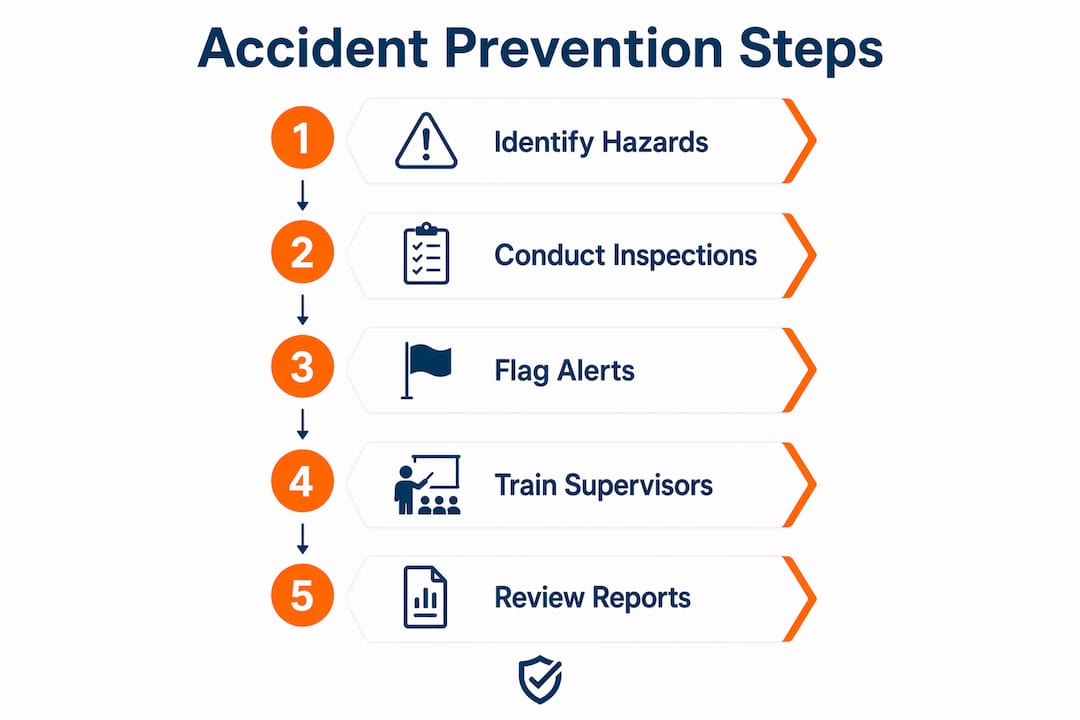
A focused 90-day pilot with defined metrics is the fastest safe path to demonstrating value and earning budget for a full rollout.
| Phase | Weeks | Key Deliverables |
|---|---|---|
| Kickoff and configuration | — | Data migration, role-based access setup, HRIS integration, pilot site selection |
| Pilot deployment and supervisor training | — | Supervisor onboarding sessions, first live meetings with digital attendance, hazard reporting activated |
| Measure, iterate, and expand | — | KPI review against baseline, corrective action audit, decision to scale |
Role responsibilities during rollout:
- Corporate safety manager: Sets pilot KPIs, approves configuration, reviews weekly reports
- Site supervisors: Run meetings using the platform, review AI-generated topics, confirm hazard alerts
- IT/admin: Manages integrations, user provisioning, and data security settings
- Field workers: Attend meetings via mobile, submit hazard reports
- Third-party consultants: Use push distribution to deliver topics across assigned companies
Essential launch tasks:
- Migrate existing employee and site data before go-live
- Configure role-based access and test permissions with a small group first
- Schedule two supervisor training sessions, not one
- Define three pilot KPIs with baseline values before the first meeting
Pro Tip: Limit field-user flows to under 60 seconds. Single-tap check-in, a photo attachment option, and a guided form with no more than five fields will prevent the “pencil-whipping” problem, where workers sign off without engaging.
Which KPIs actually tell you if your program is working?
Track leading indicators alongside lagging ones. Near-miss reports and hazard identifications tell you whether the culture is shifting; recordable incidents and TRIR tell you whether it worked.
| KPI | Baseline Target | 90-Day Target | Why It Matters | |—|—|—| | Near-miss reporting rate | Establish baseline | Increase indicating hazard-identification culture | | Hazard-to-action time | Establish baseline | Reduction indicating faster corrective action | | Training completion rate | Current % | High completion rate confirms field adoption | | Inspection coverage | Current % of sites | Full coverage of pilot sites validates deployment reach | | Days to close corrective actions | Establish baseline | Reduction tracks accountability loop |
For ROI, the math is direct: multiply your reduction in recordable incidents by the average cost per incident for your industry. Construction safety data illustrates how significant that avoided cost can be even at modest incident-reduction rates. Adoption rate in the first 30 days is your earliest signal. If supervisors are not running meetings on the platform by week four, the KPI targets for week twelve will not be reachable.
What mistakes undermine safety programs, and how do you fix them?
Most failures trace back to treating the Safety Management System as static documentation rather than a living operational tool, and to deploying software without coaching supervisors on why it matters.
- Complex mobile UX: Workers abandon flows that take more than a minute. Fix: audit your mobile form length before launch and cut every non-essential field.
- No supervisor training: Supervisors who do not understand the platform skip steps or revert to paper. Fix: run a 90-minute hands-on workshop before go-live, not a slide deck.
- Disconnected systems: Duplicate data entry between your safety platform and HRIS creates errors and resentment. Fix: require HRIS integration as a launch condition, not a phase-two item.
- No measurable pilot goals: Without a baseline, you cannot prove value to leadership. Fix: document your three KPI baselines on day one.
- Over-automation without human review: Fully automated hazard closure without supervisor confirmation erodes trust. Fix: configure human-in-the-loop alerts as the default, not an option.
- Post-incident-only use: Using the platform only after something goes wrong misses the entire prevention value. Fix: set a weekly meeting cadence as a non-negotiable from week one.
Getting your crew to care about compliance is a leadership challenge as much as a technology one.
Why does My Safety Solution fit this job-to-be-done?
My Safety Solution aligns with the procurement priorities above because it is mobile-first, OSHA-focused, and built specifically for multi-site deskless workforces in construction, manufacturing, warehousing, transportation, and utilities.
The platform’s core strengths map directly to the must-have checklist:
- Automated OSHA meeting records with timestamped digital attendance and worker signatures
- Preloaded NLTAPA-aligned content library covering the topics your workforce actually needs
- AI-assisted topic generation that tailors meeting content by industry and current hazard context
- Offline mobile support with automatic sync, so a spotty job-site connection does not break compliance
- Multi-company dashboard for safety consultants managing distributed client portfolios
- Role-based permissions that give corporate admins, site managers, and field workers exactly the access they need
OSHA’s Safety & Health Fundamentals Certificate Program requires participants to complete a minimum of 7 courses and 68 contact hours at authorized OTI Education Centers for General Industry and Construction certificates. My Safety Solution’s NLTAPA-aligned library and training scheduling features are designed to support that kind of structured, documented training cadence at scale.
Key Takeaways
AI-native, mobile-first safety meeting software that enforces OSHA-ready digital records is the most direct route to measurable accident prevention for high-risk, deskless workforces.
| Point | Details |
|---|---|
| Prioritize three must-haves | Timestamped digital attendance, OSHA-compliant topic library, and offline mobile capability are non-negotiable before any other feature. |
| Run a 90-day pilot with baselines | Set near-miss rate, hazard-to-action time, and training completion baselines on day one so you can prove ROI at week twelve. |
| Keep AI assistive, not autonomous | Configure human-in-the-loop supervisor alerts as the default to preserve trust and adoption among field workers. |
| Coach supervisors before launch | A 90-minute hands-on workshop before go-live prevents the most common rollout failure: supervisors reverting to paper. |
| My Safety Solution | Delivers automated OSHA meeting records, NLTAPA-aligned content, and AI-assisted topics for multi-site deskless workforces. |
The real adoption challenge nobody talks about
The technology gap in workplace safety is smaller than most safety managers expect. The harder problem is behavioral: getting supervisors to treat a digital safety meeting as a genuine operational moment rather than an administrative hurdle.
What actually moves the needle in real rollouts is not the feature set. It is the first two weeks of supervisor coaching, the decision to limit field-user steps to under 60 seconds, and the discipline to review KPI data weekly rather than monthly. Early wins, even small ones like a 15% increase in near-miss reports in week three, give leadership the confidence to scale and give workers the signal that reporting actually leads to action.
The platforms that fail are not the ones with the wrong features. They are the ones deployed without a change management plan, where the software becomes a new layer of paperwork instead of a replacement for the old one. Measure adoption first. Everything else follows.
Start your pilot with My Safety Solution
Fewer recordable incidents, audit-ready records, and a field team that actually uses the platform: those are the three outcomes a well-run pilot with My Safety Solution should prove within 90 days.
Here is what to expect from the pilot: setup takes less than two weeks, requires your employee roster and site list, and produces live OSHA-compliant meeting records from the first session. Your three pilot checkpoints are attendance accuracy on every meeting, a measurable increase in hazard reports from the field, and a reduction in admin hours spent on compliance documentation. Start your pilot at mysafetysolution.com, or review the full feature set to confirm it matches your procurement checklist before you commit.
Authoritative sources and further reading
- OSHA Safety & Health Fundamentals Certificate Program: Certificate requirements, course hours, and OTI Education Center details for General Industry and Construction.
- OSHA Outreach Training Program: 10-hour and 30-hour course completion cards and basic hazard training for workers and supervisors.
- National Safety Council — Safety Training: Advanced safety certificates and leadership-driven training programs that go beyond OSHA minimums.
- FAA: Safety Management System initiative: The four-pillar SMS framework (Policy, Risk Management, Assurance, Promotion) with implementation guidance.
- ICAO Safety Management Manual: Detailed SMS implementation guidance including hazard identification, safety risk management, and safety assurance processes.