
Manufacturing safety topics are specific, actionable subjects designed to address the most common workplace hazards and regulatory requirements that protect workers and keep facilities compliant. Safety officers in U.S. factories face a consistent set of risks, from machine guarding failures to chemical exposure, that demand structured, recurring discussion. OSHA data for 2026 confirms that machine guarding remains among the top 10 violations cited across industrial workplaces. Addressing these risks through focused safety topics in manufacturing is not optional. It is the foundation of any credible workplace safety program.
What are the most critical safety topics in manufacturing?
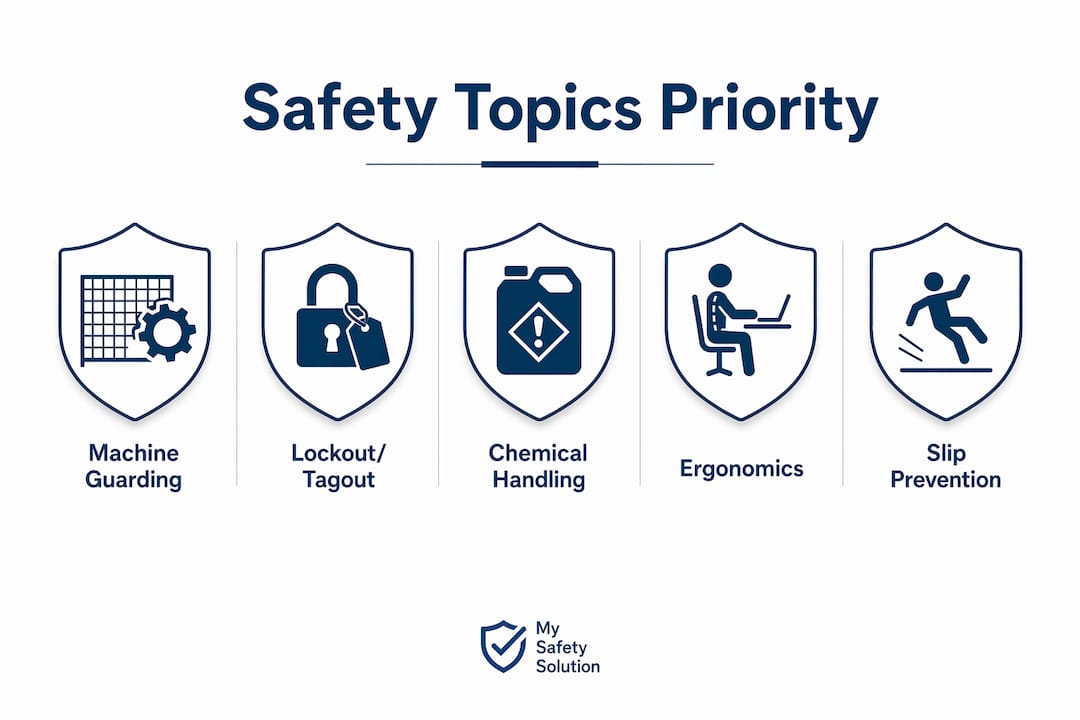
The highest-priority safety topics in manufacturing are machine guarding, Lockout/Tagout (LOTO), chemical handling, ergonomics, and slip and fall prevention. Each of these maps directly to documented injury causes and active OSHA enforcement priorities.
1. Machine guarding
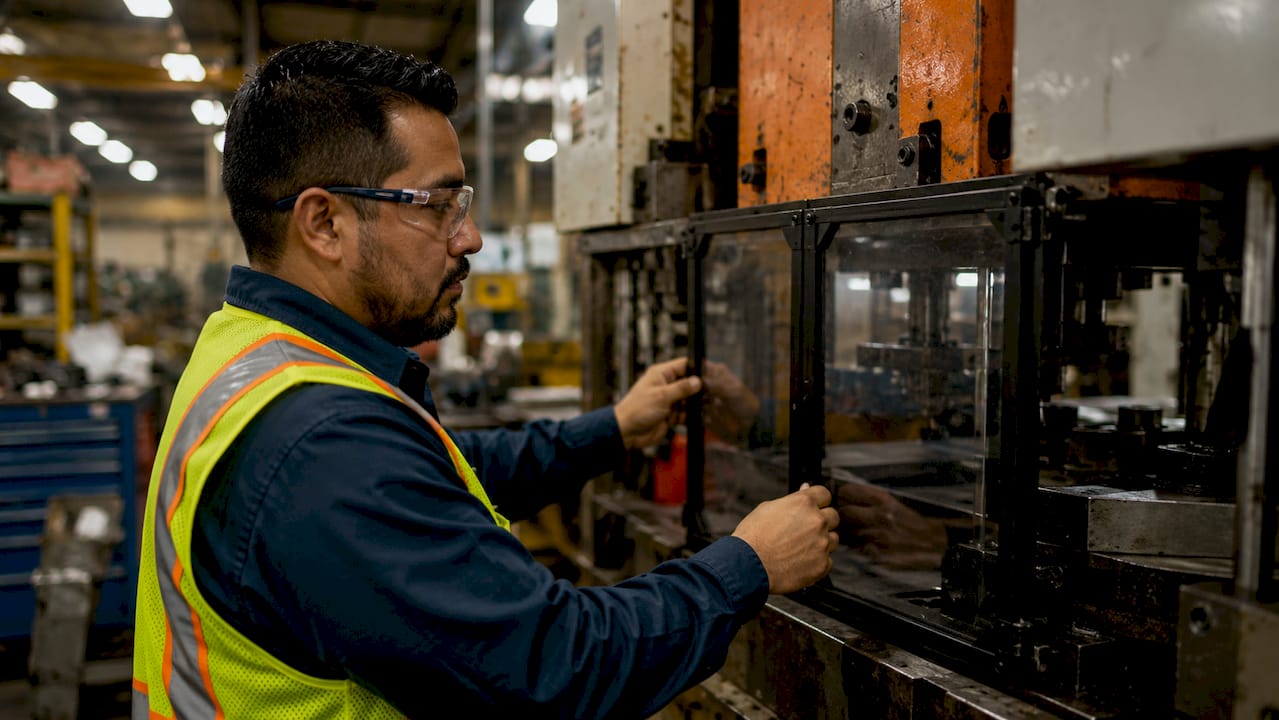
Machine guarding failures consistently rank among the top OSHA violations in manufacturing environments. Unguarded moving parts cause amputations, crush injuries, and fatalities. Every toolbox talk on machine guarding should cover inspection checklists, proper guard reinstallation after maintenance, and reporting procedures for damaged guards.
2. Lockout/Tagout (LOTO)
LOTO failures cause an estimated 120 fatalities annually in U.S. workplaces. That number represents workers who died during routine maintenance because hazardous energy was not properly controlled. Safety officers should treat LOTO as a non-negotiable weekly topic, not an annual checkbox. The LOTO procedure covers energy isolation, lockout device application, and verification before any maintenance begins.
3. Chemical handling and hazard communication
Chemical safety requirements have updated regulatory baselines in 2026, making timely training updates mandatory for compliance. Workers need current Safety Data Sheets (SDS), proper labeling knowledge, and clear spill response procedures. Hazard communication training must reflect the latest GHS alignment under OSHA’s updated standards.
4. Ergonomics and manual handling
Musculoskeletal disorders are among the leading causes of lost workdays in manufacturing. Ergonomics training covers proper lifting mechanics, workstation adjustment, and early symptom reporting. Addressing ergonomics in manufacturing safety reduces both injury rates and long-term workers’ compensation costs.
5. Slip, trip, and fall prevention
Spills and slippery surfaces are a persistent source of manufacturing incidents. Prompt cleanup protocols, proper footwear requirements, and clear aisle marking are the core elements of any effective fall prevention talk.
How to structure toolbox talks on the manufacturing floor
Short, focused toolbox talks outperform lengthy training sessions in manufacturing environments. Practitioners recommend keeping each session to five minutes and covering a single hazard. That constraint forces clarity and improves worker retention.
A weekly rotating schedule built around risk severity keeps topics relevant and workers engaged. A practical structure for a five-day cycle looks like this:
-
Monday: Machine guarding or LOTO, covering the week’s highest-severity risks
-
Tuesday: Chemical handling, with SDS review and spill response reminders
-
Wednesday: Ergonomics and manual handling, tied to current production tasks
-
Thursday: Quality and safety overlap, reviewing any near-miss reports from the week
-
Friday: Open-floor discussion, where workers raise immediate concerns directly
Open-floor sessions on Fridays close the feedback loop between the production floor and management. Workers who raise concerns on Friday see corrective actions by Monday. That cycle builds trust and reinforces that safety talks are not performative.
Dynamic rotating schedules based on weekly risk assessments outperform static topic lists. Near-miss reports, seasonal hazards, and equipment changes should all influence which topic gets priority in a given week.
Pro Tip: Rotate the person leading the talk. When a machine operator runs the LOTO session instead of the safety officer, peer credibility increases and engagement follows.
What should a manufacturing safety training program include?
A manufacturing safety training program must combine regulatory compliance frameworks with site-specific hazard knowledge. OSHA standards set the floor. ISO 45001 provides the management system structure for continuous improvement. Neither alone is sufficient without tailoring to the specific machines, chemicals, and workflows on your floor.
The core components of an effective program include:
-
Documented procedures: Written PPE requirements, emergency response protocols, and chemical safety procedures that workers can reference after training
-
Practical exercises: Hands-on LOTO demonstrations, fire extinguisher drills, and ergonomic workstation assessments that reinforce classroom instruction
-
Maintenance collaboration: Safety officers who work directly with maintenance teams catch equipment wear and energy control gaps before incidents occur
-
Quality-safety integration: Quality defects and safety incidents often share root causes. Training workers to flag quality anomalies as potential safety warnings catches latent risks early
-
Feedback loops: Adjusting training content based on near-miss reports, audit findings, and worker input keeps the program current
Integrating quality inspection observations into safety training is one of the most underused practices in manufacturing. A defect pattern on a press line often signals a guarding issue or an operator fatigue problem. Catching that signal during a quality review prevents a recordable incident.
Worker safety in factories also depends on how well training is documented. Digital records of attendance, topic coverage, and corrective actions create an audit trail that protects the organization during OSHA inspections and incident investigations.
Key manufacturing hazards to address for compliance in 2026
The table below summarizes the safety topics manufacturing officers should prioritize, ranked by risk level and OSHA citation frequency.
| Safety topic | Risk level | OSHA citation frequency | 2026 priority |
|---|---|---|---|
| Machine guarding | Critical | Top 10 annually | High |
| Lockout/Tagout (LOTO) | Critical | Top 10 annually | High |
| Chemical handling and hazard communication | High | Increasing with 2026 updates | High |
| Slip, trip, and fall prevention | High | Frequent | High |
| Hearing protection and noise | Moderate to high | Consistent | Medium |
| Confined space awareness | High | Situational | Medium |
| Fire prevention and emergency response | High | Situational | Medium |
| Ergonomics and manual handling | Moderate | Growing | Medium |
Noise levels in manufacturing frequently exceed OSHA’s 85 dBA action threshold, triggering mandatory hearing conservation programs. Hearing loss is permanent and often goes unnoticed until it is severe. Regular toolbox talks on proper hearing protection selection and fit prevent a harm that no corrective action can reverse.
Confined space awareness applies to any facility with tanks, pits, or enclosed processing areas. The hazards, including oxygen deficiency, toxic atmosphere, and engulfment, require permit systems and trained attendants. Fire prevention talks should cover hot work permits, flammable storage requirements, and evacuation routes specific to the facility layout.
Safety audits for manufacturing should verify that each of these topics appears in documented meeting records at appropriate intervals. An audit trail showing consistent coverage is the clearest evidence of a functioning safety program.
Key Takeaways
Effective safety topics in manufacturing require dynamic, risk-based scheduling tied to OSHA priorities, site-specific hazards, and continuous worker feedback to reduce incidents and maintain compliance.
| Point | Details |
|---|---|
| Prioritize LOTO and machine guarding | Both cause fatalities annually and rank in OSHA’s top 10 violations every year. |
| Keep toolbox talks to five minutes | Single-hazard, short sessions improve retention and worker engagement on the floor. |
| Rotate topics by weekly risk assessment | Near-miss reports and operational changes should drive topic selection each week. |
| Link quality defects to safety risks | Shared root causes mean quality anomalies often signal safety hazards before incidents occur. |
| Document every session | Digital attendance records and corrective action logs create the audit trail OSHA inspections require. |
Why static safety training fails manufacturing teams
The most common mistake I see in manufacturing safety programs is treating annual training as the primary vehicle for hazard prevention. A four-hour annual session covers LOTO, chemical handling, and ergonomics in sequence, workers sign the attendance sheet, and the safety officer files it away. Twelve months later, the cycle repeats. That approach satisfies a compliance checkbox. It does not change behavior on the floor.
What actually works is the weekly cycle. When machine operators hear a five-minute LOTO talk on Monday morning, then see a corrective action posted by Wednesday from Friday’s open-floor discussion, they understand that safety is a live system, not a calendar event. That perception shift is what reduces incidents.
The quality-safety connection is the insight I find most underused. I have seen facilities where a recurring defect on a stamping line was flagged in quality reports for weeks before anyone connected it to an operator bypassing a guard to speed up cycle time. Training teams to read quality data as a safety signal closes that gap. It requires cross-functional conversation between quality and safety officers, but the payoff is catching hazards before they become recordable events.
Open-floor Fridays are worth protecting even when production pressure is high. The concerns workers raise in those sessions, a frayed cord near a press, a chemical label that washed off, a near-miss that went unreported, are exactly the inputs that keep a safety program calibrated to real conditions.
How My Safety Solution supports manufacturing safety compliance
Manufacturing safety officers carry significant administrative weight alongside their field responsibilities. Scheduling weekly talks, tracking attendance, generating corrective action records, and preparing for OSHA inspections all compete for the same limited hours.
My Safety Solution automates the meeting management side of that workload. The platform schedules safety meetings, tracks worker attendance on mobile devices, and generates digital records that satisfy OSHA compliance requirements without manual paperwork. AI-powered content generation produces tailored safety topics matched to your facility’s hazard profile, so safety officers spend less time writing talk outlines and more time on floor-level risk management. Companies using My Safety Solution report reduced incident rates and cleaner compliance records. Learn more about how the platform works and whether it fits your manufacturing operation.
FAQ
What are the most important safety topics in manufacturing?
Machine guarding, Lockout/Tagout, chemical handling, slip and fall prevention, and ergonomics are the highest-priority topics based on OSHA citation data and injury frequency. These five areas account for the majority of recordable incidents and fatalities in U.S. manufacturing facilities.
How often should toolbox talks cover manufacturing safety topics?
Toolbox talks should occur daily or at minimum weekly, with each session covering a single hazard for approximately five minutes. A rotating weekly schedule tied to risk severity and near-miss reports keeps content relevant and workers engaged.
What is the best way to structure a weekly safety talk schedule?
Assign the highest-severity topics, such as LOTO and machine guarding, to the start of the week, and reserve Friday for open-floor discussions where workers raise real-time concerns. This structure closes the feedback loop between floor-level observations and management corrective actions.
How do quality defects relate to manufacturing safety topics?
Quality defects and safety incidents frequently share root causes, meaning a recurring defect pattern can signal an underlying safety hazard. Training workers to report quality anomalies as potential safety warnings helps identify risks before they cause injuries.
What documentation is required for manufacturing safety meetings?
OSHA expects records of safety training topics, attendee signatures, and corrective actions taken. Digital platforms that capture attendance and generate audit-ready reports satisfy these requirements more reliably than paper-based systems.