
Every utilities tailgate meeting record needs seven fields: date and time, job or site identifier, meeting leader, attendees with signatures, the hazards discussed and controls chosen, required PPE, and any follow-up actions. Hold the meeting at shift start or right after a break, keep it brief, typically around ten to fifteen minutes, and capture it digitally rather than on paper. A standardized template, filled out the same way every time, is what turns a routine conversation into a record that survives an audit or an incident investigation.
TL;DR:
- Maintaining a digital record with the date, site, leaders, attendees, hazards, controls, PPE, and follow-up actions is essential to provide audit-ready evidence.
- Tailgate meetings should be brief, hold attention, and include open-ended questions, hazard discussions, and group control validation within 10–15 minutes.
- Every record must document at least one hazard paired with a specific control to avoid being seen as mere attendance proof.
- Digital tools offering offline capture, export options, role-based permissions, and attachment capabilities streamline recordkeeping and improve retrieval speed.
- Consistent, comprehensive documentation supports hazard recognition, incident investigation, and regulatory compliance, especially in complex or multi-site operations.
Table of Contents
- What Fields Should a Utilities Tailgate Meeting Record Include?
- How Do You Run an Effective Tailgate Meeting?
- Reusable Tailgate Meeting Record Template You Can Copy
- How Do You Store Tailgate Records So They Survive an Audit?
- Common Recordkeeping Mistakes and How to Fix Them
- What Should You Require From a Digital Tailgate Record Tool?
- Author Perspective: Conversation First, Documentation Second
- Move From Paper Sign-In Sheets to Audit-Ready Records
- Sources
- FAQ
What Fields Should a Utilities Tailgate Meeting Record Include?
A record that only proves someone showed up tells you nothing about whether the crew actually addressed the day’s risks. That’s the gap most utilities documentation falls into, and it’s the first thing an auditor or OSHA investigator will notice.
Build every tailgate record around these fields:
- Date and start time of the meeting
- Job or site identifier, such as a project number or street address
- Meeting leader’s name and role (foreman, crew lead, supervisor)
- Attendee list with signatures or verified electronic acknowledgment
- Task description: a concise summary of what the crew is doing that day
- Hazards identified and the specific control chosen for each one
- Required PPE, plus any energy control or lockout/tagout status and equipment IDs
- Notes, corrective actions, and attachments, including photos or diagrams
The APPA’s Job Safety Briefing Checklist reflects this same structure, pairing job and location identifiers with hazards, controls, and PPE on a single form utilities already use as a template. Skip any of these fields and the record stops functioning as evidence. It becomes a sign-in sheet with a date on it.
How Do You Run an Effective Tailgate Meeting?
Timing and tone matter as much as content. The California Division of Industrial Relations recommends holding tailgate meetings at the start of a shift or right after a break, and keeping them to 10–15 minutes. Longer than that, and attention drops. Shorter, and you risk skipping the actual hazard conversation.
Run the meeting in this order:
- State the day’s tasks in plain terms, referencing the specific site or job.
- Ask open-ended questions rather than reading a script. “What’s changed on site since yesterday?” gets better answers than “any questions?”
- Invite recent observations, including near-misses, from the crew.
- Tell a brief, specific story about a similar incident if one applies. Storytelling sticks better than a bullet-point warning.
- Name the hazards and agree on controls as a group, then write them into the record while the conversation is still fresh.
- Flag anything that requires a full Job Safety Analysis and pause work until that’s completed.
Research on utility jobsite risk culture has found that the absence of a job briefing is a major precursor to serious injuries, and that conversational briefings, not one-way lectures, are what actually change hazard recognition on site. The effective toolbox talk templates supervisors use for this exact format work because they keep the structure short and the conversation specific.
Pro Tip: Ask the newest person on the crew to name one hazard before anyone else speaks. It surfaces what experienced workers have started to tune out.
Reusable Tailgate Meeting Record Template You Can Copy
A workable template needs the same fields every time, in the same order, so nobody has to guess what belongs where. Use this structure as a starting point for a paper form or a digital template:
- Job ID: project number or work order
- Location: address or site description
- Date/Time: shift date and meeting start time
- Leader: name and role of the person running the briefing
- Attendees: full names with signature or electronic sign-off
- Task Description: one sentence, e.g. “Replacing transformer on Pole 14, Feeder 3”
- Hazards: e.g. “Overhead energized lines within 10 feet of work zone”
- Controls: e.g. “De-energized and grounded per switching order #4471; observer posted”
- PPE: e.g. “Class 2 rubber gloves, hard hat, arc-rated clothing”
- Follow-up Actions: e.g. “Request updated pole inspection before next visit”
- Attachments: photos of the work zone, grounding setup, or signage
At least one hazard paired with one control has to appear on every record, no exceptions. A record with attendees and a task description but no documented hazard reads, to an investigator, like the conversation never covered risk at all.
How Do You Store Tailgate Records So They Survive an Audit?
Federal standards like 29 CFR 1910.269 require job briefings in substance for electric power work, but they don’t uniformly require a written form. Utilities document anyway, because a signed record is what protects the company when a claim or citation surfaces months later.
A workable retention approach looks like this:
- Keep records for the length of the project plus your insurer’s or legal counsel’s required retention window, whichever is longer.
- Organize by job number and date, never by loose date alone.
- Require searchable metadata in any digital system so a specific record can be pulled in seconds, not hours.
- Back up records off-site or in the cloud, with access limited by role.
- Build a standard audit packet: the tailgate record itself, signatures, attached photos, and any related corrective-action log, exportable as a single PDF.
Public utilities that publish meeting minutes and records as a matter of course show what organized documentation looks like at scale. It’s a model worth borrowing even for internal tailgate records that never see a public audience.
Common Recordkeeping Mistakes and How to Fix Them
Most weak tailgate records fail in a handful of predictable ways.
- Sign-in only, no hazards recorded. Fix it by making one hazard and one control mandatory before the form can close.
- Illegible or partially filled forms. Switch to typed fields or verified electronic initials, and mark key fields as required.
- Recurring near-misses with no closed corrective action. Assign a named, accountable person and a due date to every action item, every time.
- No quick way to check your own process. Pull five recent records at random and confirm each one has at least one hazard paired with a control.
Pro Tip: If your last five records all list “general awareness” as the hazard, that’s not documentation. That’s a placeholder, and it will read as one to an investigator.
What Should You Require From a Digital Tailgate Record Tool?

Paper forms get lost, smudged, or filed in the wrong folder. Digital capture solves that by attaching a timestamp and location automatically and making every record searchable the moment it’s saved.
Look for these capabilities before adopting any tool:
- Mobile, offline-capable capture so field crews can log meetings without signal
- PDF or CSV export built for audit packets, not just internal review
- Role-based permissions separating what workers, supervisors, and admins can edit
- Preloaded, editable templates matching the fields covered above
- An audit trail showing who created, edited, or approved each record
Practitioners who’ve integrated tailgate records into daily workflows report that pulling task lists directly from a work management system keeps the briefing relevant and cuts down on boilerplate notes that don’t reflect the actual job. The practical sequence is straightforward: pull the day’s tasks, brief the crew, capture hazards and controls in real time, then sync and tag the record to the job number. Attaching photos of grounding setups or barricades, similar to how crews tag tools in a tool room, adds another layer of verification an auditor can check against the written record.
Author Perspective: Conversation First, Documentation Second
Documentation never fixes a bad conversation. If the crew isn’t actually talking through hazards, no form saves that meeting. But a consistent record is what turns a good conversation into something defensible. It gives a supervisor proof the discussion happened, and gives a safety program the data to spot patterns before they become incidents.
— Matthew Hoffman
Move From Paper Sign-In Sheets to Audit-Ready Records
A digital safety record system replaces paper sign-in sheets and scattered spreadsheets with mobile capture, timestamped attendance with digital signatures, preloaded templates, and exportable audit packets that consolidate hazard, control, and PPE fields automatically.
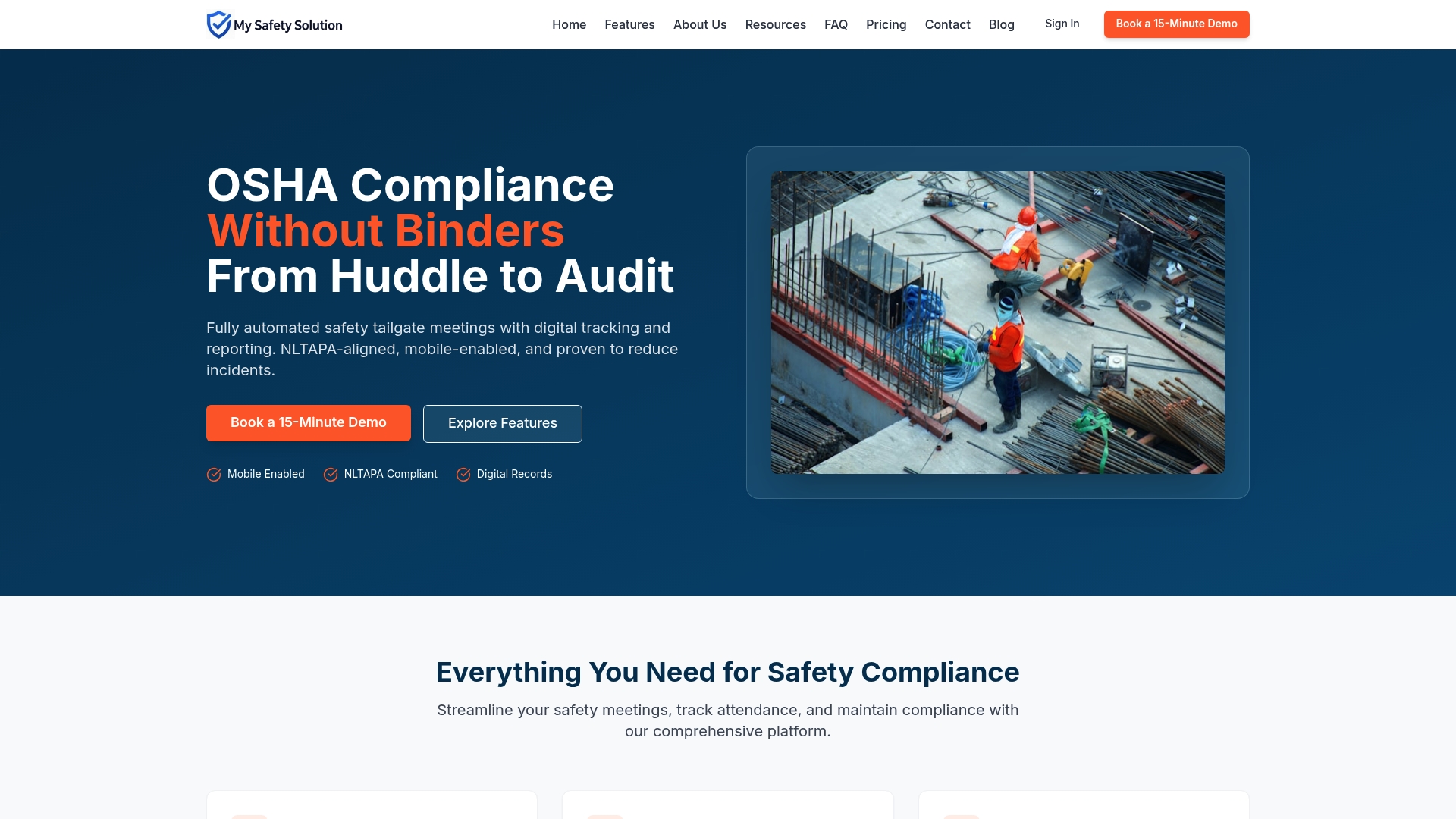
Instead of chasing down loose forms after an incident, you can run a small pilot: pick 10 sites, run it for two weeks, then export one audit packet and time how long it takes to compile a complete record versus your current process. Most teams see the retrieval-time difference immediately. The platform’s construction and utility feature set covers the fields this article recommends out of the box, and the Starter plan starts at $99 per month, with Growth and Business tiers available as your crew count grows. Check current plan details and start a pilot on the pricing page.
Sources
For further reading: OSHA’s workplace safety statistics for incident context, California DIR’s tailgate meeting guidance for meeting structure, and the APPA’s Job Safety Briefing Checklist for a ready-made field template.
- Tailgate/Toolbox Safety Meetings — California DIR eTools
- Tailgate Safety Briefings Transform Utility Jobsite Risk Culture — Lift and Access
- Tailboard Meeting Requirements, Rules, and Penalties — LegalClarity
FAQ
What Should a Tailgate Safety Meeting Record Include?
At minimum: date and time, location or job ID, leader’s name, attendee signatures, task description, hazards and controls, required PPE, and any follow-up actions.
What Is the Purpose of a Tailgate Meeting?
A tailgate meeting is a brief, on-site safety briefing held before or during a shift to review the day’s specific hazards and confirm the crew agrees on controls before work starts.
How Long Should a Tailgate Meeting Last?
Most effective tailgate meetings run 10–15 minutes, held at the start of a shift or right after a break, according to California DIR guidance.
What Are Good Talking Points for a Utilities Tailgate Meeting?
Focus on the day’s specific site conditions: overhead line locations, grounding and switching status, recent near-misses, weather changes, and any new equipment or personnel on the crew.
Does OSHA Require Written Tailgate Meeting Records?
Federal standards require job briefings in substance for electric power work, but they don’t uniformly mandate a written form. Written records remain a strong best practice for evidence and audit readiness, as outlined in LegalClarity’s review of tailboard meeting requirements.