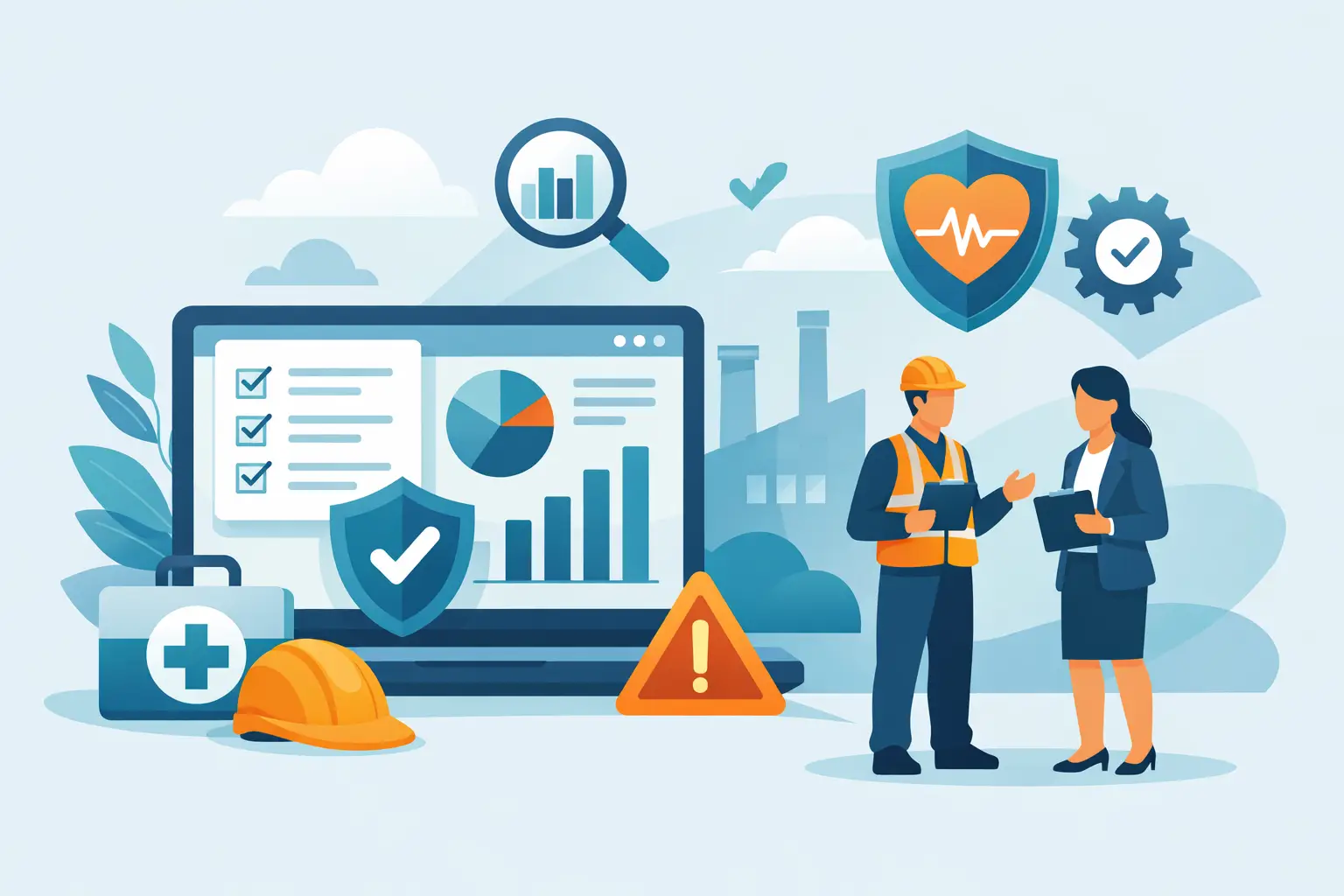
If your safety program still lives across spreadsheets, paper forms, email threads, and shared drives, the problem is not just inefficiency. It is loss of control. The best health and safety management software gives safety leaders one system to manage incidents, training, inspections, corrective actions, and compliance records without chasing information across disconnected tools.
For operations leaders and safety managers, that shift matters because safety performance is tied to execution. When documentation is hard to find, follow-up is inconsistent, and field activity is not visible in real time, risk increases. Software does not replace leadership or accountability, but it does make both easier to enforce across sites, teams, and workflows.
What the best health and safety management software actually does
At a practical level, health and safety software centralizes the work that usually gets fragmented. That includes incident reporting, investigation workflows, inspection checklists, hazard identification, employee training records, policy documents, corrective action tracking, and compliance reporting.
The value is not simply that these functions become digital. The value is that they become connected. If a near miss triggers an investigation, assigns corrective actions, updates a risk record, and creates a training need, the system should support that chain without manual handoffs. That is where many organizations move from administrative safety management to operational safety management.
The best platforms also create visibility across the business. A plant manager should be able to see overdue corrective actions. A safety director should be able to track incident trends by location. HR should be able to verify training completion. Leadership should be able to identify which sites are keeping pace with inspections and which are falling behind.
How to evaluate the best health and safety management software
Not every platform marketed to safety teams is built for the same operating environment. Some are broad compliance tools with light safety features. Others are designed for high-risk industries and support day-to-day field execution more effectively. The right choice depends on your regulatory exposure, workforce structure, and how complex your safety operations are.
Start with workflow fit, not feature volume
A long feature list can be misleading. What matters is whether the system matches how your organization actually works. If your teams conduct daily field inspections, manage subcontractors, run recurring toolbox talks, and track corrective actions across multiple sites, the software needs to support those routines clearly and consistently.
A simpler business with one location may not need deep configurability. A contractor or manufacturer with distributed teams usually does. In that case, the platform should handle mobile reporting, site-level accountability, role-based access, and standardized workflows that still allow for location-specific requirements.
Look for control across the full safety lifecycle
Strong software should not solve one problem while creating three more. Many companies adopt a tool for incident reporting, then continue managing training in one system, inspections in another, and documents in a shared folder. That keeps the same fragmentation in place.
A better approach is to evaluate whether the platform can support the full safety lifecycle in a coordinated way. That includes reporting an incident, documenting the investigation, assigning corrective actions, tracking closure dates, updating procedures, and verifying retraining where needed. The fewer disconnected systems involved, the easier it is to maintain accountability.
Prioritize audit readiness and record integrity
In regulated industries, documentation quality is not optional. Software should make it easier to demonstrate what happened, who was assigned responsibility, when actions were completed, and whether required training or inspections took place on schedule.
This is where timestamps, standardized forms, stored records, and reporting history matter. If your team has to reconstruct a compliance trail manually during an audit or after a serious incident, your system is not doing enough. The best health and safety management software reduces that scramble by making records structured and retrievable from the start.
Core capabilities that matter most
There is no perfect software stack for every organization, but several capabilities consistently separate useful systems from expensive filing cabinets.
Incident management should be fast enough for frontline use and structured enough for investigation. If reporting takes too many steps, people delay it. If forms are too loose, data becomes inconsistent. Good systems balance simplicity at the point of entry with enough detail to support trend analysis and follow-up.
Inspection management is just as important. Teams need the ability to complete routine inspections in the field, attach photos, flag hazards, assign actions, and monitor completion without relying on paper forms that sit in trucks or office inboxes.
Training management should do more than store certificates. It should track due dates, completion status, recurring requirements, and role-specific training obligations. For employers with turnover, multiple job roles, or changing site assignments, this is a control issue as much as an administrative one.
Document control is often overlooked until it fails. Policies, SDS records, procedures, forms, and supporting files need version control and clear access rules. If employees are using outdated documents or supervisors cannot confirm which version is current, the risk is operational as well as regulatory.
Dashboards and reporting matter when they lead to action. A good dashboard should help leaders spot overdue tasks, incident patterns, training gaps, and site-level performance issues quickly. More charts are not always better. Clear reporting tied to decisions is what matters.
Common mistakes buyers make
One of the most common mistakes is choosing software based on presentation quality rather than implementation reality. A polished demo can hide a system that requires too much setup, too many workarounds, or too much administrative maintenance to sustain.
Another mistake is underestimating adoption. Safety software only works if supervisors, managers, and field employees actually use it. That means mobile accessibility, straightforward forms, and processes that fit existing operations. If the platform feels like extra work, usage drops and the data becomes unreliable.
Some buyers also focus too narrowly on compliance. Compliance is critical, but safety management software should also improve execution. If the system helps you pass an audit but does not improve inspection consistency, follow-up discipline, or incident visibility, its operational value is limited.
Cost can be another trap. The lowest subscription price is not always the lowest total cost. If a cheaper system forces you to keep separate tools for training, corrective actions, and document control, the organization still pays for fragmentation through labor, inconsistency, and missed follow-up.
What different industries should weigh differently
Construction firms often need stronger support for site inspections, subcontractor oversight, field reporting, and mobile access. Conditions change quickly, and the software needs to keep up with active job sites rather than office-only workflows.
Manufacturing environments typically need tighter control over recurring inspections, corrective action closure, training documentation, and hazard tracking across shifts or departments. Consistency and traceability usually matter more than flexibility alone.
Logistics, warehousing, and field service organizations often need visibility across dispersed teams. In those settings, centralized reporting and standardized workflows are especially valuable because safety performance can vary widely by location, supervisor, or route.
That is why there is no single answer for every buyer asking for the best platform. The best fit depends on where risk lives in your operation and which parts of the safety process break down most often today.
When a unified platform makes the biggest difference
Organizations feel the strongest return when safety responsibilities are spread across multiple people, locations, or processes. If one person handles everything manually at a single site, software can still help, but the urgency may be lower.
The need becomes more obvious when incidents are reported one way, inspections another, training tracked somewhere else, and action items managed informally. In that environment, leadership lacks a reliable operating picture. Standardization becomes difficult, and accountability depends too heavily on individual effort.
A unified platform brings discipline to those moving parts. It creates one source of truth, reduces duplicate entry, and makes it easier to enforce expectations across the organization. For companies trying to scale safety performance without scaling administrative chaos, that is a meaningful operational advantage.
Solutions such as My Safety Solution are built around that need for centralization and control, especially for businesses managing compliance obligations across multiple teams or sites. The real benefit is not digitization for its own sake. It is having a system that supports repeatable safety execution.
Choosing with the long term in mind
The software you choose should fit where your safety program is going, not just where it is today. If your business is growing, adding sites, facing tighter customer requirements, or formalizing safety processes, the system should be able to support that progression without a full rebuild.
That means asking practical questions. Can workflows be standardized across departments? Can reporting scale across locations? Can leadership see trends without pulling data manually? Can records hold up under audit pressure? And just as important, can your team use the system consistently without creating more administrative drag?
The best health and safety management software is the one that gives your organization stronger control over risk, clearer accountability, and fewer gaps between policy and execution. When the system fits the operation, safety management becomes more consistent, more visible, and far easier to maintain under real-world pressure.
If you are evaluating options, focus less on who has the longest feature sheet and more on who can help your team run a safer, more organized operation every day.