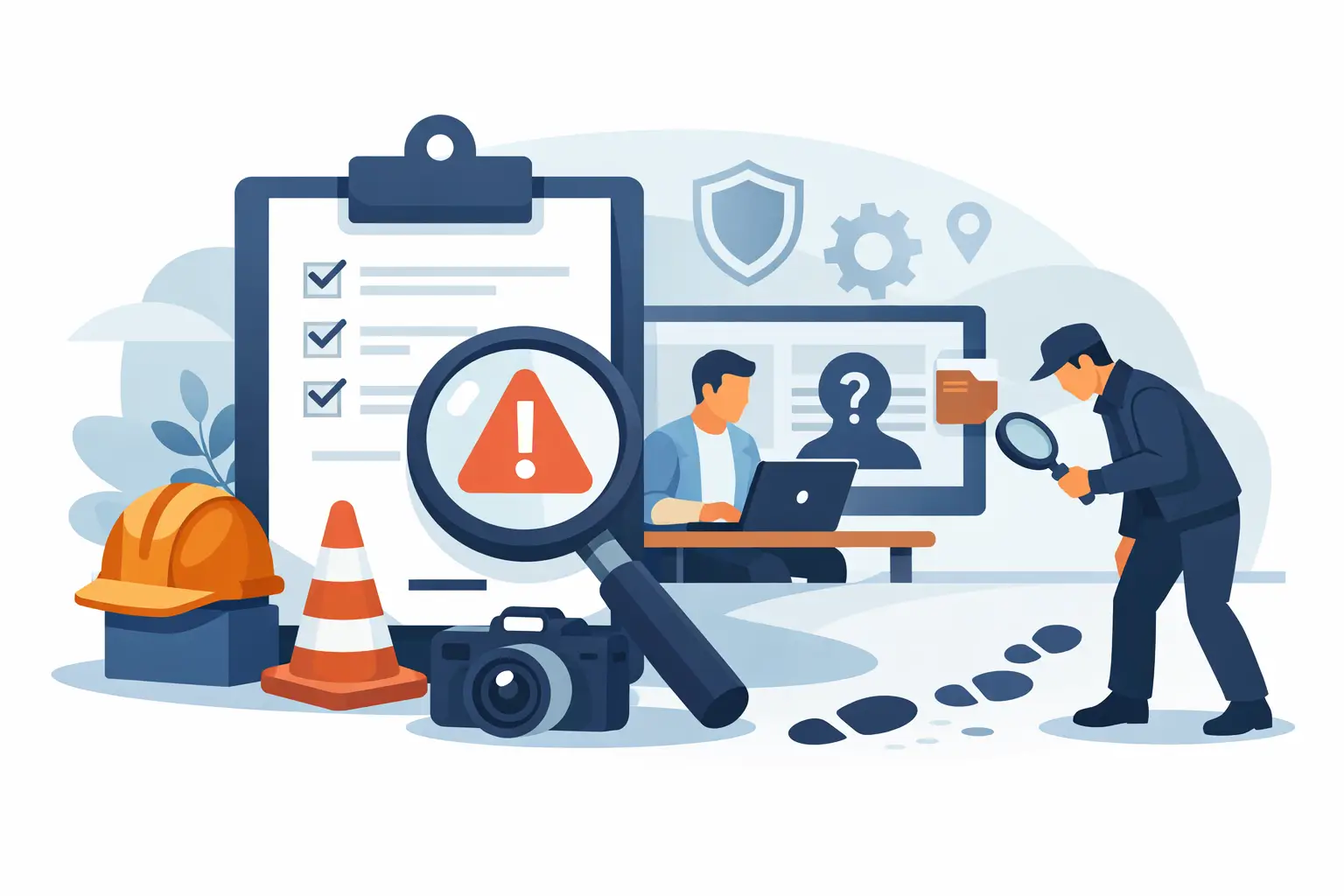
When a forklift clips a rack, a technician strains a shoulder, or a contractor reports a near miss, the clock starts immediately. Delays in an incident reporting and investigation procedure create gaps in facts, accountability, and corrective action. What happens in the first few hours often determines whether the organization learns from the event or simply documents it.
For operations leaders and safety managers, this procedure is not just paperwork. It is a control mechanism. A well-defined process protects employees, supports compliance, and gives management a reliable way to identify root causes before the same issue appears again at another site, on another shift, or in another department.
What an incident reporting and investigation procedure should accomplish
At a basic level, the procedure should answer five questions clearly: what must be reported, who reports it, how quickly it must be reported, who investigates it, and how corrective actions are tracked to completion. If any of those elements are vague, execution becomes inconsistent.
The strongest procedures do more than collect forms. They create a standard operating process for triage, fact gathering, analysis, approval, and follow-up. That matters most in organizations with multiple facilities, field crews, or layered management structures, where verbal reporting and local habits often replace formal process.
An effective procedure also separates reporting from blame. Employees are more likely to report incidents, near misses, and unsafe conditions when they know the organization is focused on facts and prevention rather than immediate fault finding. That does not remove accountability, but it changes the sequence. First establish what happened and why. Then address performance, policy, or disciplinary issues if the facts support it.
Start with clear reporting criteria
One of the most common failures is assuming employees and supervisors already know what counts as an incident. In practice, they often report serious injuries but ignore property damage, minor first aid cases, environmental releases, or near misses that could have resulted in a severe outcome.
A procedure should define reportable events in plain language. That usually includes work-related injuries and illnesses, vehicle incidents, equipment damage, spills, fires, security events, and near misses. Some organizations also require reporting of unsafe acts and unsafe conditions through the same workflow, while others keep hazard observations separate. Either approach can work if the threshold is clear.
Timing matters just as much as definitions. Immediate verbal notification for serious events should be required, followed by formal written or digital submission within a defined window. For lower-severity incidents, same-shift or end-of-day reporting may be reasonable. The right timing depends on the organization’s operating risk, staffing model, and regulatory exposure, but the standard should never be left to discretion.
The first response sets the quality of the investigation
Before the analysis begins, the site team needs to stabilize the situation. That means caring for injured employees, securing the area, preserving evidence where appropriate, and notifying internal stakeholders. In high-risk operations, preserving the scene can be critical. Moving equipment, cleaning spills, or restarting a process too quickly can erase information that would explain the event.
This is where many procedures become too theoretical. They describe investigation steps but not operational priorities. A practical process should tell supervisors exactly what to do first, second, and third. If a supervisor has to interpret the process during a stressful event, consistency will break down.
There is also a trade-off here. Operations often need to resume quickly, especially in production, logistics, and field service environments. But restarting before key evidence is documented can lead to shallow findings. The procedure should define when photographs, witness statements, equipment status, or environmental conditions must be captured before normal work resumes.
How to investigate without stopping at the obvious answer
A strong incident reporting and investigation procedure does not end with statements like employee error, failure to pay attention, or improper lifting. Those may describe the last action before the event, but they rarely explain why the conditions existed in the first place.
The investigation should establish a timeline, identify the sequence of events, review relevant procedures, and examine contributing factors such as training, supervision, equipment condition, workload, communication, and environmental conditions. For example, if an employee bypassed a machine guard, the investigation should examine whether production pressure, poor equipment design, inadequate lockout practices, or recurring downtime made that behavior more likely.
Root cause analysis does not need to be overly academic. In many organizations, a simple structured method is more effective than a complicated model no one uses correctly. The key is discipline. Ask what happened, what conditions allowed it, what management systems failed, and what controls were missing or ineffective.
This is also where investigator capability matters. Not every supervisor is equipped to conduct a sound investigation. Serious incidents may require EHS leadership, operations management, HR, maintenance, or quality to participate. The procedure should define escalation criteria so that high-severity or high-potential events receive the right level of review.
Documentation should support action, not just recordkeeping
Most organizations have incident forms. Fewer have documentation that actually drives follow-through. If reports are inconsistent, missing fields, or stored across email, spreadsheets, and paper files, the investigation process becomes hard to audit and even harder to improve.
Documentation should capture the facts of the event, evidence reviewed, witnesses interviewed, immediate actions taken, root causes identified, and corrective actions assigned. It should also record dates, owners, and status updates. That last part is where many programs fail. An action that is identified but never verified is not a control.
A centralized system improves this significantly. When incident records, corrective actions, training records, and inspection history sit in the same environment, safety teams can see whether a problem is isolated or part of a broader pattern. That level of visibility is difficult to achieve with disconnected files and site-specific reporting habits.
Corrective action is where the procedure proves its value
An investigation is only useful if it leads to change. Corrective action should focus on reducing the chance of recurrence through stronger controls, not just reminders to be careful. Administrative controls and retraining may be appropriate in some cases, but they are often overused because they are fast and inexpensive.
The better question is whether the fix addresses the underlying exposure. If a recurring injury stems from workstation design, staffing levels, equipment maintenance, or incomplete procedures, awareness training alone will not solve it. Stronger actions may involve engineering changes, revised workflows, updated inspections, supervisor accountability, or changes to procurement standards.
Each action should have a defined owner and due date. It should also require verification of completion and effectiveness. Closing an action because an email was sent is not the same as confirming the risk was reduced in the field.
Why consistency matters across locations and teams
In distributed operations, inconsistency is one of the biggest hidden risks. One site may investigate every near miss thoroughly, while another only documents OSHA-recordable cases. One manager may assign actions and track them weekly, while another treats the report as complete once submitted.
That inconsistency weakens trend analysis, compliance posture, and operational control. It also creates uneven exposure across the business. Senior leaders may believe they have one safety process when they actually have ten variations of it.
Standardization does not mean every incident gets the same level of review. It means the thresholds, workflow, documentation requirements, and approval steps are consistent. The intensity of the investigation can scale based on severity and potential outcome, but the structure should remain stable.
This is where software becomes operationally useful rather than administrative. A platform such as My Safety Solution can standardize reporting fields, route notifications automatically, assign investigations, track corrective actions, and maintain a complete audit trail. For organizations managing multiple sites or mobile teams, that kind of control reduces lag time and limits process drift.
Common procedure gaps to fix now
If your current process depends on paper forms, scattered email chains, or local spreadsheets, you likely already have blind spots. The most common issues are late reporting, incomplete investigations, unclear ownership, missing corrective action follow-up, and weak visibility into repeat causes.
Another frequent problem is overcomplication. If the procedure is too long, too legalistic, or too difficult to complete in the field, people will work around it. The process needs to be structured, but it also needs to match operating reality. A warehouse supervisor, field foreman, or plant manager should be able to execute it without guessing what comes next.
The strongest procedures are clear enough for frontline use and disciplined enough for management review. They make expectations visible, create accountability, and turn each incident into actionable data instead of isolated paperwork.
A solid incident reporting and investigation procedure does not just help after something goes wrong. It gives the organization a more reliable way to see risk, correct weak controls, and keep safety performance from depending on memory, habit, or individual judgment.