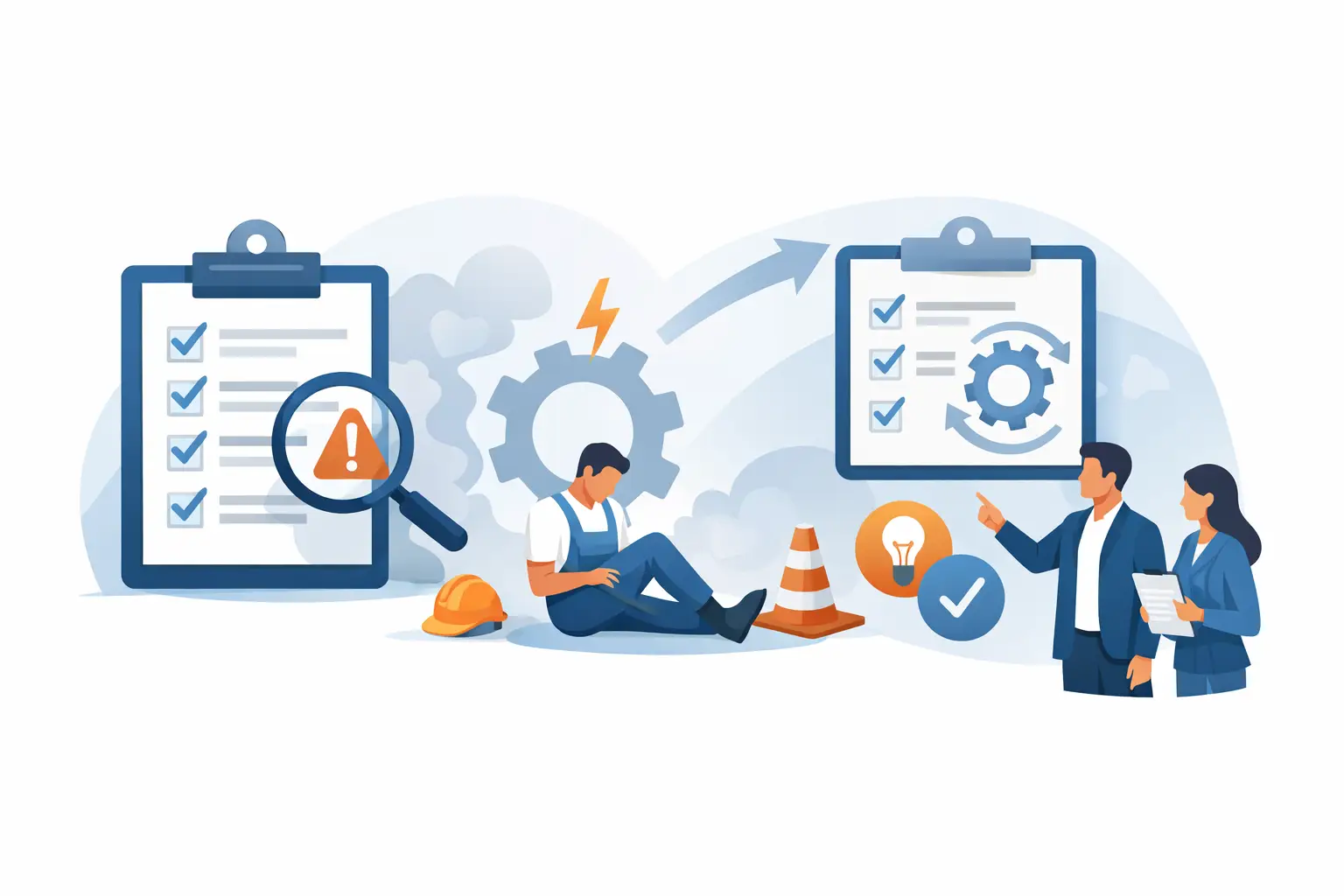
A delayed report after a forklift near miss or a repeat strain injury on the same line usually points to the same problem: the organization recorded the event, but it did not convert that information into action. An effective incident report and corrective action process closes that gap. It turns a workplace event into a documented response, a clear assignment of responsibility, and a measurable step toward preventing recurrence.
For safety managers, operations leaders, and compliance teams, that process is not just paperwork. It is a control mechanism. When reporting and corrective action are disconnected, hazards stay in circulation, repeat incidents become more likely, and audit readiness weakens. When they are connected in one workflow, the organization gains visibility into what happened, why it happened, and what must change.
Why incident report and corrective action belong together
An incident report captures facts. Corrective action addresses causes. Treating them as separate administrative tasks creates delays, duplicate work, and inconsistent follow-through.
This matters most in complex environments like construction, warehousing, manufacturing, and field operations, where multiple supervisors, shifting crews, and changing conditions can make accountability hard to maintain. A report filed at one site may never translate into a policy update, equipment repair, retraining task, or procedural change unless there is a defined corrective action process attached to it.
A connected system improves more than compliance. It supports operational discipline. Supervisors know what needs to happen next. Safety teams can track whether actions were completed on time. Leadership can see patterns across locations instead of reacting to events one at a time.
There is also a practical distinction worth making. Not every incident requires the same level of response. A minor first-aid event may need a local procedural adjustment, while a recordable injury or equipment-related near miss may require formal investigation, root cause analysis, and documented verification that controls are in place. The process should be standardized, but the response should scale to the risk.
What a strong incident report includes
A useful report does more than preserve a timeline. It gives the organization enough detail to make a sound decision about corrective action.
At minimum, the report should document who was involved, what occurred, where and when it happened, the immediate conditions present, and any initial response taken. It should also capture witness information, equipment involved, and whether the event resulted in injury, property damage, environmental impact, or a near miss.
The quality of the report matters. Vague statements like “employee was not paying attention” do not help a safety program improve. They push the issue toward blame instead of control. A better report identifies observable facts such as line-of-fire exposure, missing guarding, incomplete training, poor housekeeping, unclear work instructions, or schedule pressure that affected decision-making.
Good reporting also depends on timing. Details become less reliable as time passes, especially in fast-moving operations. The sooner the event is documented, the easier it is to preserve evidence, interview witnesses accurately, and assess whether immediate containment measures are needed.
How corrective action should work after an incident report
Corrective action is where many organizations lose control. The report is completed, emailed, saved, or discussed in a meeting, but no one owns the next step with a due date and a record of completion.
An effective corrective action process starts by separating immediate fixes from long-term prevention. Immediate action may include taking equipment out of service, cleaning a spill, replacing damaged PPE, or stopping a task until conditions are safe. Those steps matter, but they do not necessarily solve the underlying problem.
Long-term corrective action addresses the factors that allowed the incident to occur. That could mean revising a procedure, adding a guarding requirement, changing traffic flow in a warehouse, updating a lockout practice, improving supervisor sign-off, or retraining employees on a task that has drifted from the approved method.
Each action should have an owner, a due date, and a clear standard for completion. “Retrain team” is too loose. “Conduct documented forklift pedestrian separation training for all warehouse employees on shifts A, B, and C by May 15” is accountable and verifiable.
Verification is the step that often gets skipped. Corrective action is not complete because someone said it was handled. It is complete when the organization confirms the hazard was addressed and the change is functioning as intended. In some cases, that means a follow-up inspection. In others, it means reviewing behavior in the field, checking maintenance records, or confirming that a revised procedure has actually been adopted.
The role of root cause in incident report and corrective action
If incident reporting stays at the surface level, corrective action usually does too. That is why root cause matters.
The immediate cause of a slip may be water on the floor. The contributing causes could include a leaking unit, delayed maintenance, no inspection trigger, and no ownership for cleanup in that area. If the corrective action only addresses the water on the floor, the organization has not solved the real exposure.
This is where disciplined investigation helps. The goal is not to produce a complicated analysis for every event. It is to ask enough of the right questions to understand what failed in the system. Was the procedure missing, unclear, outdated, or ignored? Was training incomplete? Was supervision inconsistent? Was production pressure affecting safe decision-making? Did inspection routines miss a known issue?
The right level of analysis depends on severity and risk. A simple event may only need a brief review. A serious injury, high-potential near miss, or recurring event demands a deeper look. The key is consistency. Organizations should have a defined method for deciding when a basic review is enough and when a formal investigation is required.
Where organizations break down
Most failures in incident report and corrective action do not come from lack of intent. They come from fragmented process.
Paper forms get filed locally and never reach the central safety team. Corrective actions are tracked in spreadsheets that no one updates. Different sites use different report formats, which makes trend analysis unreliable. Supervisors close actions informally, but there is no documented evidence for internal review or external audit.
These gaps create risk on two levels. First, hazards remain unaddressed or are addressed inconsistently. Second, the organization cannot prove it responded appropriately if a regulator, insurer, or legal review examines the event later.
Distributed operations are especially vulnerable. One location may handle incident follow-up with discipline, while another relies on email threads and memory. Over time, that inconsistency affects both safety performance and compliance posture.
Building a process that holds up under pressure
A workable process needs structure, but it also needs to fit daily operations. If reporting takes too long, supervisors delay it. If corrective action approval is too cumbersome, deadlines slip. If leadership cannot see open actions across sites, accountability weakens.
The strongest programs standardize a few essentials. They use one reporting framework across the organization. They define who investigates, who approves corrective actions, and who verifies completion. They classify incidents by severity and potential risk so response levels are consistent. They also create visibility into overdue actions, repeat incident types, and site-level trends.
Digital workflows can materially improve this process because they reduce the handoff failures common in manual systems. When incident details, investigation notes, action assignments, evidence of completion, and status tracking live in one place, teams spend less time chasing updates and more time resolving hazards. For organizations managing multiple facilities or job sites, that control becomes operationally significant.
This is where a platform approach has an advantage. Rather than treating reporting, investigation, training, and follow-up as disconnected tasks, systems like My Safety Solution help organizations manage them as part of one safety operation. That supports consistency across locations and gives leadership a clearer view of whether corrective actions are actually reducing repeat risk.
What better reporting changes over time
A disciplined process does more than respond to incidents. It improves decision-making across the business.
When incident data and corrective actions are organized well, patterns become easier to see. Certain injury types may cluster by shift, task, site, or supervisor. Equipment issues may point to maintenance gaps. Repeat corrective actions may show that training is being assigned but not retained. These are operational insights, not just safety records.
That said, more data is not automatically better. The value comes from usable information and consistent follow-through. A simple, enforced process will outperform a complicated one that teams avoid. The standard should be clear enough to support compliance and strong enough to drive prevention.
A solid incident report should never be the end of the story. It should be the starting point for a corrective action process that assigns responsibility, verifies change, and reduces the chance that the same event happens again. When that connection is built into daily operations, safety becomes easier to manage and harder to ignore.
The most effective safety programs are not the ones with the most forms. They are the ones that can show, every time an incident occurs, what was learned, what changed, and who made sure it stayed changed.