
Toolbox talks reduce incidents when they are delivered consistently, kept short, and built around real hazards rather than generic reminders. The first action for any supervisor is simple: standardize a short, job-specific talk format, document who attended, and assign one clear corrective action before the crew disperses. The sections below lay out the evidence, ready-to-use templates, measurement methods, and adjustments for diverse crews that turn a routine into a control.
TL;DR:
- Consistently delivered toolbox talks that are short, relevant, and interactive can modestly reduce injury rates, with a correlation of 0.27 between participation and fewer recordable injuries.
- Effective talks are limited to 10-15 minutes, focus on one or two key topics aligned with the day’s work, and involve participatory discussion to build ownership.
- Visual aids, open questions, and assigned follow-up actions with deadlines significantly improve hazard recognition and safe behavior on site.
- Tracking leading indicators like near-miss reports and hazard observations provides a better measure of talk effectiveness than attendance alone.
- Using simple visual scripts, adapting content by site conditions, and maintaining standardized templates help scale quality safety communication across multiple crews.
Table of Contents
- Why toolbox talks lower incident risk: key studies and behavioral mechanisms
- What makes a toolbox talk effective: duration, ownership, and interactivity
- A one-page checklist and three ready-to-use talk templates
- High-impact topics and prompts tied to common incident types
- How to measure whether toolbox talks are actually working
- Common toolbox talk mistakes and how to fix them fast
- Adapting talks for multilingual and transient crews
- A 30-day plan for supervisors who want fewer incidents
- Scaling consistent, audit-ready toolbox talks across a site
- Sources
- FAQ
Why toolbox talks lower incident risk: key studies and behavioral mechanisms
The link between toolbox talks and fewer injuries is not theoretical. A multi-site CDC study found that contractor participation in safety meetings correlated with reduced recordable injury rates, a relationship strong enough to treat as directional even if not proof of causation on its own.
A correlation of 0.27 (p = 0.05) links higher contractor participation in safety meetings to lower recordable injury rates, according to the CDC study. That is a modest but statistically meaningful signal: sites where more contractors show up and engage tend to record fewer injuries over time.
A 2025 scoping review of toolbox talk research covering 2000 through 2024 reinforces the pattern. It found that talks consistently improved safety knowledge and leading indicators, though effects on behavior and health outcomes varied across studies, largely because delivery quality varied too.
The mechanisms behind these numbers are practical, not mysterious. Attention and retention are limited, so a talk that covers five topics teaches none of them well. Participatory problem-solving, where workers name a hazard rather than hear it read to them, builds ownership that a monologue never does. Near-miss stories work because they are specific and recent: a peer-reviewed review of toolbox talk practices found that training foremen to deliver participatory talks raised both talk frequency and self-reported safe behavior on site. Visual aids matter too, since simple line drawings help crews spot hazards more effectively than text alone.
None of this amounts to proof that a single talk prevents a specific injury. Few randomized controlled trials measure long-term effects on lagging indicators like total recordable injury rate, and the honest position is that toolbox talks work best as one lever among several. That is exactly why leading indicators, covered later in this guide, matter more for day-to-day program management than waiting on annual injury data to tell you if last month’s talks helped.

What makes a toolbox talk effective: duration, ownership, and interactivity
A toolbox talk that runs too long or covers too much loses its audience before it delivers value. Research and field trials point to a narrow set of rules that separate a talk crews remember from one they tune out.
- Keep it to 10 to 15 minutes and limit the content to one or two messages, not a checklist of everything that could go wrong.
- Apply an 80:20 split: roughly 80% of topics should match the day’s actual work, with the remaining 20% covering scheduled or seasonal reminders.
- Have the supervisor lead the talk personally rather than reading from a pre-printed sheet, since ownership signals that the content matters.
- Use a recent, anonymized near-miss story instead of a hypothetical one, and ask at least one open question that requires a real answer, not a nod.
- Skip pre-circulated sign-off sheets. Signing before the talk happens defeats the purpose and creates a documentation gap if an incident follows.
Visuals do heavy lifting here. Supplemental CDC testing found that one-page scripted talks using simple line drawings saved supervisors prep and presentation time while improving how far away workers could correctly identify a hazard compared with photo-based materials. A single clear drawing often communicates a fall hazard faster than a paragraph describing it.
Follow-up closes the loop. A talk that ends with “be careful out there” changes nothing. A talk that ends with one assigned action, a named owner, and a 48-hour deadline creates a record you can check.
Pro Tip: Ask the crew to point at the hazard in the drawing before you explain it. Their answer tells you whether the message landed.

A one-page checklist and three ready-to-use talk templates
Consistency beats improvisation. A one-page pre-talk checklist keeps every session anchored to the same standard, no matter who is running it that day.
- Confirm the topic matches the day’s actual task, not a generic rotation.
- Have one visual aid, ideally a line drawing, ready before the crew gathers.
- Confirm the attendance method (paper roster, digital sign-in, or app-based capture) is working before you start.
- Assign one corrective action with a name and a deadline before the crew disperses.
Three templates cover most site needs.
5-minute template: One safety message, one line-drawing visual, one discussion question, one assigned action.
10-minute template: Opening line naming the day’s task, two teaching points, one near-miss story, one discussion prompt, one takeaway, one assigned action with a timeline.
12-minute template: Opening line, two teaching points, one near-miss story, two discussion prompts that require specific answers, one takeaway, one assigned action logged with a follow-up date.
Customization takes minutes, not hours. Swap the near-miss story and the teaching points to match the day’s task, keep the discussion prompts generic enough to reuse, and log every assigned action in a shared list so nothing gets forgotten by the next shift. Recording follow-up actions matters as much as the talk itself: an assigned corrective action with no record of completion is functionally the same as no action at all.
- Match every topic to the day’s work order, not a rotating calendar.
- Log attendance the same way every time so records hold up under review.
- Track assigned actions separately from attendance so completion is visible at a glance.
High-impact topics and prompts tied to common incident types
Topic selection should follow the work, not a generic annual calendar. Choosing the evening before, based on the next day’s task, keeps the 80:20 rule intact.
- Falls: Ask “Where on this task could someone lose footing or balance?” and “Is the guardrail or harness anchor point inspected today?” Assign a corrective action of confirming fall protection equipment before work starts.
- Struck-by hazards: Ask “Where is the swing radius of equipment on this task?” and “Can everyone see the operator, and can the operator see everyone?” Assign spotters where visibility is limited.
- Caught-between hazards: Ask “What could pin someone between two moving or fixed objects here?” Assign a lockout check before any work near moving machinery.
- Ergonomics: Ask “What repetitive motion in today’s task strains the back or shoulders?” Assign a rotation schedule for repetitive tasks.
- PPE: Ask “Is today’s PPE matched to today’s task, not yesterday’s?” Assign a quick visual check of PPE condition before work begins.
- Heat stress: Ask “What are today’s signs to watch for, and where is water staged?” Assign scheduled hydration breaks tied to the day’s forecast.
- Hazardous materials: Ask “Where is the safety data sheet for what we’re handling today?” Assign a spill kit location check.
Each prompt is designed to get a specific answer, not a shrug. A supervisor who hears silence after a prompt has learned something about the talk’s effectiveness that no attendance sheet will show.
How to measure whether toolbox talks are actually working
Attendance alone tells you who showed up, not whether anything changed. Leading indicators tell you whether the talks are shaping behavior before an incident forces the question.
Prioritize near-miss reports, hazard observations, and participation quality (are workers answering prompts or staying silent) over attendance counts alone. A rising number of near-miss reports is usually a positive sign: it means workers are noticing and reporting hazards rather than letting them go unspoken.
Lagging indicators still matter for the bigger picture. Review first-aid and recordable incidents monthly, and evaluate total recordable injury rate on a quarterly cycle rather than expecting month-to-month swings to mean much on their own.
| Indicator | Collection method | Target frequency |
|---|---|---|
| Near-miss reports | Worker-submitted reports, verbal or app-based | Weekly review |
| Hazard observations | Supervisor walkaround notes | Weekly review |
| Talk participation rate | Attendance and question-response log | Per talk |
| First-aid and recordable incidents | Incident log review | Monthly review |
| Total recordable injury rate | Formal incident reporting | Quarterly review |
Set a simple improvement target, such as a steady or rising near-miss report count alongside a flat or declining recordable count, and treat any sudden drop in near-miss reporting as a warning that engagement, not safety, has slipped.
Common toolbox talk mistakes and how to fix them fast
Most weak toolbox talk programs share the same handful of problems, and each has a direct fix.
- Irrelevant topics: Fix by matching tomorrow’s topic to tomorrow’s task, using the 80:20 rule from earlier.
- Lecturing instead of discussing: Fix by requiring at least one open question with a real answer before the talk ends.
- Signing off before the talk: Fix by moving attendance capture to the end of the session, not the start.
- No follow-up on assigned actions: Fix by logging every action with a name and a 48-hour deadline.
- Ignoring language needs: Fix by pairing verbal delivery with a bilingual one-page visual.
- Repeating the same rotation regardless of site conditions: Fix by reviewing the topic list weekly against actual site hazards.
Pro Tip: A 60-second audit is enough to spot a failing talk: check whether the topic matches today’s task, whether anyone spoke besides the supervisor, and whether an action from last week’s talk was actually closed out.
Adapting talks for multilingual and transient crews
Crews change composition often, and a talk written for one group can lose an entire shift if language or literacy needs go unaddressed. A 2025 Frontiers study on landscaping and tree care crews found that user-centered, worker-informed toolbox talks improved clarity, usability, and participation, particularly when bilingual phrasing and iterative testing were built in from the start rather than added afterward.
Practical tactics that consistently help:
- Use line drawings rather than text-heavy slides, since visuals cross language barriers that words do not.
- Pair every talk with a bilingual one-page script rather than relying on live translation alone.
- Rotate which crew member contributes the near-miss story so the content reflects the actual crew, not just the supervisor’s experience.
- Build a rapid local translation workflow for new topics rather than translating everything centrally and slowly.
Before rolling any adapted material out site-wide, pilot it with a small crew first. Ask directly whether the format made sense and adjust based on their answer, not assumptions about what should have worked. Companies with multilingual crews often find that a short pilot catches translation gaps a full rollout would have missed.
A 30-day plan for supervisors who want fewer incidents
The evidence in this guide points to a short, concrete starting sequence rather than an overhaul. In the first 30 days, standardize one talk template across every supervisor, train those supervisors specifically in participatory delivery rather than assuming they already know it, and start tracking two or three leading indicators immediately rather than waiting for a formal program review.
Toolbox talks are not a compliance formality to check off. Treated as a measurable input tied to near-miss reports and hazard observations, they become one of the more cost-effective controls a site has, and the data will tell you within weeks whether the change is working.
“Consistent, targeted safety discussions directly reduce jobsite incidents. MySafetySolution equips supervisors to deliver relevant, high-impact talks every single shift while building the audit trail leadership requires.”
— Matthew Hoffman, President - MySafetySolution
Scaling consistent, audit-ready toolbox talks across a site
Running one great toolbox talk is straightforward. Running the same quality of talk, every shift, across every crew, with a clean record to show an inspector, is where most programs lose consistency. That is the specific gap meeting-management software is built to close.
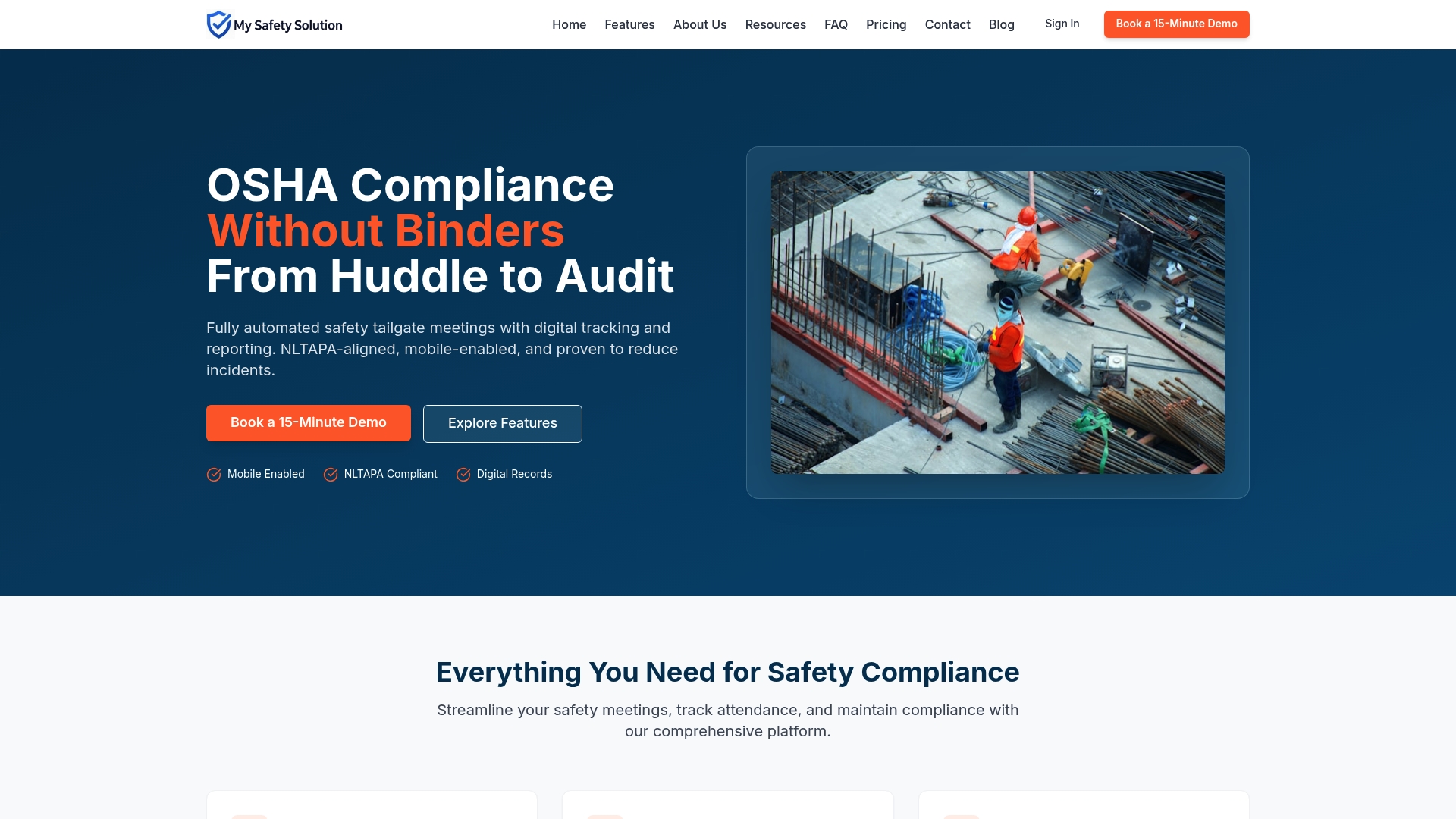
My Safety Solution addresses the operational friction that paper logs and spreadsheets create for busy supervisors:
- Attendance capture with timestamps and signatures, removing the guesswork of paper rosters.
- Audit-ready digital records that hold up when a compliance review happens.
- Ready-to-run talks for 22 industries and 262 trades, ranked by OSHA injury and citation data, that keep the 80:20 rule intact without daily manual prep.
- Searchable training records that show participation across multiple crews or job sites.
When evaluating any software for this purpose, look for mobile ease-of-use for field supervisors, ready-made templates, reporting built around leading indicators, and true audit readiness rather than a simple attendance log. My Safety Solution’s construction safety software is built specifically around those requirements for high-risk, deskless crews. Plans are priced by headcount and include the same features at every size; see the pricing page to start a 15-day free trial.
Sources
- Toolbox talks: How to maximize impact and improve workplace safety (CDC / study collection)
- Effectiveness of Toolbox Talks as a Workplace Safety Intervention in the United States: A Scoping Review
- Bridging the occupational policy to practice gap: user-centered designed toolbox talks for landscaping tree care
- Toolbox Talks: Insights for improvement (peer-reviewed article)
FAQ
What are some good safety toolbox talk topics?
The strongest topics match the day’s actual task rather than a generic annual rotation, covering areas like falls, struck-by hazards, caught-between hazards, ergonomics, PPE, heat stress, and hazardous materials. A scoping review of toolbox talk practices found that culturally appropriate, regularly scheduled topics tied to real site conditions produced the most consistent improvements in safety knowledge.
What are common toolbox talk mistakes?
The most frequent mistakes are choosing irrelevant topics, lecturing instead of discussing, collecting sign-offs before the talk happens, and skipping follow-up on assigned actions. Each of these breaks the participatory delivery pattern that field research links to improved safe behavior on site.
What is a 5-minute safety talk?
A 5-minute safety talk is a short, focused briefing covering one safety message, one visual aid, and one discussion question, designed to fit into a crew’s start-of-shift routine without disrupting production. Brief, one-page formats using line drawings were found in CDC testing to save supervisor prep time while still improving hazard recognition.
Are toolbox talks required by OSHA?
OSHA does not name toolbox talks specifically as a mandatory program, but its recommended practices for safety and health programs call for brief, task-specific safety communication, and many existing standards require task-specific instruction that toolbox talks commonly satisfy. Documenting attendance and content is the practical way to show that instruction happened.