
What are the top EHS management software alternatives for US organizations?
The strongest EHS management software alternatives available to US safety managers in 2026 span a wide range of capabilities, from AI-native enterprise platforms to mobile-first tools built specifically for frontline workers. Choosing the wrong platform means low adoption, fragmented compliance records, and audit exposure. The right one becomes the operational backbone of your entire safety program.
The platforms below represent the leading options recognized across Gartner Peer Insights and G2 for 2026, compared across the dimensions that matter most to safety and compliance managers.
| Platform | Best For | Core Features | Industry Focus | Deployment / Mobile | Rating |
|---|---|---|---|---|---|
| Intelex Technologies Inc. | Integrated EHS and quality compliance | Compliance, incident reporting, workflow configuration | Cross-industry, ISO-aligned | Cloud, mobile | 3.9★ |
| Cority Software Inc. | Unified health, safety, and sustainability | Occupational health, EHS+, sustainability reporting | Healthcare, manufacturing, energy | Cloud | 4.3★ |
| Benchmark Gensuite | AI-powered enterprise risk and compliance | AI workflows, sustainability, operational safety | Enterprise, multi-sector | Cloud, mobile | 4.6★ |
| EcoOnline | Chemical safety and ESG programs | Chemical management, EHS, climate initiatives | High-risk, multi-site | Cloud, mobile | 4.3★ |
| SafetyCulture Americas | Frontline team engagement | Checklists, audits, customizable workflows | Deskless, field operations | Mobile-first | 4.6★ |
| VelocityEHS | Mid-market risk and compliance | AI insights, ergonomics, chemical management | Mid-market to enterprise | Cloud, mobile | 2.3★ |
| EHS Insight | AI compliance and safety automation | LLM integration, compliance, sustainability | Cross-industry | Cloud, mobile | 3.7★ |
| Sphera Solutions | Carbon management and operational risk | Process safety, ESG, supply chain risk | Heavy industry, enterprise | Cloud | 4.7★ |
| ESM Software, LLC | Flexible mid-market EHS management | Modular safety and compliance tools | Mid-market | Cloud | 5★ |
| Enablon North America Corporation | Multinational risk and sustainability governance | Audit trails, compliance reporting, risk | Global enterprise | Cloud | 5★ |
| EHS Momentum | Real-time compliance and risk monitoring | Compliance workflows, operational analytics | Safety-focused teams | Cloud | 5★ |
| EHS Compliance Associates | Consultative EHS technology services | Compliance advisory, digital tools | Cross-industry | Cloud | 5★ |
Why these platforms stand out for safety managers in 2026:
- AI-powered risk prioritization is now standard in leading platforms, not a premium add-on.
- Mobile-first design directly determines whether frontline workers actually use the system.
- Configurable workflows reduce dependency on vendor support for routine process changes.
- Unified platforms that connect incident management, training, and risk data reduce administrative burden.
- Pricing models range from freemium tiers to enterprise contracts, giving organizations at every scale a viable entry point.
How do you choose the right EHS management software?
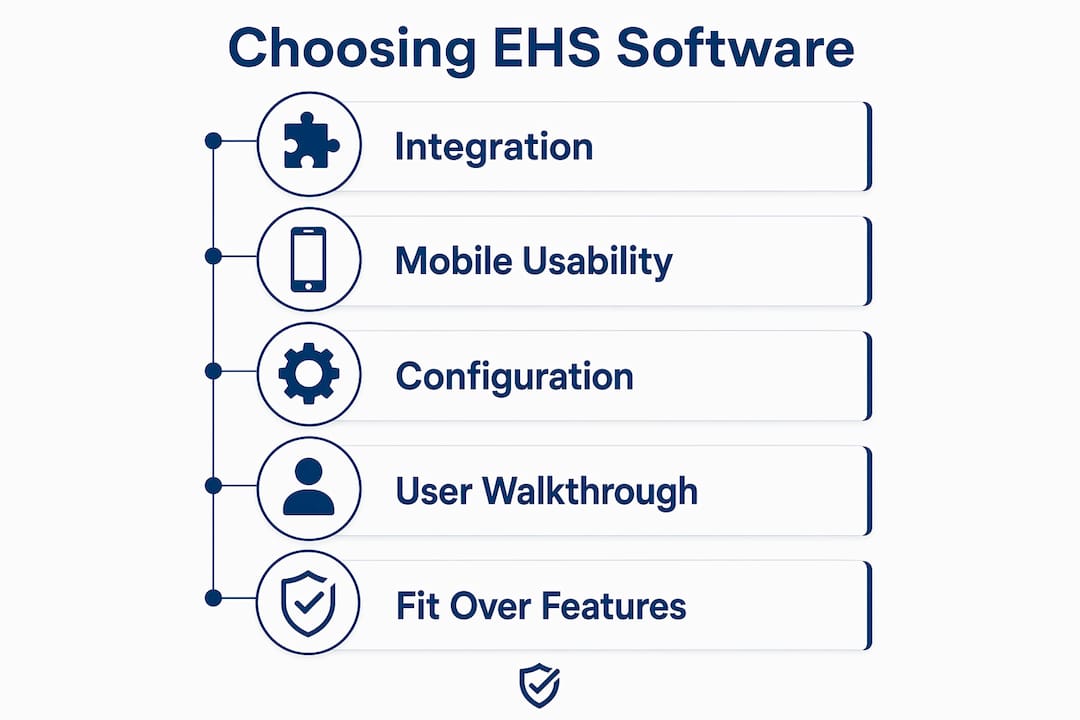
The most common mistake safety managers make is evaluating EHS software by feature count rather than fit. A platform with 40 modules your team will never open is less useful than one with 10 that integrate cleanly with your existing systems and actually get used.
Start with integration. Safety data that lives in silos produces a patchwork of reports that no one trusts. Prioritize platforms that connect incident management, training records, and risk assessments into a single source of truth. This is where legacy desktop-first systems consistently fall short.
Evaluate mobile usability before anything else. If your workforce is deskless, a platform that requires a desktop login is effectively unusable in the field. Test the mobile experience with actual frontline workers during any trial period, not just with office-based administrators.
Favor configuration over customization. Configurable EHS software lets your safety team adjust workflows internally without filing change requests with the vendor. This keeps the system stable and reduces long-term technical debt. Heavy vendor-led customizations tend to create problems at every software update.
Account for total cost of ownership. Enterprise systems like Sphera Solutions and Enablon North America Corporation carry longer implementation timelines and higher upfront costs. Modern alternatives often deploy faster and at lower cost, which matters when your organization needs compliance coverage quickly.
Key evaluation steps:
- Define your top three compliance requirements before any demo.
- Confirm offline mobile functionality for field teams.
- Request a sandbox environment to test configuration without vendor involvement.
- Ask vendors specifically about integration with your existing HRIS or ERP system.
- Get a realistic implementation timeline in writing, not a best-case estimate.
Pro Tip: Request a live walkthrough of the mobile app from a vendor’s frontline user perspective, not the admin console. The gap between those two experiences often reveals whether the platform will actually get adopted.
Detailed profiles of leading EHS software alternatives
Each platform below serves a distinct use case. The right choice depends on your organization’s size, industry risk profile, and how your safety team operates day to day.
Intelex Technologies Inc.
Intelex has been in the market for over 30 years, building a configurable EHSQ platform that covers EHS, quality, risk, and environmental management in one place. Its core strength is workflow flexibility: organizations can shape the system around their own processes rather than adapting to the vendor’s defaults. It suits mid-market to enterprise organizations that need ISO alignment alongside EHS compliance.
Cority Software Inc.
Cority is built around the idea that occupational health and EHS should not be managed as separate programs. It connects them at the architecture level, so data does not need to be exported and rebuilt elsewhere when you need to understand the relationship between exposures and health outcomes. For large enterprises where occupational health integration is a priority, Cority is the strongest purpose-built option.

Benchmark Gensuite
Benchmark Gensuite is an AI-native platform that integrates EHS, risk, sustainability, quality, and operational safety workflows into one unified system. It is recognized for enterprise risk and compliance specialization, and its AI-enhanced workflow orchestration makes it particularly effective for organizations managing compliance across multiple business units simultaneously.
EcoOnline
EcoOnline targets high-risk, multi-site operations that need incident management, audits, chemical safety, and contractor management in a single system. Its user-centric design makes it easier for safety teams to manage chemical compliance and climate initiatives without heavy IT involvement. Organizations running complex chemical inventories will find its depth here genuinely useful.
SafetyCulture Americas
SafetyCulture Americas is not a traditional EHS platform and does not position itself as one. It describes itself as a workplace operations platform that supports EHS management, and that distinction matters in high-risk environments. Where it excels is frontline adoption: its mobile-first interface and customizable checklists drive participation among deskless workers in ways that desktop-heavy systems rarely achieve.
VelocityEHS
VelocityEHS is a 2026 G2 Software Leader recognized for compliance and ergonomics management. Its AI-powered insights help safety teams prioritize risks quickly rather than sorting through undifferentiated incident data. The platform covers chemical management and ergonomics alongside standard EHS functions, which gives mid-market organizations a broad capability set without enterprise-level pricing.
EHS Insight
EHS Insight earned recognition as a Capterra Shortlist and Software Advice Front Runner for 2026. Its most distinctive capability is direct integration with large language models including Claude, ChatGPT, and Copilot, enabling AI-assisted compliance management at a level most competitors have not yet reached. Organizations prioritizing advanced AI integration for safety automation should put it on the shortlist.
Sphera Solutions
Sphera Solutions is built for large enterprises in heavily regulated industries where operational risk, compliance, and ESG reporting need to connect across multiple jurisdictions. Named a carbon management software leader in the Green Quadrant Report, it functions as a full operational risk management platform. It is not a fast-deployment product, and organizations should plan implementation timelines accordingly.
ESM Software, LLC
ESM Software offers modular EHS management tools suited to mid-market companies that need flexibility without the overhead of an enterprise platform. Its capabilities cover operational risk and safety compliance, and its modular structure lets organizations add functionality as their programs mature.
Enablon North America Corporation
Enablon is one of the most established names in enterprise EHS, built around governance, compliance reporting, and cross-site data visibility. It gives large, multi-jurisdictional organizations a single version of truth across risk, environment, health, and safety. Teams that need deep traceability and evidence management for regulatory audits will find its audit trail capabilities particularly strong.
EHS Momentum and EHS Compliance Associates
EHS Momentum focuses on real-time compliance workflows and operational safety analytics, suited to safety teams that need current risk visibility without a full enterprise deployment. EHS Compliance Associates takes a consultative approach, combining compliance advisory expertise with digital tools for organizations that want guided implementation alongside the software itself.
What trends are shaping EHS software adoption in 2026?
Mobile-first, AI-powered platforms are pulling ahead of legacy desktop systems because frontline adoption is the single biggest predictor of EHS software success. Legacy platforms built for desktop use often suffer low engagement among deskless workers, which means incident data goes unreported and compliance gaps go undetected.
Feature bloat in older platforms is driving safety managers toward solutions that prioritize usability and AI-powered features tailored to frontline users, rather than broad module catalogs that require months of configuration. The organizations seeing the best outcomes are those that chose configurable platforms their safety teams can manage internally, without filing change requests for every workflow adjustment.
Best practices for successful EHS software implementation:
- Assign a dedicated internal champion who owns the rollout and drives adoption.
- Run a phased deployment starting with the highest-risk workflows before expanding.
- Prioritize platforms with offline mobile functionality for field teams in low-connectivity environments.
- Measure adoption rates at 30, 60, and 90 days post-launch and address friction points early.
- Treat integration with existing systems as a launch requirement, not a future phase.
Frontline adoption drives EHS software outcomes. Platforms with intuitive mobile interfaces and offline functionality consistently outperform desktop-first systems in incident reporting participation and inspection completion rates.
My Safety Solution covers the compliance gap most EHS platforms leave open
Most EHS platforms handle incident tracking and risk reporting well. What they rarely address is the structured, recurring safety meeting that keeps frontline workers informed and OSHA-compliant between incidents.
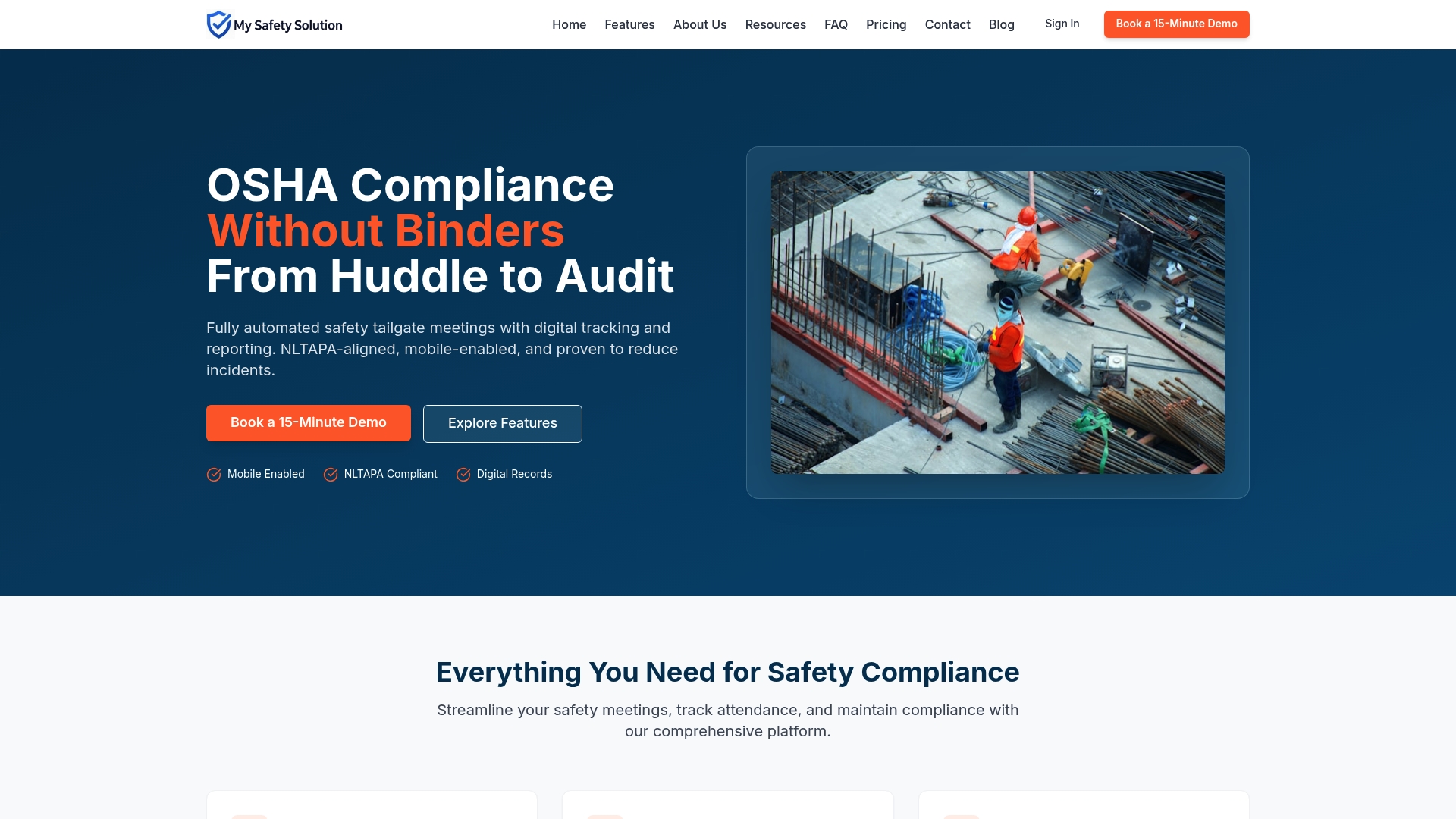
My Safety Solution fills that gap directly. It automates OSHA compliance meeting management for high-risk, deskless workforces in construction, manufacturing, and utilities, with AI-powered safety topic generation, digital attendance recording with signatures and timestamps, and a preloaded NLTAPA-compliant content library. Safety managers can distribute topics to field teams via mobile, track completion in real time, and generate audit-ready compliance reports without manual paperwork. For safety consultants managing multiple client accounts, the multi-company dashboard keeps every organization’s records organized in one place. If your current EHS platform handles risk data but leaves safety meeting compliance to spreadsheets and paper sign-in sheets, My Safety Solution is the purpose-built alternative. Learn more at mysafetysolution.com.
Key Takeaways
The strongest EHS management software alternatives in 2026 win on frontline adoption, AI-powered insights, and configurable workflows, not on feature count alone.
| Point | Details |
|---|---|
| Frontline adoption drives outcomes | Platforms with mobile-first design and offline functionality see higher incident reporting and inspection completion. |
| Configuration beats customization | Software your team can adjust internally reduces technical debt and keeps compliance workflows stable over time. |
| Integration is a launch requirement | Connecting incident management, training, and risk data into one system eliminates the compliance gaps that patchwork tools create. |
| Match platform to risk profile | Enterprise tools like Sphera and Enablon suit governance-heavy organizations; mobile-first tools like SafetyCulture suit deskless teams. |
| My Safety Solution fills the meeting gap | For OSHA-compliant safety meeting automation in construction and manufacturing, My Safety Solution addresses what most EHS platforms leave unmanaged. |