AI shifts safety management from reactive paperwork to proactive risk prevention, and three applications deliver measurable value fastest: predictive analytics that flag failures before they happen, computer-vision hazard detection that catches PPE and proximity violations in real time, and AI-augmented safety meeting workflows that turn documentation into decision support. None of it works unassisted. Every credible deployment keeps a human in the loop, backed by governance that keeps the models honest.
TL;DR:
- AI deployments support PPE compliance and hazard detection through cameras and sensors, but require human oversight to maintain trust and accuracy.
- Predictive analytics use historical incident data to identify high-risk tasks and conditions, but effectiveness depends on data quality and site-specific tuning.
- Small-scale pilots focusing on narrow violation categories and clear KPIs help build reliable models before wider adoption.
- Privacy and model risk management demand careful data collection permissions, grounding models in site procedures, and continuous performance monitoring.
- Combining AI detection with human decision-making and workflow integration enhances safety outcomes without replacing safety managers.
Table of Contents
- What AI in safety management actually means
- Key applications and how they work in practice
- Measured benefits and evidence from deployments
- How to implement AI in your safety program
- Governance, privacy and model risk management
- Industry examples and short case evidence
- How My Safety Solution applies AI to meeting-driven workflows
- What actually works in the field
- Put AI-powered safety meetings to work on your site
- Sources
What AI in safety management actually means
AI in safety management refers to a specific stack of technologies, not a single product: machine learning (ML), deep learning (DL), computer vision, natural language processing (NLP), and Internet of Things (IoT) sensor networks working together to detect, predict, and document risk. A systematic review of construction safety literature covering 122 studies found these tools consistently support PPE recognition, proximity monitoring, and real-time hazard detection, shifting programs from reactive incident logging to proactive prevention.
The components safety teams actually work with include:
- Cameras and drones feeding computer-vision models trained to spot missing hard hats, unsecured harnesses, or workers inside exclusion zones.
- Wearables and environmental sensors tracking fatigue, heart rate, and gas or air-quality levels in confined spaces.
- Large language models and visual language models (VLMs) that read incident reports or reason about photos to flag violations.
- Predictive models trained on historical near-miss and injury data to forecast where the next failure is likely.
- BIM and digital twin integration that maps sensor data onto a 3D site model for spatial context.
Each of these feeds into your existing safety management system (SMS) as structured data, not a replacement for it.
Key applications and how they work in practice
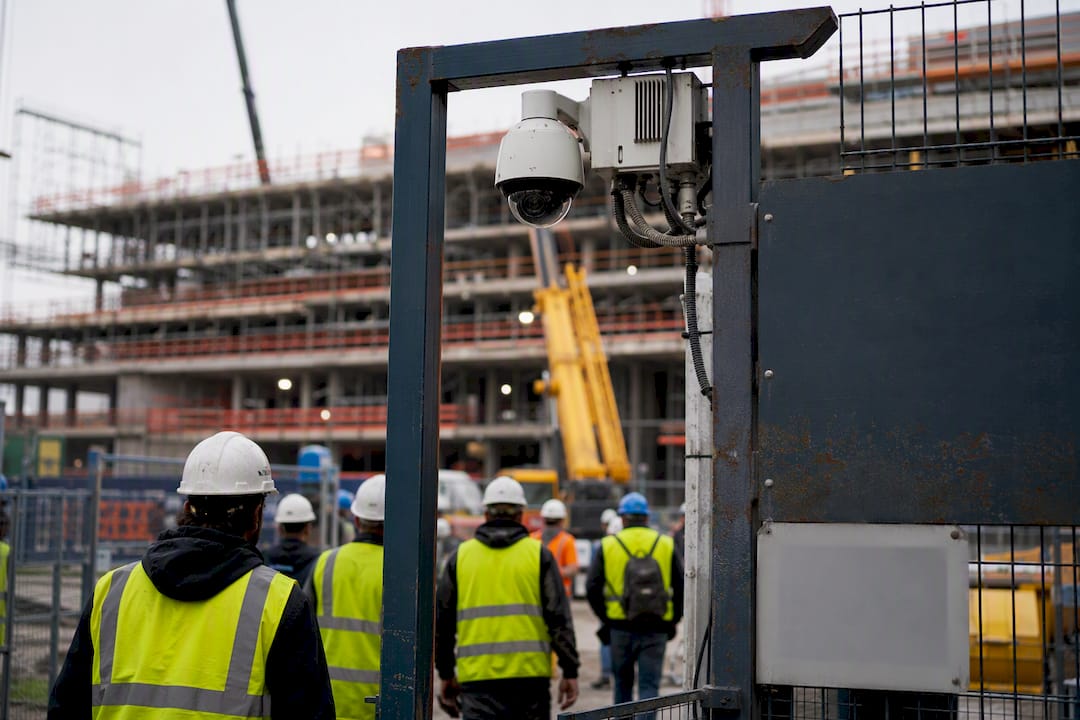
Computer vision handles the most mature use case: automated PPE and compliance monitoring. Cameras positioned at site entrances or gantries detect hard hats, high-visibility vests, and harness attachment points, then flag violations to a supervisor’s phone within seconds. This is the same detection technology behind proximity alerts that stop equipment operators before they swing a load over an occupied zone.
Predictive analytics works differently. Instead of watching the present, it studies your historical incident, near-miss, and equipment-failure data to score which tasks, crews, or conditions carry elevated risk on a given day. A comprehensive review across multiple industries found AI paired with IoT sensors enables this kind of real-time monitoring and early intervention, though the review also flags data-quality and interpretability gaps you need to manage.
Wearables extend that same logic to the individual worker. Reviews of AI-enhanced occupational health monitoring show these devices can detect fatigue and stress indicators alongside environmental hazards like elevated gas concentrations, triggering targeted breaks or evacuation before a medical event occurs.
Three more applications round out a modern deployment:
- Automated inspection workflows that route photo evidence and checklists directly into corrective-action tracking.
- Audio and voice monitoring with NLP that triages incoming incident reports by severity and routes them to the right responder.
- Visual language models that don’t just detect an object but reason about context, distinguishing a worker legitimately on a ladder from one violating fall-protection rules.
That last category is where the technology gets genuinely interesting, and where its limits also show up fastest.
Measured benefits and evidence from deployments
The clearest evidence comes from a deployed system called ConstructAI, which reported a more than 70% increase in violation rectification rates, a sharp reduction in the time it took crews to fix flagged violations, and a 45% drop in repeat violations once workers understood the system was watching consistently.
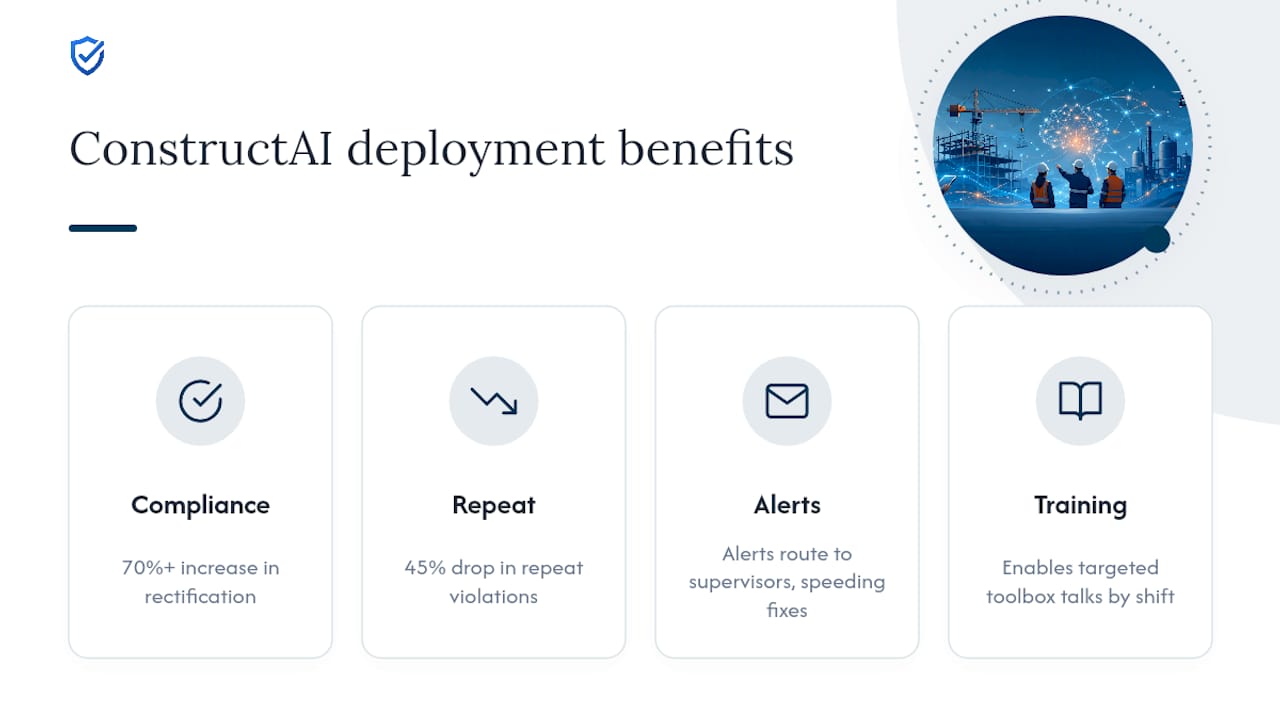
Those numbers translate into operational payoff beyond the safety file. Fewer manual site walks are needed when cameras handle continuous monitoring. Corrective actions move faster because alerts route directly to the responsible supervisor instead of waiting for a weekly report. Training gets sharper too. If predictive analytics shows fall risks spiking during a specific shift, you target that crew’s toolbox talk instead of running a generic monthly session.
Two caveats matter before you extrapolate those figures to your own site. Deployment metrics like ConstructAI’s came from a specific system tuned to a specific site’s camera placement and violation categories. Expect a ramp-up period of weeks to months before your model reaches comparable accuracy, and don’t assume results transfer unchanged across a different trade mix or site layout.
How to implement AI in your safety program
A successful pilot follows a sequence, not a shopping list. Skipping steps is the fastest way to end up with a dashboard nobody trusts.
- Run a readiness check. Inventory what data you already have (incident logs, inspection records, camera feeds), confirm site connectivity can support real-time uploads, and map any privacy constraints around biometric or wearable data before you sign a contract.
- Scope a narrow pilot. Pick one problem, such as PPE compliance at a single gate, rather than trying to monitor everything at once. Build a “golden dataset” of labeled examples so the model has a clean baseline to learn from.
- Build a validation plan. Define your KPIs up front (violation rectification rate, time-to-corrective-action, repeat-violation rate), require human review of every AI flag during the pilot phase, and roll out in phases rather than site-wide on day one.
- Integrate the workflow end to end. An alert that doesn’t route into an action-tracking system and then into your next safety meeting is just noise. Connect detection to documentation to follow-up.
- Invest in people, not just software. Train supervisors on what the system does and doesn’t do, manage the change carefully with crews who may see cameras as surveillance, and keep final judgment calls with a qualified human.
Pro Tip: Start your pilot with the violation category that already has the most historical data behind it, usually PPE noncompliance. A model trained on thin data will produce false positives that erode trust before you get a fair read on the technology.
Resources like My Safety Solution’s field guide to safety management systems are useful here for mapping exactly where AI-generated alerts should plug into your existing corrective-action loop, so you’re not building that connection from scratch.
Governance, privacy and model risk management
Every wearable and camera deployment raises a privacy question before it raises a safety benefit. Collect only the data you need for the stated purpose, get explicit consent for biometric monitoring, and be prepared to explain to your workforce exactly what’s tracked and why.
The bigger technical risk is hallucination. A language model that reasons about safety violations without being grounded in your actual procedures can generate plausible-sounding but wrong guidance. Practitioner reporting recommends grounding models in internal manuals and standard operating procedures rather than relying on generic training data, which keeps recommendations tied to your actual site rules.
Beyond that, treat the model like any other safety-critical system: log every decision, version your models so you can trace when performance shifted, and monitor accuracy continuously rather than trusting a one-time validation. Explainable AI and regular auditing are becoming baseline expectations for teams trying to limit legal exposure while still capturing the proactive benefits.
Industry examples and short case evidence
Construction has produced the most documented case evidence so far. The ConstructAI deployment discussed earlier didn’t just improve rectification rates. It also demonstrated that pairing computer vision with a spatial model of the site, rather than vision alone, produced more reliable reasoning about complex scenarios like scaffolding access or crane swing radius.
Process safety and industrial deployments tell a similar story from a different angle. Reporting on Skanska and Cargill describes AI functioning as a decision-support “safety sidekick” rather than an autonomous enforcer, surfacing institutional knowledge to field supervisors who might not have twenty years of tenure to draw on themselves.
A few patterns hold across both sectors:
- Generative visual language models reach strong accuracy in controlled conditions, with one vendor-cited example near 95%, but edge cases like unusual lighting or partial occlusion still trip them up.
- VLMs perform best paired with specialized image-segmentation or photogrammetry tools rather than working alone on spatial judgment calls.
- The programs described as successful all kept a supervisor as the final decision-maker, not the model.
You can find additional background on how AI augments field teams without replacing safety managers in My Safety Solution’s guide to construction safety meeting software.
How My Safety Solution applies AI to meeting-driven workflows
The pilots described above focus on detection. My Safety Solution focuses on the workflow that follows: automated attendance tracking with digital signatures and timestamps, comprehensive digital records for every tailgate meeting, and AI-powered topic generation tailored to your crew’s actual risk profile. That combination frees safety managers from paperwork so they can spend more time on the proactive risk work AI detection is designed to support.
What actually works in the field
Pick a small pilot before you commit to a platform. The construction sites getting real results started narrow, with one violation type and one clean dataset, then measured rectification rate and time-to-correction before expanding. Data hygiene matters more than model sophistication. Stakeholder buy-in comes from showing supervisors the system flags issues faster than they would catch on a walk-through, not from a vendor demo. Keep a human making the final call every time.
“We designed MySafetySolution so technology works for the field, not the other way around. AI handles the heavy lifting of drafting hazard-specific talks, while supervisors keep the human judgment that actually saves lives.”
— Matthew Hoffman, President - MySafetySolution
Put AI-powered safety meetings to work on your site
You’ve seen what predictive analytics and computer vision can do for hazard detection. My Safety Solution takes that same logic and applies it to the part of your safety program that eats the most administrative time: tailgate meetings and their paper trail. Instead of a supervisor manually logging attendance and hunting for a relevant topic each morning, the platform generates NLTAPA-aligned content tailored to your crew and captures digital signatures automatically.
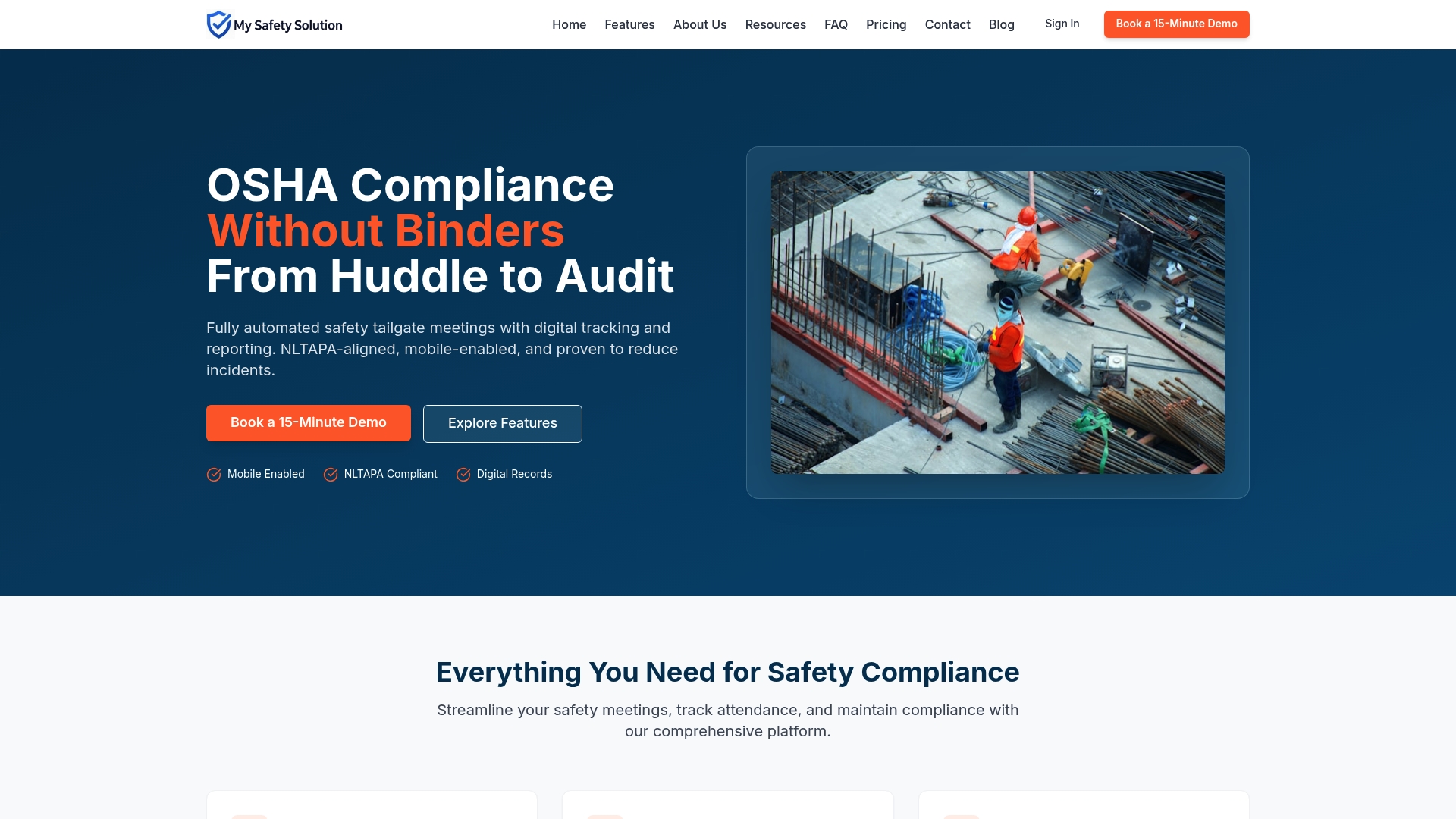
That means less time reconstructing records for an OSHA audit and more time acting on the hazard data your other systems surface. Companies running the platform report improved compliance records and fewer incidents, which is the same outcome every pilot in this article was chasing. If you’re building an AI-driven safety program and meeting documentation is the piece still stuck in a binder, start a trial of My Safety Solution and see how the pilot maps to your crew’s current workflow.
Sources
- Artificial Intelligence (AI) in Construction Safety: A Systematic Literature Review
- Artificial intelligence and occupational health and safety (systematic review)
- ConstructAI: From Real-Time Safety Insight to Skill Growth in Deployed Construction AI Systems
- Transforming Safety Management with AI One Step at a Time | EHS Today
- How generative AI could help make construction sites safer | MIT Technology Review