
Every effective safety meeting agenda needs seven components: logistics, a clear objective, attendance tracking, a review of prior action items, focused discussion topics, new action items with owners and due dates, and a plan for the next session.
Here’s a mini agenda you can paste into a calendar invite today:
- Date/Time/Location: | Virtual link:
- Attendees: [Team/department, mandatory sign-in required]
- Objective: One sentence stating what this meeting must accomplish
- Previous action review: [Status of last meeting’s open items]
- Topic: [Single focused subject, 5–10 minutes]
- New actions: [Task / Owner / Due date] | Next meeting: [Date]
Pro Tip: Match meeting length to format. Daily huddles run just a few minutes, toolbox talks are typically brief, and full committee meetings last up to an hour. If you’re consistently running over, you’re covering too many topics in one sitting.
TL;DR:
- Reviewing prior action items before starting new topics is critical to ensuring issues are resolved and safety improvements are continuous.
- Different meeting formats require tailored agendas, with short huddles focusing on immediate risks and longer meetings addressing policy and incident review.
- Recording complete minutes, including attendance, decisions, and actions, within 48 hours strengthens audit readiness and accountability.
- Assigning action items with clear ownership, due dates, and verification methods is essential to closing safety loops and demonstrating progress.
- Automated tools that capture digital signatures, track tasks, and generate compliance reports significantly improve follow-through and reduce manual errors.
Table of Contents
- Safety Meeting Agenda Components That Actually Matter
- Ready-to-Use Templates for Every Meeting Length
- What Safety Meeting Topics Should You Rotate Each Month?
- Writing Minutes and Records That Hold Up Under Audit
- Choosing Between a Huddle and a Full Meeting
- How to Facilitate a Safety Meeting People Actually Engage With
- The Templates Are the Easy Part
- Turning These Templates Into a Repeatable Habit
- Key Takeaways
- Sources
Safety Meeting Agenda Components That Actually Matter
A standard safety meeting agenda works because each field does a specific job. Skip one and the whole record loses either clarity or defensibility. Here’s what each component needs and why it earns its place.
- Logistics. Date, time, location, virtual link if hybrid, and a named meeting leader. This isn’t paperwork for its own sake. When an OSHA inspector or insurance auditor asks who ran the meeting and where, “we’re not sure” is not an answer you want to give.
- Objective. Write one sentence that states the single outcome you want. “Discuss ladder safety” is a topic, not an objective. “Confirm every crew member can identify the three-point contact rule before Friday’s roof job” is an objective.
- Attendance. Decide upfront whether the session is mandatory or optional, and capture it accordingly. Digital sign-in with timestamps holds up far better under audit than a clipboard that gets left in a truck.
- Review of previous minutes. Read the open action items from last time, not the whole document. This should take two minutes, not ten.
- Incident and near-miss review. State what happened, where, and what corrective action followed. Skip speculation about blame. Stick to facts and fixes.
- Topic discussion. One topic, discussed with enough depth that workers can apply it, beats five topics skimmed at surface level.
- Action items. Require four fields for every action: what needs to happen, who owns it, when it’s due, and how completion will be verified. An action item without an owner is a suggestion, not a commitment.
The review step matters more than most facilitators treat it. If last week’s action item to repair a guardrail is still open, that gets addressed before anyone talks about this week’s topic. Closing loops is what separates a documented safety program from a folder of good intentions.
Ready-to-Use Templates for Every Meeting Length
Different formats call for different structures. Using a 60-minute template for a 10-minute huddle wastes time; using a huddle format for a committee meeting loses the documentation depth regulators expect.
The 10-minute safety huddle runs on a simple board layout. Effective huddle formats track three columns: yesterday’s outcome, today’s predictable risks, and actions with an owner and due date. A quick behavior spotlight and closing commitment round it out. This format fits daily shift starts where speed matters more than paperwork.
The 30-minute toolbox talk opens with a one-sentence claim tied to the day’s work, followed by two discussion prompts that invite real answers rather than nods. Add a short demo or quick inspection walk, then close with exactly one action item. Learn more about how toolbox talks fit into a broader safety cadence.
The 60-minute committee meeting needs a fuller structure:
| Agenda Section | What to Capture |
|---|---|
| Opening & attendance | Sign-in sheet, quorum check, meeting leader |
| Previous minutes review | Status of each open action item |
| Incident reports | Details, root cause notes, corrective steps taken |
| New business | Topics submitted by committee members |
| Action tracker | Task, owner, due date, verification method |
| Circulation plan | Who receives minutes and by when |
For dispersed or multi-site teams, swap the physical board for a shared digital tracker everyone can update in real time, and store completed agendas and minutes in one central folder rather than scattered inboxes.
What Safety Meeting Topics Should You Rotate Each Month?
Strong programs cycle through five categories rather than repeating the same three topics on autopilot. Collections of 35 to 51 workplace safety topics organized by category make it far easier to build a full year’s calendar without scrambling every Monday morning.
Emergency preparedness
- Evacuation routes and muster points: walk the route, don’t just describe it.
- Fire extinguisher use: consult this fire safety planning checklist to confirm who’s trained and when the last hands-on refresher occurred.
Physical hazards
- Ladder and fall protection: what’s the three-point contact rule, and who checks harnesses?
- Slips, trips, and falls: what changed on-site this week that creates new tripping hazards?
PPE and tool safety
- Proper PPE fit: are hard hats, gloves, and eye protection actually being worn correctly?
- Power tool lockout/tagout: has anyone bypassed a guard to save time?
Health and wellbeing
- Heat stress and hydration: what are the early warning signs, and who’s watched most closely?
- Fatigue and shift length: is anyone showing signs of exhaustion that raise incident risk?
Workplace security
- Visitor and contractor check-in: is every non-employee signed in and escorted?
- Reporting suspicious activity: does everyone know who to call?
Seasonal risks
- Cold stress and ice hazards in winter months.
- Heat illness prevention during summer peak hours.
The twelve topics above cover the highest-frequency incident categories across construction, manufacturing, and warehousing. Rotate them monthly, but let recent incidents override the schedule. If a near-miss happened on a ladder Tuesday, ladder safety becomes Wednesday’s topic regardless of what the calendar says. For prompts specific to production environments, this manufacturing safety topic guide breaks down priorities by season and role.
Choose topics based on three filters: who’s in the room, what’s happened recently, and what time of year it is. A crew doing rooftop work in July needs heat stress guidance more urgently than a January refresher on winter driving.

Writing Minutes and Records That Hold Up Under Audit
Safety meeting minutes need a minimal but non-negotiable schema: meeting metadata (date, attendees, leader), a brief summary of what was discussed, any decisions made, and a full action item list with owner and due date attached to each. Attach incident reports or inspection photos as supporting documents rather than describing them in prose.
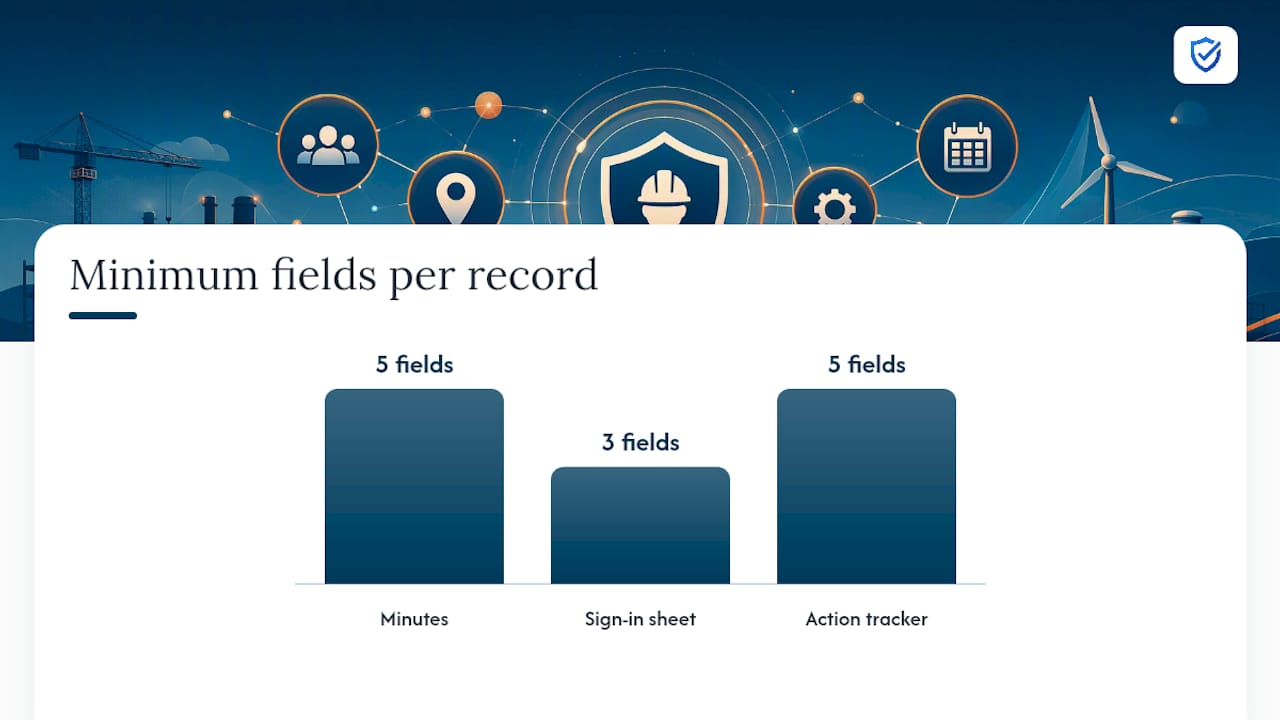
Sign-in sheets should capture name, role or department, and signature or digital timestamp. For hybrid teams, a digital form that logs off-site attendees’ login time works as well as a paper sheet, provided it’s retained the same way.
Your action tracker needs five columns: action, owner, due date, status, and verification method. Review this tracker at the start of every subsequent meeting, not just when someone remembers.
| Record Type | Minimum Fields to Capture |
|---|---|
| Minutes | Date, attendees, summary, decisions, action items |
| Sign-in sheet | Name, role, signature/timestamp |
| Action tracker | Action, owner, due date, status, verification |
Draft minutes should circulate within 48 hours of the meeting, according to HSE meeting record guidance, and every organization should set a clear retention period, commonly several years, with version control so amended minutes don’t overwrite the original. When an auditor asks for six months of records, you want a folder, not a search party.
Choosing Between a Huddle and a Full Meeting
A huddle runs 5 to 15 minutes and covers immediate, shift-level risks. A toolbox talk runs 20 to 30 minutes and goes one level deeper on a single hazard. A committee meeting runs 45 to 60 minutes and handles policy, trend analysis, and incident review requiring group decisions.
- Daily or per-shift: huddle, attended by the crew and supervisor.
- Weekly: toolbox talk, attended by the full crew.
- Monthly: committee meeting, attended by safety leads and management.
Short, frequent huddles with visible tracking boards generate faster corrective action than infrequent long meetings because risks surface daily instead of piling up for a month-end review. Track two metrics per format: huddle completion rate and committee action-closure rate.
How to Facilitate a Safety Meeting People Actually Engage With
Open with a one-line objective stated out loud, not buried in a slide. “Today we’re confirming everyone can identify a lockout point before we touch that machine” sets the room’s focus in one breath.
- Rotate who leads the discussion so it’s not always the same voice.
- Ask a quick poll question instead of a rhetorical one: “Raise a hand if you’ve seen this hazard this month.”
- Spotlight a specific safe behavior you noticed, by name, before diving into problems.
- Close with a repeat-back: have the action owner restate the task and due date aloud.
Record actions live rather than after the meeting ends, using a shared board or a mobile app with a timestamp. Memory fades fast once people are back on task.
Pro Tip: If your meetings routinely run long, the fix usually isn’t a stricter clock. It’s fewer topics per session. One well-discussed hazard beats three rushed ones.
The most common facilitation error is treating the agenda as a script to read rather than a structure to guide conversation. The fix: memorize the objective and let the discussion breathe within it.
The Templates Are the Easy Part
Most safety meeting advice focuses on what to say. It rarely addresses what happens after the meeting ends, which is where compliance programs actually break down. A perfectly run 10-minute huddle means nothing if the action item discussed never gets logged, assigned, or checked at the next session.
The conventional wisdom treats topic selection as the hard problem. It isn’t. Pulling a relevant hazard from a rotating list takes five minutes. The genuine difficulty is consistency: running the same disciplined format every week, capturing attendance every time, and closing the loop on last week’s open items before anyone opens their mouth about a new topic.
If there’s one thing worth prioritizing above template polish, it’s the habit of reviewing prior action items at the start of every meeting, without exception. That single discipline is what separates a program that improves incident rates from one that just generates paperwork. Tools that automate reminders and tracking, My Safety Solution among them, exist precisely because manual follow-through is where good intentions quietly die.
“An organized agenda keeps safety meetings focused and effective under tight time constraints. MySafetySolution automates agenda distribution, hazard talking points, and sign-in capture in one seamless workflow.”
— Matthew Hoffman, President - MySafetySolution
Turning These Templates Into a Repeatable Habit
Running a strong meeting once is easy. Running it the same way, every week, across every crew and job site, without someone forgetting the sign-in sheet or losing last week’s action tracker, is the real challenge safety managers face.
My Safety Solution builds the exact structure covered here directly into a mobile app your crews already have in their pockets. Instead of retyping the huddle board or chasing paper sign-in sheets, field leaders capture attendance with digital signatures and timestamps, log the day’s topic, and record action items on the spot. The three templates from this article, the huddle, the toolbox talk, and the committee meeting, map into distinct session types inside the platform, each generating an OSHA-ready compliance report automatically. AI-powered topic suggestions pull from a preloaded, NLTAPA-aligned content library, so facilitators aren’t scrambling to write a fresh talk every week. Companies running construction safety programs on the platform report tighter compliance records and fewer incidents tied to missed follow-up. If you’re ready to see how automated agendas and action tracking would work for your team, start with My Safety Solution and try it on your next scheduled meeting.
Key Takeaways
An effective safety meeting agenda requires logistics, a clear objective, attendance tracking, review of prior actions, one focused topic, and assigned action items with owners and due dates.
| Point | Details |
|---|---|
| Match format to purpose | Use a 10-minute huddle for daily risks, a 30-minute toolbox talk for weekly hazards, and a 60-minute committee meeting for policy decisions. |
| Close the loop every time | Review last meeting’s open action items before introducing any new topic. |
| Assign four fields per action | Require action, owner, due date, and verification method for every item logged. |
| Circulate minutes within 48 hours | Faster distribution improves accountability and keeps records audit-ready. |
| Automate the repetitive parts | My Safety Solution captures digital attendance, tracks actions, and generates OSHA-ready reports so follow-through doesn’t depend on memory. |
Sources
- 7 Components of an Effective Safety Meeting Agenda
- 35 Workplace Safety Topics For Meetings
- Safety Huddles: Enhancing Workplace Safety Through Communication – OHSE