
What are safety inspection reports and how do you access them?
Safety inspection reports are formal records documenting the results of safety evaluations conducted across industries, facilities, and vehicles. They serve two core functions: establishing regulatory compliance and creating an audit trail that demonstrates ongoing commitment to safe operations. The U.S. Nuclear Regulatory Commission frames this well, noting that inspection reports establish documented proof of “good repair,” not merely a record of violations.
These reports appear across a wide range of sectors, each with its own access protocols:
- Food establishments: State health department portals, often searchable by name or location
- Commercial vehicles: Federal Motor Carrier Safety Administration (FMCSA) online database
- Housing: HUD Housing Choice Voucher Program inspection checklists and public housing authority records
- Nuclear and energy facilities: NRC public document room and state energy agency filings
- Workplaces: OSHA fatality and enforcement data at osha.gov
Access points vary considerably. Some states publish reports online in real time; others require a formal open records request. Knowing which system applies to your industry and jurisdiction is the first step toward using these documents effectively.
How do you find food establishment inspection reports by state?
Food safety inspection reports are maintained at the state level, which means there is no single national portal. Each state’s department of agriculture or public health manages its own database, and public access varies widely, with some states offering full online portals and others limiting availability.
States with active, publicly searchable portals include:
- Pennsylvania: The PA Food Safety portal lets you search by establishment name or location, with a clear disclosure that any inspection is a snapshot in time and may not reflect long-term conditions
- Kansas: The Kansas Department of Agriculture publishes inspection results after August 4, 2015, with older records available via open records request
- California, Texas, and New York: Each maintains state-run portals, though search functionality and report depth differ by county
The Association of Food and Drug Officials (AFDO) maintains a directory of states with online inspection report access, making it a practical starting point when you are unsure where your state’s data lives. For historical reports predating a state’s digital portal, a written public records request to the relevant agency is usually the only path forward.
Pro Tip: When reviewing a food establishment’s report, check the inspection date. A passing score from eight months ago tells you less than you might think, especially for high-volume kitchens.

How do you access driver vehicle inspection reports through the FMCSA?
Driver Vehicle Inspection Reports (DVIRs) document the mechanical and safety condition of commercial motor vehicles, and the FMCSA is the federal authority managing this data. These reports are required by federal regulation for commercial drivers and fleet operators, covering everything from brake systems to lighting and cargo securement.
- Visit the FMCSA website at fmcsa.dot.gov and navigate to the DVIR section under the Safety tab.
- Use the Safety Measurement System (SMS) to look up a carrier’s inspection history, out-of-service rates, and violation patterns by USDOT number.
- Review the carrier’s BASIC scores (Behavior Analysis and Safety Improvement Categories) to understand how a fleet’s inspection record compares to peers.
- Request specific inspection records through FMCSA’s DataQs system if you believe a report contains an error or needs correction.
- Check roadside inspection results for individual drivers, which are logged after Level I through Level VI inspections conducted by certified officers.
For fleet operators, DVIRs are not just a compliance checkbox. A pattern of repeated defect citations in the same vehicle system often signals a maintenance gap that, left unaddressed, affects both safety scores and insurance costs.
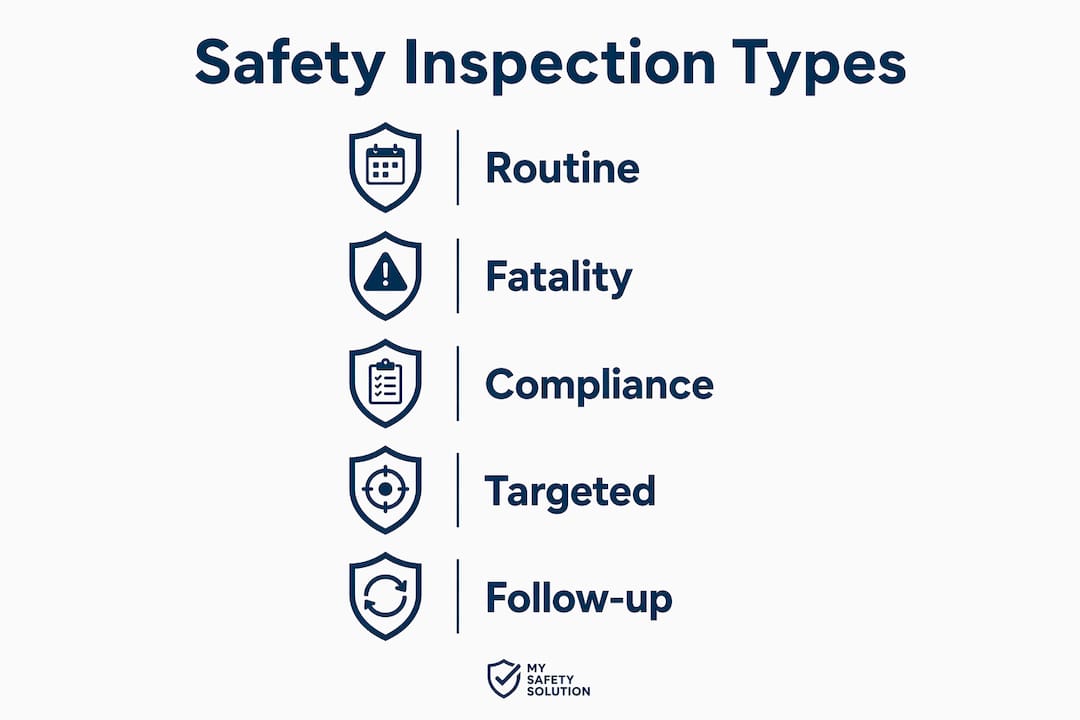
What are the four main types of safety inspections?
Safety inspections are not a single category. The type of inspection conducted determines what the resulting report covers, how it is used, and whether it is publicly accessible.
- Routine inspections: Scheduled, periodic evaluations against a standard checklist. These generate the most common compliance inspection reports and are the basis for most publicly available food, housing, and vehicle safety data.
- Compliance inspections: Triggered by a complaint, incident, or regulatory requirement. OSHA’s fatality inspection data falls into this category, as do post-incident workplace safety evaluations.
- Voluntary audits: Organizations proactively request these to identify gaps before a regulator does. Entities that engage actively with corrective action plans from voluntary audits tend to maintain better regulatory relationships than those who wait for enforcement.
- Fatality and catastrophic event inspections: Conducted after a serious incident. These reports carry the highest evidentiary weight and often drive systemic regulatory changes.
Report availability differs by type. Routine inspection results are most likely to appear on public portals. Fatality investigation reports may be released after an enforcement action concludes, while voluntary audit findings are often internal unless disclosure is required by law.
Maryland State Safety Inspection: a verified vehicle safety example
Maryland’s vehicle safety inspection program is one of the clearest examples of a transaction-triggered inspection requirement in the United States. Fourteen states maintain periodic vehicle safety inspection programs, but Maryland ties its requirement specifically to vehicle sales, titling, and transfers rather than annual renewals.
Key facts about Maryland’s program:
- Legal requirement: A valid Maryland Safety Inspection Certificate is required before a vehicle can be titled, sold, or transferred in the state
- Licensed stations: Inspections are conducted only at Maryland Motor Vehicle Administration licensed inspection stations, not at general repair shops
- Pricing: Fees are set by individual licensed stations; the MVA does not publish a fixed statewide rate
- Certificate validity: A passed inspection certificate is time-limited, so buyers and sellers need to coordinate timing carefully
- Scope: Inspectors evaluate brakes, steering, lighting, tires, and structural components against Maryland’s safety standards
For anyone buying or selling a used vehicle in Maryland, understanding this process protects against purchasing a car that cannot legally be registered. The inspection report itself becomes part of the transaction record.
Public access and limitations of safety inspection reports in the U.S.
Access to safety inspection reports in the United States is fragmented by design. Federal agencies like FMCSA and OSHA maintain centralized databases, but most inspection data lives at the state or local level, governed by each jurisdiction’s public records laws.
Mandatory inspections, such as food establishment and commercial vehicle checks, typically produce reports that are at least partially public. Voluntary safety audits, by contrast, are often internal documents unless a regulator requires disclosure. The California Energy Infrastructure Safety office’s audit of PG&E’s vegetation management program illustrates how even large utility audits become public only through statutory mandate.
Historical reports present a separate challenge. Many states digitized records only after 2010–2015, meaning older data requires a written open records request and sometimes a processing fee. Stakeholders relying on report transparency for due diligence, whether in real estate, fleet acquisition, or supply chain vetting, should build in time for this process.
Key components and terminology in safety inspection reports
Every safety inspection report, regardless of industry, shares a common structural vocabulary. Knowing these terms helps you read a report accurately rather than reacting to surface-level pass/fail language.

Inspection scope: Defines what systems, areas, or processes were evaluated. A report’s findings are only meaningful within its stated scope.
Findings and violations: A finding is an observed condition that deviates from a standard. A violation is a finding that breaches a specific regulatory requirement. Not all findings become violations.
Corrective Action Plan (CAP): A formal response to findings, outlining how and when deficiencies will be resolved. Under standards like those applied in formal safety audits, a CAP is required documentation, not optional. For construction compliance audits, having a CAP ready before an inspector arrives signals operational maturity.
Out-of-service order: Used in vehicle and transportation inspections; removes a vehicle or driver from service until deficiencies are corrected.
Inspection checklist: The structured form inspectors complete during an evaluation. The HUD Housing Choice Voucher Program uses a standardized inspection checklist that covers living rooms, kitchens, bathrooms, building exteriors, heating, and general health and safety items.
How to interpret safety inspection report scores and outcomes
A passing score does not mean a facility or vehicle is problem-free. As Pennsylvania’s food safety portal explicitly states, an inspection is a snapshot of conditions at a single moment. Violations are often corrected on-site before the inspector leaves, which means the final report may reflect a resolved issue rather than an ongoing one.
When reviewing any compliance inspection report, focus on three things: the severity classification of each finding, whether a corrective action was completed on-site or deferred, and the pattern across multiple inspection dates. A single critical violation corrected immediately is very different from the same violation appearing across three consecutive inspections. Digital inspection tools that capture geotagged and timestamped records add another layer of accountability, making it harder to dispute when and where a condition was observed.
Industry-specific nuances: HUD housing, utilities, and beyond
Beyond food and vehicles, safety assessment documentation spans several other critical sectors, each with distinct access rules and report formats.
HUD housing inspections: The HUD Housing Choice Voucher Program uses a standardized checklist estimated to take approximately 0.50 hours per response. Inspections cover structural conditions, lead-based paint, fire exits, heating, and sanitation. Reports are held by the local Public Housing Authority and are not universally public, though tenants and landlords involved in the program receive copies.
Nuclear facilities: The NRC publishes integrated inspection reports for every licensed reactor, covering operational safety, maintenance, and emergency preparedness. These are fully public through the NRC’s ADAMS document system.
Transit and rail: The Washington Metrorail Safety Commission conducts formal safety audits of WMATA’s emergency management and life safety programs, producing detailed findings with required corrective action plans. These reports are publicly released and cover everything from radio communication reliability to fire suppression system maintenance.
Utilities and energy: State energy safety offices audit utility companies against their approved wildfire mitigation and vegetation management plans, with findings and corrective action plans entered into public dockets. For organizations managing safety in utility operations, understanding how these audit cycles work is directly relevant to internal compliance planning.
Compliance documentation that keeps pace with your operations
Tracking safety inspection outcomes across multiple sites, vehicles, or crews is where paper-based systems consistently break down. The patchwork of spreadsheets and manual logs creates gaps in the audit trail precisely when regulators need to see continuity.
My Safety Solution is built for organizations that cannot afford those gaps. The platform automates OSHA-compliant safety meeting management for high-risk, deskless workforces in construction, manufacturing, transportation, and utilities. Digital attendance records with signatures and timestamps, AI-powered safety topic generation, and a preloaded NLTAPA-aligned content library mean your team spends less time on administration and more time on actual risk management. For safety consultants managing multiple clients, the multi-company dashboard consolidates compliance reporting in one place. See how it works and evaluate whether it fits your compliance workflow.
Key Takeaways
Safety inspection reports are formal, time-bound records that require active corrective action and continuous monitoring to deliver real compliance value across any industry.
| Point | Details |
|---|---|
| Reports are snapshots, not guarantees | A passing inspection reflects conditions at one moment; ongoing safety requires continuous monitoring and follow-up. |
| Access varies by state and industry | Some states offer real-time online portals; others require open records requests, especially for historical data. |
| Fourteen states have vehicle inspection programs | Maryland ties its requirement to vehicle sales and transfers, not annual renewals, making timing critical for buyers and sellers. |
| Corrective action plans matter | Entities that respond to audit findings with formal CAPs maintain better regulatory standing than those that do not. |
| My Safety Solution for compliance teams | The platform automates OSHA meeting records, digital signatures, and compliance reporting for multi-site safety operations. |