
Safety administration is the comprehensive management system organizations use to identify hazards, control risks, ensure compliance with occupational safety regulations, and embed safety into daily operations. The industry term is “safety management system,” or SMS, and the two phrases are used interchangeably across OSHA guidance and ISO 45001. For safety professionals in construction, manufacturing, utilities, and transportation, a well-built SMS is the difference between a workplace that reacts to incidents and one that prevents them. Standards like OSHA’s Recommended Practices and ISO 45001 provide the architecture. The safety admin role is what makes that architecture function in the real world.
What are the core elements of effective safety admin systems?
A sound safety management system rests on a defined set of elements, not a collection of loosely connected policies. OSHA’s 2026 Recommended Practices identify seven core SMS elements: management leadership, worker participation, hazard identification and assessment, hazard prevention and control, education and training, program evaluation and improvement, and coordination for multi-employer worksites. Each element connects to the others. Weak leadership commitment, for example, undermines worker participation and makes training feel optional.
ISO 45001 organizes the same territory through a Plan-Do-Check-Act cycle, requiring organizations to set objectives, implement controls, monitor performance, and review results. The structural difference between OSHA’s Recommended Practices and ISO 45001 is certification. ISO 45001 is a certifiable standard audited by third parties. OSHA’s framework is guidance-based, meaning compliance is measured against specific regulations rather than a single standard.
The table below compares the two frameworks at a glance.
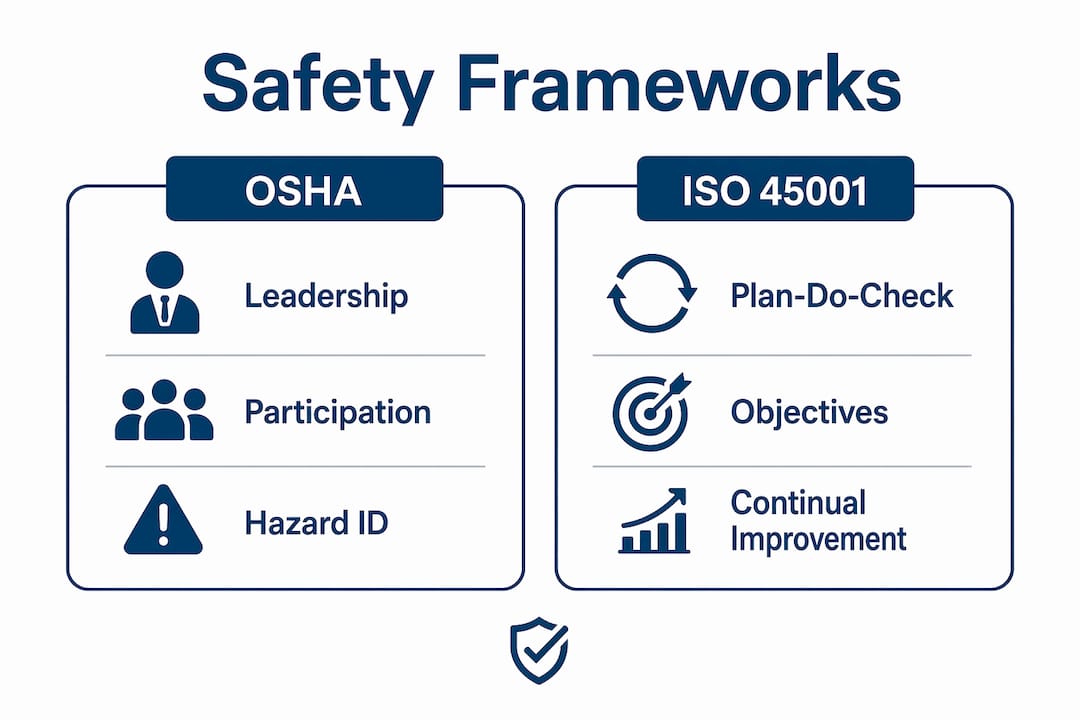
| Element | OSHA Recommended Practices | ISO 45001 |
|---|---|---|
| Leadership | Management leadership | Leadership and worker participation |
| Hazard control | Hazard identification, prevention, and control | Risk and opportunity management |
| Training | Education and training | Competence and awareness |
| Evaluation | Program evaluation and improvement | Performance evaluation and improvement |
| Multi-employer | Coordination on shared worksites | Interested parties and context |
An HSE management system built on these frameworks covers six operational elements: policy, hazard identification, operational controls, incident reporting, audits, and documentation. That structure applies directly to high-risk industries where a single missed control can result in a fatality.
- Policy: Defines the organization’s safety commitments and legal obligations.
- Hazard identification: Requires systematic field-level inspection and worker input.
- Operational controls: Translates hazard findings into specific work procedures.
- Incident reporting: Creates the feedback loop that drives corrective actions.
- Audits: Verify that controls are working as designed, not just documented.
- Documentation: Provides the audit trail regulators and insurers require.
Pro Tip: Build your documentation system around what field supervisors can realistically maintain. A six-page daily inspection form that no one completes accurately is less useful than a one-page checklist that gets done every shift.
How does the hierarchy of controls influence safety administration practices?
The hierarchy of controls is the legal and practical framework safety administrators use to prioritize hazard mitigation. Elimination sits at the top. PPE sits at the bottom. The order matters because higher-level controls must be applied before administrative procedures are considered a sufficient response.
The five levels are:
- Elimination: Remove the hazard entirely. Redesign a process so the dangerous step no longer exists.
- Substitution: Replace a hazardous material or method with a safer one.
- Engineering controls: Isolate workers from the hazard through physical means, such as machine guarding or ventilation systems.
- Administrative controls: Change how work is done through procedures, scheduling, or training.
- PPE: Provide personal protective equipment as a last line of defense.
Administrative controls are the most common tool in a safety administrator’s kit, and also the most misused. A written procedure does not eliminate a hazard. It reduces exposure only if workers follow it consistently, which requires training, supervision, and accountability. Overreliance on administrative controls without applying higher-level controls first leads to regulatory non-compliance and ineffective hazard mitigation in high-risk environments. That is a legal exposure, not just an operational one.
A practical example: a construction site with overhead crane operations cannot rely solely on a “stay clear” zone marked with tape and a verbal warning. Engineering controls, such as physical barriers and load path exclusion zones, must be in place before administrative procedures apply. The administrative layer then reinforces the engineering layer, not replaces it.

Pro Tip: When auditing a site, ask one question for every administrative control you find: “What engineering control was evaluated and rejected before this procedure was written?” If no one can answer, the hazard assessment is incomplete.
What practical steps can safety administrators take to implement a dynamic SMS?
A stepwise SMS rollout follows five phases: gap analysis, policy development, operationalization, measurement, and certification or review. For mid-size firms, this process typically spans 12 months. Rushing the operationalization phase, where policies become field procedures, is the most common reason implementations fail.
- Gap analysis: Benchmark current practices against OSHA requirements and ISO 45001 clauses. Identify which elements are missing, partial, or documented but not practiced.
- Policy development: Write a safety policy that senior leadership signs and communicates to every worker. The policy must state specific commitments, not generic intentions.
- Hazard assessment: Conduct job hazard analyses (JHAs) for every high-risk task. Involve frontline workers. They know where the real hazards are.
- Training programs: Design training around the hazards identified in step three. Generic safety training that does not reference site-specific conditions has limited impact.
- Audits and inspections: Schedule both planned and unannounced audits. Use a safety audit checklist that maps directly to your hazard assessment findings.
- Management review: Hold quarterly reviews where leading and lagging indicators are presented to senior leadership. Decisions about resources and corrective actions must come from this meeting.
Documentation must reflect actual field practices. Excessive paperwork disconnected from daily operations creates “paper compliance” with little real safety impact. A safety administrator who builds a system that frontline supervisors cannot maintain has built a liability, not a safeguard.
Leading and lagging indicators are both necessary for proactive program evaluation. Lagging indicators, such as incident rates and workers’ compensation costs, tell you what went wrong. Leading indicators, such as near-miss reports, completed inspections, and training completion rates, tell you where the system is under stress before an incident occurs.
Pro Tip: Track near-miss reporting rates as a leading indicator of safety culture health. A site where workers report near-misses freely has a culture of trust. A site with zero near-miss reports almost certainly has a culture of silence.
How to integrate safety administration with workplace culture and regulatory compliance
Safety culture and regulatory compliance are not the same thing, but they reinforce each other when leadership treats safety as a core business value. Integrating safety into organizational decision-making improves both compliance outcomes and workplace culture. The mechanism is straightforward: when safety decisions are made at the same level as production and budget decisions, resources follow.
Worker involvement is the most underused element in most safety programs. OSHA’s Recommended Practices treat worker participation as a structural element, not an optional add-on. Workers who participate in hazard identification and incident investigations are more likely to follow the controls that result from those processes.
Key practices for embedding safety into culture include:
- Visible leadership: Senior managers conduct site walks and participate in safety meetings. Their presence signals that safety is not delegated away.
- Recognition programs: Acknowledge workers and supervisors who identify hazards or report near-misses. Recognition reinforces the behavior you want to see.
- Two-way communication: Safety meetings must allow workers to raise concerns, not just receive information. A workplace health and safety framework that flows only downward misses the most valuable hazard intelligence on the site.
- Regulatory compliance as a floor, not a ceiling: OSHA standards define the minimum. Organizations that treat compliance as the goal rather than the baseline consistently underperform on safety outcomes.
Multi-employer worksites require explicit coordination between all duty holders. Consultation, cooperation, and coordination among contractors and subcontractors are legal requirements, not courtesy. Gaps in hazard control at the interface between employers are a leading cause of serious incidents on construction sites.
What challenges and common pitfalls do safety administrators face?
The most damaging pitfall in safety administration is confusing documentation with safety. A binder full of signed training records does not mean workers know how to do their jobs safely. It means they attended a session. Paper compliance creates a false sense of security and leaves organizations exposed during OSHA inspections when field conditions contradict written procedures.
Common pitfalls and how to address them:
- Overreliance on administrative controls: Audit every procedure to confirm that elimination, substitution, and engineering options were evaluated first.
- Neglecting multi-employer coordination: Assign a designated safety coordinator for every shared worksite. Document coordination meetings and corrective actions.
- Ignoring leading indicators: If your program only tracks incident rates, you are managing by looking in the rearview mirror. Add near-miss reporting and inspection completion rates to your monthly dashboard.
- Treating training as a one-time event: Safety training programs require refreshers tied to incident findings, regulatory updates, and seasonal hazard changes.
- Failing to close the loop on corrective actions: An audit that generates findings with no assigned owner and no deadline is worse than no audit. It documents awareness of a problem without fixing it.
Pro Tip: Incident reporting is only as good as the corrective action process that follows it. Build a 30-day close-out requirement into every incident report, and track open items in every management review.
Key Takeaways
Effective safety administration requires a structured SMS anchored in OSHA’s seven core elements and ISO 45001, with documentation that reflects field reality and controls that prioritize elimination over administrative procedures.
| Point | Details |
|---|---|
| Use a recognized framework | Align your SMS with OSHA’s Recommended Practices or ISO 45001 to cover all required elements. |
| Prioritize higher-level controls | Apply elimination, substitution, and engineering controls before writing administrative procedures. |
| Match documentation to field practice | Build systems frontline supervisors can maintain daily, not just during audits. |
| Track leading indicators | Monitor near-miss reports and inspection rates to catch system failures before incidents occur. |
| Embed worker participation | Involve workers in hazard identification and investigations to improve both compliance and culture. |
The shift I keep seeing safety programs get wrong
Safety administration has changed significantly over the past decade. The programs that struggle most are the ones still treating their SMS as a static document. They update the binder once a year, run the annual training, and call it done. The programs that perform well treat their SMS as a living operational cycle, one that gets tested against field conditions every week.
The most common mistake I see is building a system for the auditor, not for the worker. When a safety administrator designs forms, procedures, and checklists around what looks good during an OSHA inspection rather than what actually helps a supervisor manage a crew, the system fails the moment the auditor leaves. Field supervisors quietly abandon the paperwork. Hazards go unrecorded. The audit trail looks clean while the worksite gets more dangerous.
The fix is not more technology or more documentation. It is starting with the field problem and working backward to the paperwork. What does a foreman actually need to identify a hazard and communicate it up the chain before someone gets hurt? Build that process first. Then build the documentation around it.
Technology does accelerate this when it is applied correctly. Mobile-enabled platforms that let workers complete inspections and report near-misses from the field, rather than transcribing paper forms at the end of a shift, close the gap between what happens and what gets recorded. That gap is where most compliance failures live.
Safety culture is not a program. It is the product of consistent leadership behavior, genuine worker involvement, and a system that makes doing the right thing easier than ignoring it. Organizations that treat safety as a business pillar rather than a compliance obligation consistently outperform on both incident rates and regulatory standing.
“Administrative drag pulls compliance officers away from where they make the greatest difference: on site with the workers. MySafetySolution automates tracking, notifications, and reporting so you can focus on true hazard prevention.”
— Matthew Hoffman, President - MySafetySolution
How My Safety Solution supports safety administration in the field
Safety administration in high-risk industries generates a constant volume of documentation, training records, and compliance tracking. Managing that volume manually creates friction that pulls safety managers away from the field work that actually prevents incidents.
My Safety Solution is built specifically for deskless workforces in construction, manufacturing, utilities, and transportation. The platform automates safety meeting management, tracks attendance, and generates digital records that satisfy OSHA audit requirements without the paperwork burden. Its AI-powered content generation produces tailored safety topics for each meeting, keeping training relevant to the specific hazards your crews face. Companies using My Safety Solution report reduced incident rates and stronger compliance records. If your current system relies on spreadsheets and paper sign-in sheets, see how the platform works and evaluate whether it fits your operation. For construction-specific needs, safety meeting software for construction is available as a targeted solution.
FAQ
What does a safety admin do?
A safety administrator manages the policies, training programs, audits, and documentation that keep a workplace compliant with OSHA regulations and ISO 45001 standards. The role includes hazard identification, corrective action tracking, and coordinating safety communication across all levels of the organization.
What is the difference between a safety admin and a safety compliance officer?
A safety administrator manages the full SMS, including policy development, training, and audits. A safety compliance officer focuses primarily on regulatory adherence, monitoring whether the organization meets OSHA and other legal requirements.
What are the 7 elements of OSHA’s safety management system?
OSHA’s Recommended Practices identify seven elements: management leadership, worker participation, hazard identification and assessment, hazard prevention and control, education and training, program evaluation and improvement, and multi-employer coordination.
Why do administrative controls rank low in the hierarchy of controls?
Administrative controls depend on consistent human behavior to work. They do not physically remove or isolate a hazard, so their effectiveness drops when workers are fatigued, undertrained, or under production pressure. Higher-level controls like engineering solutions work regardless of human behavior.
How do leading indicators improve safety administration?
Leading indicators such as near-miss reporting rates and completed inspection counts signal system weaknesses before an incident occurs. Tracking them alongside lagging indicators like injury rates gives safety administrators a complete picture of program health and allows for proactive corrective actions.