
The most effective way to reduce incidents in construction is to move from reactive responses to proactive hazard control, guided by OSHA’s recommended practices and NIOSH standards. Sites that wait for injuries before acting pay a steep price in workers’ compensation costs, legal exposure, and lost productivity. The foundation of any serious safety program rests on these core strategies:
- Proactive hazard identification before work begins, not after something goes wrong
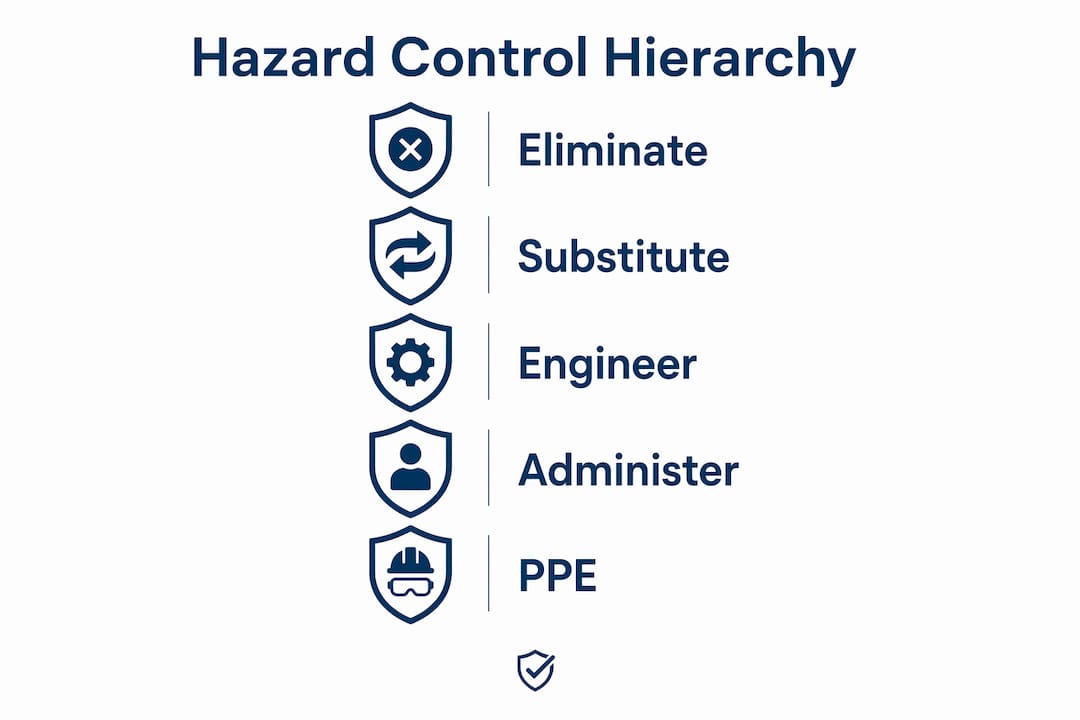
- Hierarchy of controls applied in order: elimination, substitution, engineering controls, administrative controls, then PPE
- Regular safety audits and inspections to catch new or recurring hazards before they cause harm
- Worker training and competency programs that build genuine understanding, not just checkbox compliance
- Safety stand-down events to reset awareness and reinforce critical hazard topics
- Digital record-keeping for incidents, near misses, and corrective actions to support root cause analysis
- Incident investigation and learning loops that ask “why” until the root cause is found, not just the trigger
OSHA frames this as a continuous cycle: identify, assess, control, and review. Safety programs built this way reduce workers’ compensation premiums, lower litigation risk, and improve overall business performance, making them sound business investments, not just regulatory obligations.
Table of Contents
- Safety stand-downs: how they raise awareness and prevent falls
- What the incident data tells you about construction hazards
- Strategic interventions and hazard-specific controls that actually work
- How proactive safety management systems reduce workplace hazards
- My Safety Solution puts safety management where it belongs
- Key Takeaways
Safety stand-downs: how they raise awareness and prevent falls
Safety stand-downs are voluntary, site-wide pauses where all work stops so supervisors and workers can focus entirely on a specific hazard topic. OSHA’s National Safety Stand-Down to Prevent Falls in Construction is a widely recognized program of this kind in the US, conducted annually. Falls from elevation remain the leading cause of construction worker fatalities, which is exactly why stand-downs center on fall hazards first.
An effective stand-down is more than a brief toolbox talk. It creates space for workers to ask questions, share close calls, and review actual site conditions without the pressure of production schedules. The best-run events include:
- A site walk to identify active fall hazards such as unprotected edges, open floor holes, and unsecured ladders
- Demonstration of proper fall protection equipment, including harness inspection and anchor point selection
- Review of emergency response procedures if a fall does occur
- Open discussion of near misses that workers may not have formally reported
- Commitment from site leadership to address any hazard identified during the event
The supervisory presence during a stand-down sends a clear signal: safety is not a background concern. When foremen and project managers participate alongside workers, engagement rises and the conversation shifts from compliance to genuine hazard awareness. That cultural shift is what makes stand-downs a durable tool for reducing workplace injuries, not just a one-day event.
What the incident data tells you about construction hazards
Construction’s four leading hazard categories, known as the “Fatal Four” by OSHA, account for the majority of fatalities on US job sites: falls, struck-by incidents, caught-in/between events, and electrocutions. NIOSH data confirms that struck-by incidents are the second leading cause of construction fatalities and the leading cause of nonfatal injuries, making them a priority target alongside fall prevention.
| Hazard Category | Primary Risk Factor | Highest-Risk Work Phase |
|---|---|---|
| Falls | Unprotected edges, ladders, roofs | Framing, roofing, steel erection |
| Struck-by | Dropped objects, moving equipment | Excavation, crane operations |
| Caught-in/between | Unguarded machinery, trenching | Excavation, equipment operation |
| Electrocution | Overhead lines, unprotected wiring | Rough-in electrical, site prep |
Tracking incident trends by hazard type lets you allocate safety resources where exposure is highest. A site with heavy crane activity faces a different risk profile than a residential framing crew. Grouping similar incidents and identifying patterns, as OSHA’s hazard identification guidance recommends, reveals which hazards are recurring and which corrective actions are not holding. That analysis is what separates a safety program that learns from one that simply documents.
Vulnerable worker groups deserve specific attention. New hires, workers assigned to nonroutine tasks, and subcontractor crews unfamiliar with site-specific conditions face elevated risk. Targeting training and supervision toward these groups during high-risk phases produces measurable reductions in exposure.
Strategic interventions and hazard-specific controls that actually work
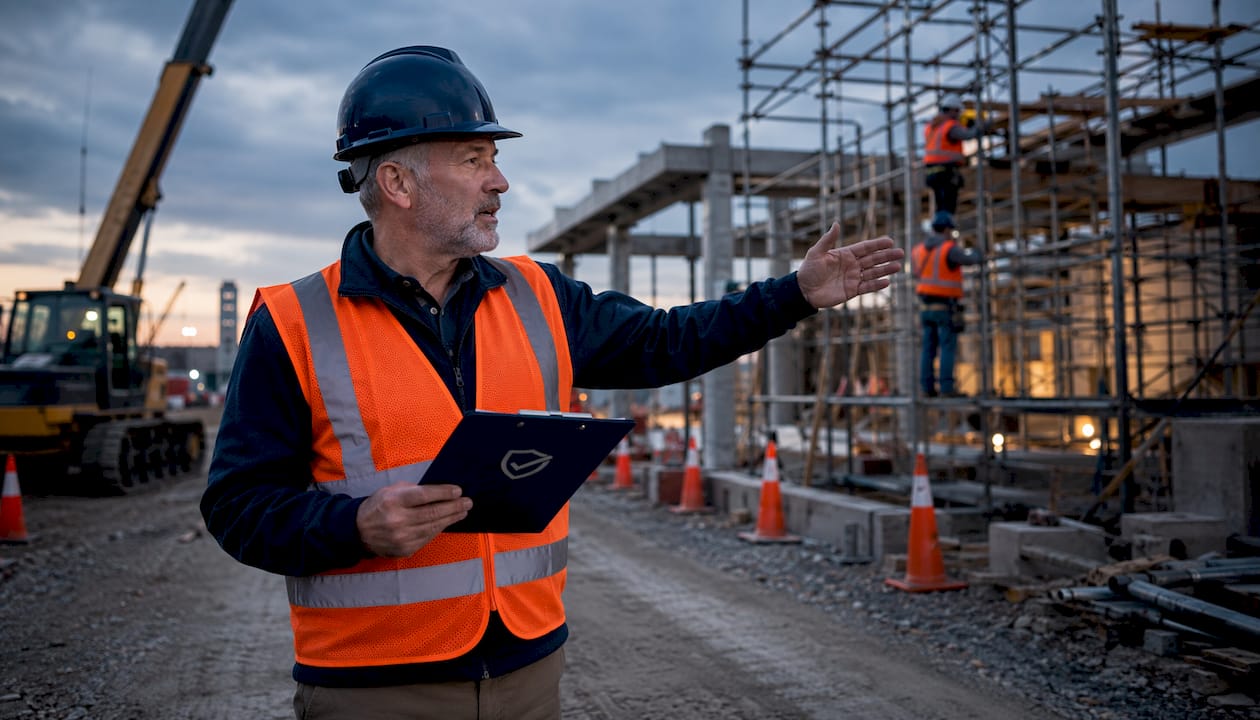
Reducing workplace hazards requires more than a written safety plan. It requires deliberate, layered controls applied in the right sequence, with workers involved at every step.
Training and competency development must go beyond annual certifications. Workers need task-specific instruction before they encounter a new hazard, not after. Job hazard analyses reviewed with crews before nonroutine work begins, as OSHA recommends, catch gaps that generic training misses.
PPE selection and inspection are only as effective as the enforcement behind them. Hard hats, high-visibility vests, fall harnesses, and cut-resistant gloves must be matched to the specific hazard, inspected before each use, and replaced when damaged. A harness with a frayed lanyard provides no protection.
Site supervision is the most direct lever a safety manager controls. Supervisors who conduct daily site walks, correct unsafe conditions on the spot, and recognize safe behavior build a culture where workers self-police. That culture is harder to build than any engineering control, and far more durable.
Hazard control planning follows OSHA’s hierarchy: eliminate the hazard first, then substitute, then engineer, then administer, then protect with PPE. Using a combination of controls when no single method fully protects workers is standard practice, not a fallback.
Prevention through Design (PtD), endorsed by NIOSH, takes this further by eliminating hazards at the planning stage. When architects and engineers specify guardrail anchor points, pre-cut materials, and tool tethering systems in bids and contracts, workers never face those hazards during construction execution.
Pro Tip: Schedule equipment maintenance reviews alongside your safety audits. Proactive maintenance reduces equipment failure risk and directly lowers the rate of struck-by and caught-in incidents, two of the most serious hazard categories on any site.
Incident reporting and investigation close the loop. Every near miss is a free lesson. Investigating close calls with the same rigor applied to recordable injuries, asking “why” at each step until the root cause surfaces, prevents the next event. Communicate findings to the full crew, not just management.
How proactive safety management systems reduce workplace hazards
The shift from lagging indicators, such as recordable injury rates, to predictive safety analytics is where serious safety programs are heading. Lagging indicators tell you what already went wrong. Predictive frameworks tell you where risk is concentrating before an incident occurs.

The Predictive Safety Analytics Framework (PSAF) tracks serious injury and fatality potential observations alongside weighted audit scores, producing weekly composite risk signals. When those scores rise on a specific crew or work area, supervisors can intervene before a recordable event happens. That is a fundamentally different posture than reviewing injury logs after the fact.
Evaluating safety risk by labor-hour intensity rather than raw incident counts gives a more accurate picture across projects of different sizes. A site with twice the labor hours and the same incident count is actually safer, not equivalent. Normalizing for exposure lets safety managers and executives compare risk honestly and allocate resources to where the true concentration lies.
Digital tools support this shift in several concrete ways:
- Digital incident and near-miss logs create a searchable record that reveals patterns raw paper forms cannot
- Automated compliance tracking confirms that safety meetings, inspections, and corrective actions are completed on schedule
- Attendance records with timestamps and signatures provide an audit trail that protects both workers and the company
- Construction project automation tools help integrate safety monitoring data with broader project workflows, reducing the gap between field observations and management decisions
Construction safety management systems that centralize these functions give safety managers a single source of truth instead of a patchwork of spreadsheets, paper sign-in sheets, and disconnected apps. The administrative burden drops, and the quality of safety data rises.
My Safety Solution puts safety management where it belongs
Consistent safety meetings are one of the most direct tools you have to reduce workplace accidents, but managing them manually creates friction that erodes compliance over time. My Safety Solution was built specifically for high-risk, deskless workforces in construction, where paper-based systems and disconnected records leave gaps in your audit trail.
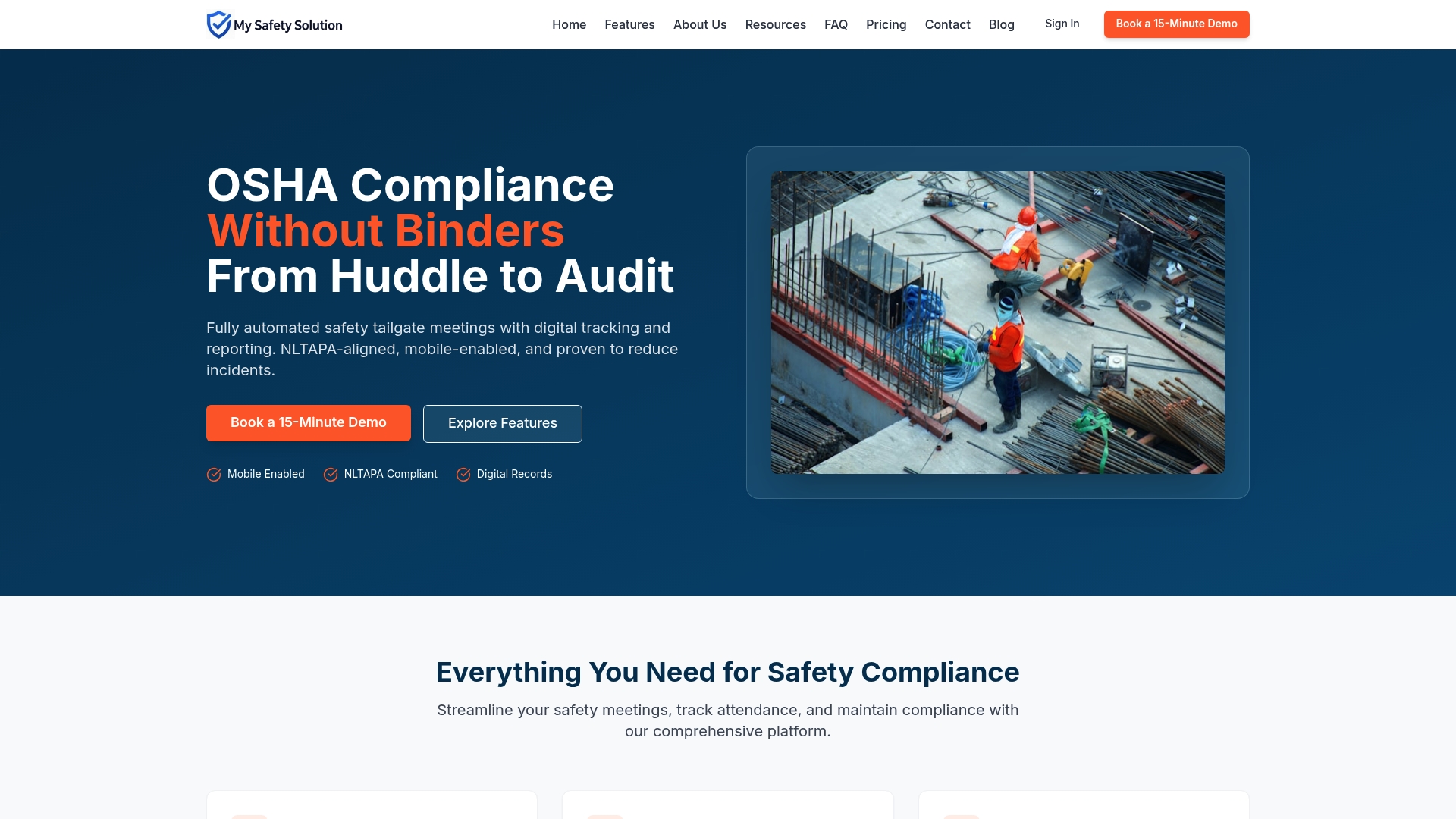
The platform automates the full safety meeting cycle: AI-powered topic generation tailored to your site’s hazards, digital attendance with signatures and timestamps, OSHA compliance tracking, and instant reporting. Safety managers spend less time on administration and more time on the site conditions that actually drive incidents. The NLTAPA-aligned content library means your meetings cover the topics that matter, and every session is documented in a format that holds up under inspection.
If you are ready to move from reactive documentation to a proactive safety meeting system that keeps your crew protected and your compliance records complete, My Safety Solution is the place to start.
Key Takeaways
Reducing construction incidents requires a coordinated system of proactive hazard control, targeted training, predictive analytics, and consistent digital documentation, not any single intervention alone.
| Point | Details |
|---|---|
| Proactive beats reactive | OSHA’s recommended practices center on finding and fixing hazards before injuries occur, not after. |
| Fatal Four drive priorities | Falls, struck-by, caught-in/between, and electrocution account for the majority of US construction fatalities. |
| Hierarchy of controls | Applies elimination first, then substitution, engineering, administrative controls, and PPE last. |
| Predictive analytics shift | The PSAF framework uses weighted audit scores to signal rising risk before a recordable incident happens. |
| My Safety Solution | Automates safety meeting management, digital attendance, and OSHA compliance tracking for construction sites. |