
What safety compliance software reviews should actually cover
The best safety compliance software reviews cut straight to what matters for OSHA compliance: does the platform produce accurate, retrievable records, manage training documentation to regulatory standards, and support deskless workers in the field without friction? Those three capabilities separate genuinely useful platforms from tools that look good in a demo but create audit exposure in practice.
When evaluating any compliance management platform, reviews should assess:
- Recordkeeping accuracy: Does the system capture work-related injuries, illnesses, and safety meeting attendance with timestamps and signatures that satisfy OSHA’s recordkeeping standards?
- Training documentation: Can it generate sign-in sheets with the exact fields the OSHA Outreach Training Program requires, including student names, signatures, course details, and trainer attestation?
- Audit readiness: Are records retrievable on demand, organized by date and crew, and exportable in formats an inspector can review without delay?
- Mobile accessibility: Does the platform work for workers who never sit at a desk, covering construction sites, manufacturing floors, and distribution yards?
- Content relevance: Does the system deliver safety topics tailored to specific industry hazards rather than generic material that workers tune out?
Compliance software ratings on platforms like Gartner Peer Insights are most useful when you look past the star average and examine reviewer feedback on audit readiness, workflow breadth, and administrative burden. A four-star rating means little if reviewers consistently flag gaps in documentation completeness.
Table of Contents
- What OSHA actually requires from your recordkeeping and training documentation
- Key features that separate effective compliance software from the rest
- How automation closes the compliance gap for deskless workforces
- My Safety Solution delivers compliance-ready automation for high-risk industries
- Key Takeaways
What OSHA actually requires from your recordkeeping and training documentation
OSHA’s recordkeeping obligations are not optional background noise. Under the OSH Act, employers must maintain accurate, accessible records of all work-related injuries and illnesses beyond minor first aid cases, and those records must be available for enforcement and data development purposes. Software that cannot produce those records on demand creates direct legal exposure.
Training documentation carries its own specific requirements. The OSHA Outreach Training Program mandates that trainers retain class records for five years from the class end date. Each class record must include:
- Course name and date/time
- Student names and signatures
- Trainer’s signature and attestation
- Any guest trainer qualifications
That schema is the industry benchmark for audit-grade training documentation. Software that generates digital sign-in sheets replicating those exact fields gives safety managers a defensible record. Software that stores a PDF or a spreadsheet patchwork does not.
One distinction that many safety compliance solution reviews overlook: OSHA training requirements vary significantly by standard and industry hazard. OSHA Publication 2254 covers multiple industry-specific standards, including 29 CFR 1910.332 for electrical safety and 29 CFR 1926.21 for construction safety training. A platform that treats all training as a generic checkbox fails the moment an inspector asks whether your crew received training specific to the hazards they face.
Pro Tip: When reviewing any safety management platform, request a sample audit export before you commit. If the vendor cannot show you a complete, field-accurate sign-in sheet within minutes, that is your answer about audit readiness.
Key features that separate effective compliance software from the rest
Safety managers evaluating top compliance software for high-risk, deskless workforces should organize their assessment around five feature categories. Not every platform addresses all five with equal depth.
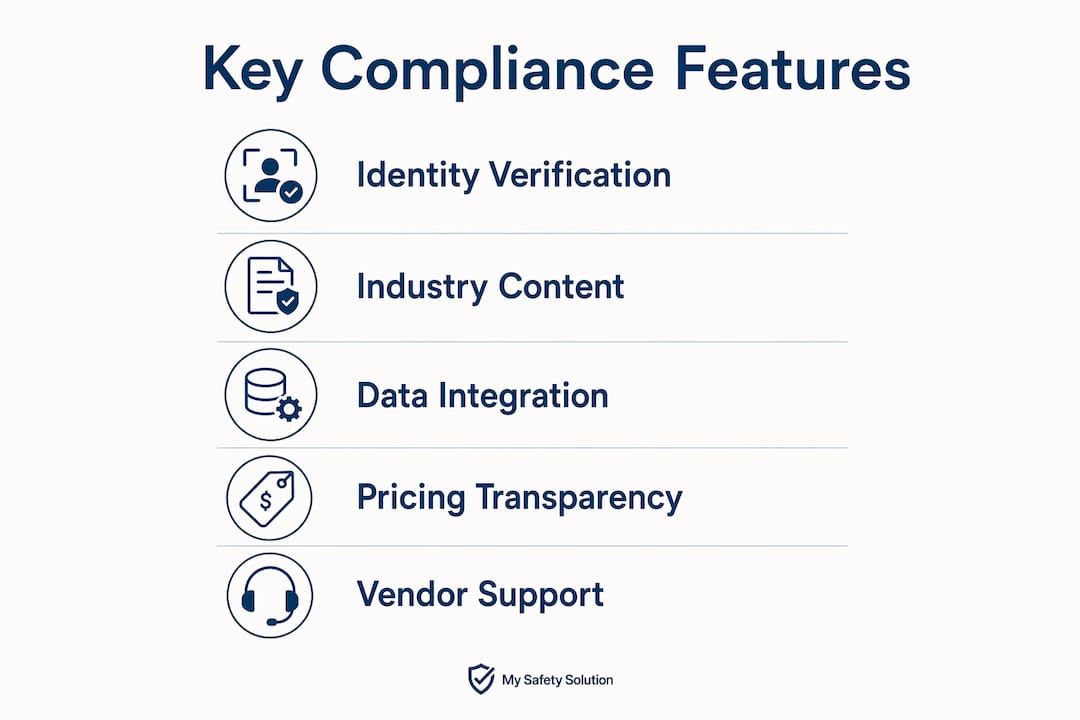
Digital attendance capture and documentation
The core function is capturing attendance with identity verification, timestamps, and signatures at the point of the meeting, not reconstructed afterward. NLTAPA’s tailgate talk resources establish the operational blueprint: standardized sign-in sheets paired with topic delivery, not just PDF storage. Software that integrates both into a single mobile workflow eliminates the gap where documentation errors occur.

Customizable and industry-specific content libraries
Generic safety topics generate compliance theater, not genuine hazard communication. Platforms worth considering offer preloaded content libraries aligned with OSHA standards and specific industry hazards, plus the ability to customize topics for your crew’s actual work conditions. For construction and manufacturing environments, this means content that maps to the specific CFR standards governing those workplaces.
Integration, data security, and system compatibility
A safety platform that cannot connect with your existing HR or workforce management systems creates duplicate data entry and increases error risk. Equally, data security is non-negotiable: records containing employee signatures and personal identifiers require encryption, role-based access controls, and audit logs. Verify that any platform you evaluate meets current data privacy standards before signing a contract.
Pricing model transparency
Review sites can anchor your expectations, but treat published pricing as a starting point, not a final figure. Minimum seat requirements, compliance feature add-ons, and contract length terms often change the total cost significantly. Build a procurement checklist that confirms which compliance features are included in the base plan versus billed separately.
Vendor support quality
For deskless industries, implementation support and ongoing responsiveness matter more than they do in office environments. Workers in the field cannot troubleshoot software issues during a tailgate meeting. Evaluate vendor support through user reviews of safety tools that specifically address response time and problem resolution, not just onboarding experience.
How automation closes the compliance gap for deskless workforces
Manual safety meeting management creates a predictable failure pattern: sign-in sheets get lost, training records are incomplete, and documentation gaps surface only when an inspector arrives. Automated systems address each of those failure points directly.
Automated recordkeeping produces records that are accurate, timestamped, and retrievable without manual reconstruction. When OSHA requests documentation, the response time drops from days to minutes. That speed is not just convenient; it is the difference between demonstrating compliance and scrambling to explain gaps.
Tailored safety content improves the quality of hazard communication, not just the volume of meetings conducted. When workers receive topics relevant to the specific risks in their environment, engagement increases and the meeting serves its actual purpose. Tailgate talk workflows that integrate content delivery with attendance capture reflect how field teams actually operate, rather than imposing an office-based process on a job site.
The administrative burden reduction is significant for safety managers overseeing multiple crews or locations. Automated reminders, scheduled training distribution, and centralized reporting replace a patchwork of spreadsheets and manual follow-up. That shift allows safety managers to focus on proactive risk management rather than paperwork recovery.
OSHA estimates that employers pay nearly $1 billion per week in direct workers’ compensation costs. Platforms that reduce incident rates through consistent, documented safety communication directly affect that exposure. Mobile accessibility is the mechanism that makes consistency possible for deskless workers: if the tool requires a desktop, field crews will not use it.
My Safety Solution delivers compliance-ready automation for high-risk industries
Safety managers who have worked through the evaluation criteria above will recognize that most general-purpose EHS platforms were not built with the tailgate talk workflow in mind. My Safety Solution was.
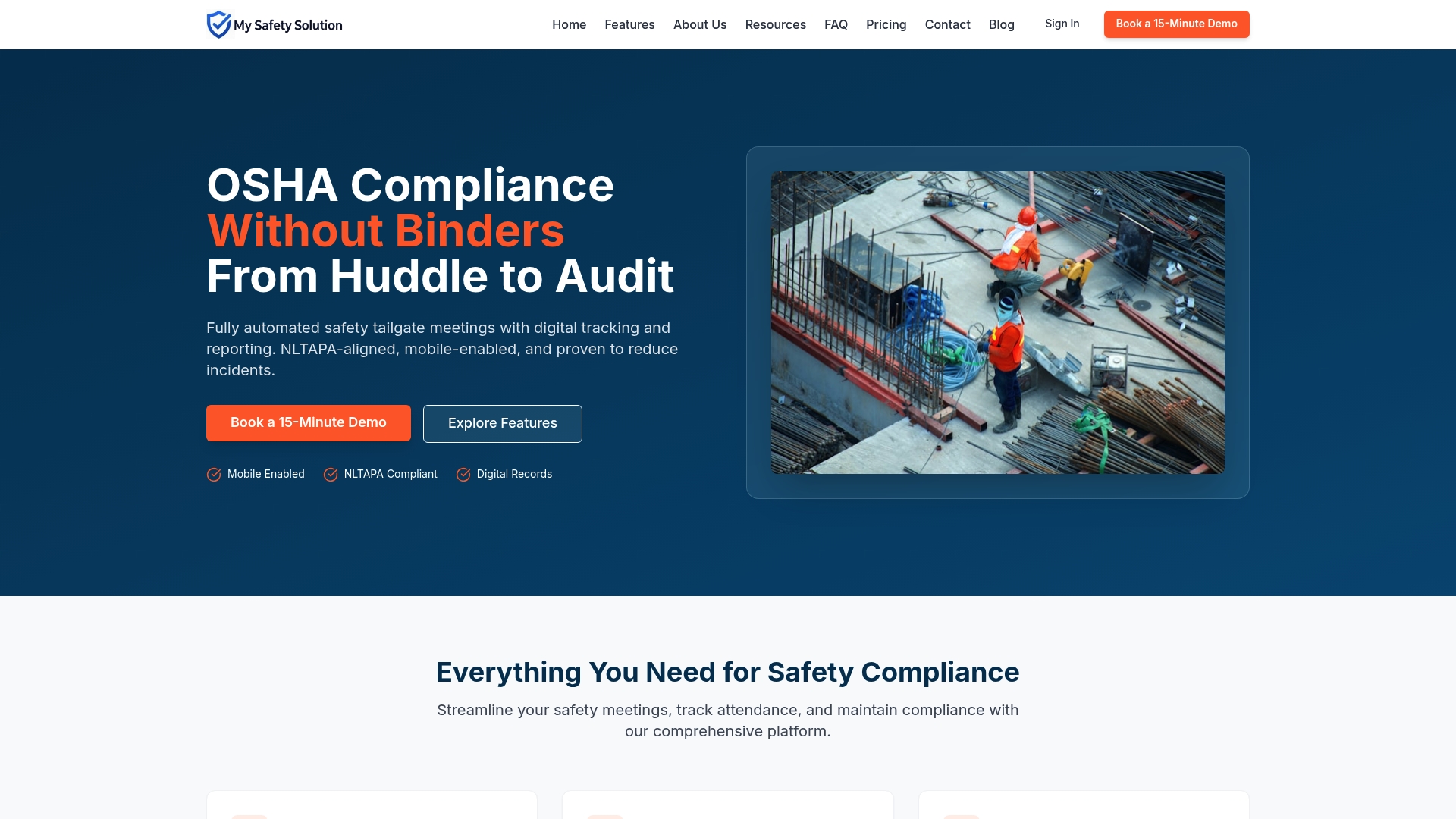
The platform is built specifically for high-risk, deskless workforces in construction, manufacturing, utilities, and warehousing. Its AI-powered safety topic generation produces content tailored to your industry’s specific hazards, drawing from a preloaded NLTAPA-aligned content library that maps to OSHA standards. Digital attendance capture includes signatures and timestamps at the point of the meeting, generating audit-grade records without any manual reconstruction. For safety consultants managing multiple clients, the multi-company dashboard and role-based permissions for consultants, admins, managers, and workers eliminate the operational complexity of managing compliance across separate accounts.
The result is a compliance record that holds up under inspection, not one assembled after the fact. Companies using My Safety Solution report reduced incident rates and improved audit readiness, with safety managers freed from administrative recovery to focus on the work that actually reduces risk.
If you manage safety meetings in manufacturing or oversee crews across construction sites, see how My Safety Solution’s automated meeting management fits your compliance program. Visit mysafetysolution.com to start a free trial and review the platform’s full feature set for your industry.
Key Takeaways
Effective safety compliance software must produce audit-grade, OSHA-aligned records automatically, covering training documentation, attendance capture, and industry-specific content delivery for deskless workforces.
| Point | Details |
|---|---|
| OSHA recordkeeping is non-negotiable | Employers must maintain accessible records of work-related injuries and illnesses; software must produce these on demand. |
| Long-term training record retention | OSHA Outreach Training Program requires class records, including signed sign-in sheets, retained for five years from the class end date. |
| Industry-specific training alignment | Software must map training modules to specific OSHA standards such as 29 CFR 1910.332 and 1926.21, not treat training as a generic checkbox. |
| Pricing requires direct verification | Published pricing from review sites is a starting anchor only; confirm compliance feature inclusion and contract terms directly with vendors. |
| My Safety Solution | Built for deskless, high-risk workforces with NLTAPA-aligned content, AI-powered topic generation, and audit-ready digital attendance records. |