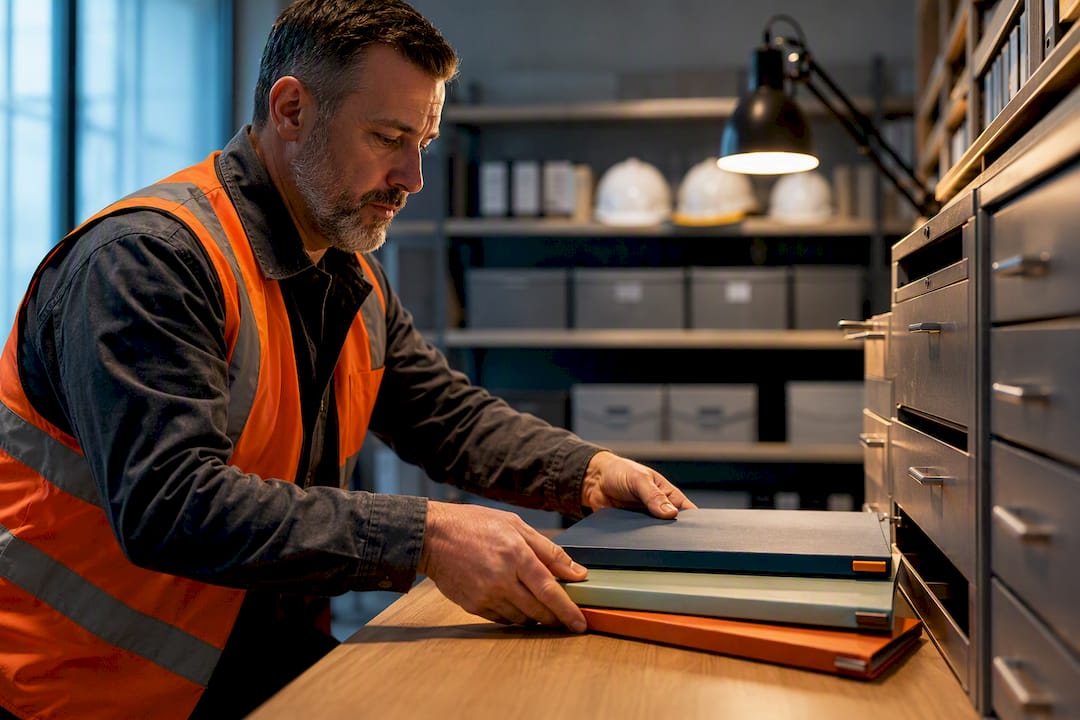
An OSHA inspection is a documentary exercise: have your OSHA logs, written programs, training records, maintenance files, and a designated document custodian ready before the compliance officer walks in. The Compliance Safety and Health Officer builds a case file from exactly those records, so gaps in paperwork become gaps in your defense. Centralize access now, name one person as custodian, and keep printable copies on hand.
TL;DR:
- Maintaining centralized, easily accessible records with clear documentation of training, maintenance, and incident investigations reduces inspection time and potential citations.
- Employers must retain OSHA injury and illness records for five years and be able to produce them within four hours of request, especially during the posting season from February to April.
- Case files built from photographs, interviews, and logs are the backbone of OSHA citations, making it crucial to record detailed, verified corrective actions and consistent documentation.
- Electronic recordkeeping must include secure, timestamped signatures, accessible reports, and backups to meet OSHA standards for digital document availability during inspections.
- Organizing a rapid response during inspections involves appointing one document custodian, providing organized copies, and controlling the presentation of logs, programs, and training records.
Table of Contents
- Which Documents OSHA Inspectors Commonly Request
- OSHA Recordkeeping Rules, Retention, and Electronic Submission
- What a CSHO Actually Documents in a Case File
- A Self-Audit Checklist That Actually Holds Up
- Electronic Records and Inspection Readiness
- What OSHA Arrivals Teach You About Preparation
- Centralizing Records Before OSHA Calls
- Sources
Which Documents OSHA Inspectors Commonly Request
A Compliance Safety and Health Officer doesn’t guess at compliance. They ask for specific paperwork, and each document type answers a different question about how your operation runs.
The core request almost always includes:
- OSHA Forms 300, 300A, and 301. These show recordable injuries, the annual summary, and incident-level detail, and inspectors cross-check them against actual events on site.
- Written programs. Hazard communication, lockout/tagout, respiratory protection, and confined space programs each need documented implementation, not just a binder that exists.
- Training records. Rosters alone don’t cut it. CSHOs want dates, topics, and signatures tied to specific employees.
- Maintenance logs and SDS inventories. These prove equipment upkeep and chemical hazard awareness match what’s on paper.
- Incident investigations, contractor documentation, photographs, and interview notes. These fill in the human and physical context a log can’t capture.
OSHA’s own Safety and Health Program Audit Tool lists exactly these categories: leadership commitment, hazard identification, control implementation, training, and program evaluation. It’s the same rubric field auditors use, so treating it as your internal checklist saves you from guessing what matters.
Pro Tip: Rank your documents by how fast they prove compliance. A signed training roster dated last month answers a question in seconds. A vague policy statement invites more questions than it resolves.
OSHA Recordkeeping Rules, Retention, and Electronic Submission
Federal recordkeeping requirements set the floor every safety manager has to clear, and the rules are more specific than most people assume.
Under 29 CFR 1904, covered employers with more than 10 employees must maintain OSHA Forms 300, 300A, and 301, with limited industry exemptions for lower-hazard sectors like retail and finance. Retention runs five years past the end of the calendar year the records cover, and you must produce them within four business hours of a request.
A few dates matter more than the rest of the calendar:
- February 1 to April 30: Form 300A must be posted at each establishment, summarizing the prior year’s injuries and illnesses.
- A company executive must certify the 300A summary as accurate before posting.
- Establishments meeting size or industry thresholds must submit injury and illness data electronically through OSHA’s Injury Tracking Application.
Miss the posting window or skip electronic submission when you’re required to file, and you’ve created a citation before an inspector even asks a question.
What a CSHO Actually Documents in a Case File
OSHA’s Field Operations Manual instructs officers to build case files from notes, photographs, interviews, and employer records, and that file becomes the backbone of any citation. Understanding what goes into it changes how you prepare.
A typical case file includes:
- The inspection report and violation worksheets, which document the specific standard cited and the evidence supporting it.
- Photographs, used to establish physical conditions at a fixed point in time.
- Employee and supervisor interviews, which often determine whether OSHA classifies a violation as serious or willful.
- An activity diary, the officer’s contemporaneous record of what was observed and when.
These notes and materials are considered government property once collected, and original field notes stay in the case file permanently, per the Field Operations Manual.
The gap between paperwork and proof is where most citations originate. A training log that lists a class date means little if it doesn’t tie to individual attendance. A maintenance file needs to show completed abatement, not just a scheduled inspection. Corrective-action records need abatement dates and a name attached to verification, not a checkbox.
Common pitfalls that hand inspectors an easy citation include missing direct evidence for a claimed practice, incomplete logs with unexplained date gaps, no proof that a flagged hazard was actually corrected, and inconsistent recordkeeping across multiple sites doing the same work differently. Interviews and photos exist specifically to establish what management knew and when, which is why “we didn’t know” rarely survives a well-documented case file.
A Self-Audit Checklist That Actually Holds Up
A checklist only works if it produces documentation someone else could verify without asking you questions. OSHA and NIOSH’s Small Business Safety and Health Handbook makes the same point: a completed checklist means nothing unless it’s backed by actual logs, training records, and maintenance files.
Work through these in priority order:
- Pull current OSHA 300, 300A, and 301 forms and confirm they match actual incident reports.
- Confirm every written program carries a review date and a name attached to implementation.
- Cross-reference training rosters against sign-in sheets for a random sample of employees.
- Verify maintenance and corrective-action files show completion dates, not just scheduled work.
- Check SDS inventories against what’s physically stored on site.
For coordinated worksites, confirm host employers and staffing agencies can produce records for contractor employees on request. Enforcement directives on records audits describe this exact process: sample employees, reconstruct logs where needed, and document any discrepancy rather than hide it, per OSHA’s recordkeeping enforcement directive.
Build a simple template with four fields for every corrective action: hazard identified, responsible person, completion date, and verification method. That structure turns a vague “fixed it” into evidence.
Electronic Records and Inspection Readiness
OSHA allows written programs to exist solely in electronic format, provided employees can access them without barriers and print them on request, according to an OSHA standard interpretation. That flexibility only helps if your digital system actually delivers on demand.
Strong digital practice includes:
- An audit trail that can’t be edited after the fact, with timestamps on every entry.
- Signed, dated attendance records for every training and safety meeting.
- Exportable reports a CSHO can review without a login tutorial.
- Backups and role-based access so records survive a device failure or staff turnover.
| Practice | Why it matters for inspection |
|---|---|
| Timestamped digital signatures | Proves attendance at a specific date and time |
| Searchable meeting archive | Lets you pull months of records in minutes |
| Role-based access | Controls who can edit versus who can only view |
| Exportable PDF reports | Matches OSHA’s printable-on-request expectation |
Automated safety-meeting platforms like My Safety Solution build this structure in from the start, generating mobile-accessible, NLTAPA-aligned records automatically rather than relying on someone remembering to file a paper sign-in sheet. That kind of searchable archive is exactly what closes the gap between “we probably have that” and producing it in four hours.
What OSHA Arrivals Teach You About Preparation
Most disruption during an inspection comes from disorganization, not noncompliance. The moment a CSHO arrives, designate one point of contact immediately. Notify leadership, but don’t let three people hand over documents independently. Secure original records and provide copies wherever the officer allows it.
Presenting documents in a controlled sequence, logs first, then programs, then training, keeps the conversation on your terms and preserves a clear chain of custody. An inspection isn’t a threat to survive. It’s an opportunity to show active hazard control and a program that improves over time, not a static binder waiting to be tested.
“When OSHA arrives, you typically have hours to produce complete training and meeting records. MySafetySolution allows safety managers to generate comprehensive, certified audit packets with a few clicks, eliminating inspection panic.”
— Matthew Hoffman, President - MySafetySolution
Centralizing Records Before OSHA Calls
Most safety managers don’t lack documentation. They lack a system that makes it retrievable in minutes instead of hours. Some platforms address this gap by offering automated attendance capture, timestamped digital signatures, and a searchable meeting archive that replaces the folder-hunting scramble when an inspector requests six months of training records on the spot.
For mobile crews working across multiple job sites, or operations juggling frequent subcontractors, a centralized dashboard can provide one login showing every site’s compliance status instead of separate spreadsheets. AI-generated safety topics help keep tailgate meetings relevant to current site conditions, and sessions can log automatically without manual data entry afterward.
Before requesting a demo, pull a list of your current pain points: how many sites you manage, how attendance gets recorded today, and how long it currently takes to produce six months of training records on request. That gives you a direct comparison against what a centralized compliance platform can deliver from day one.
Sources
- Field Operations Manual - Chapter 5 | Occupational Safety and Health Administration
- Safety and Health Program Audit Tool | OSHA