How OSHA accident prevention and safety compliance work on multiemployer job sites
On any multiemployer job site, OSHA’s position is unambiguous: more than one employer can be cited for the same hazardous condition. That shared accountability is the foundation of the Multi-Employer Citation Policy, and misunderstanding it is one of the most common and costly mistakes safety managers make.
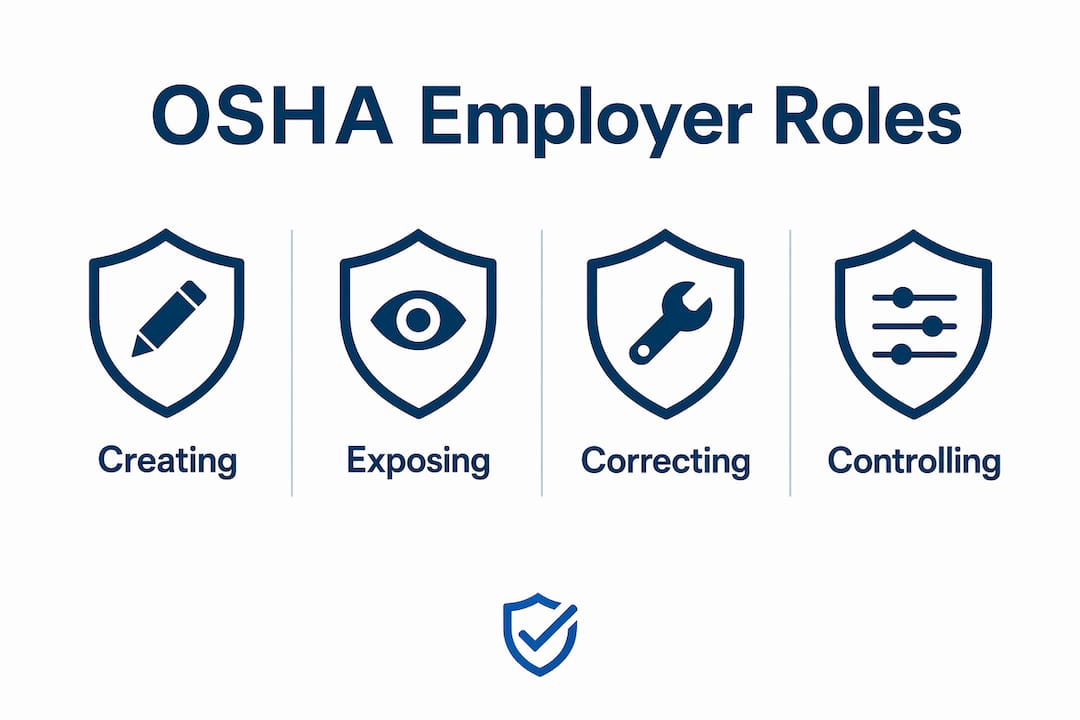
The policy applies across all industry sectors, not just construction. When an OSHA inspector arrives on a multiemployer worksite, they follow a two-step process. First, they determine which employer category applies. Second, they assess whether that employer’s actions met the obligations tied to that category. The categories are:
- Creating employer: Caused the hazardous condition. Citable even if only another employer’s workers are exposed.
- Exposing employer: Has employees working in or near the hazard zone. The only category that can be cited under the General Duty Clause.
- Correcting employer: Contracted specifically to analyze, fix, or correct safety and health conditions. Must exercise reasonable care in preventing and discovering violations.
- Controlling employer: Holds general supervisory authority over the worksite, with the power to correct violations or require others to do so.
Shared responsibility does not mean equal responsibility. Each role carries distinct obligations, and the degree of care OSHA expects scales accordingly. A controlling employer, for example, is not held to the same inspection frequency as an employer protecting its own workers, but it must still demonstrate a functioning enforcement system. Hazard recognition, clear communication across all employers on site, and documented corrective actions form the compliance backbone that OSHA inspectors look for first.
Table of Contents
- Understanding employer roles and OSHA responsibilities on multiemployer worksites
- Best practices for coordinating safety across multiple employers on a job site
- Strategies to prevent OSHA violations and maintain ongoing compliance
- How digital safety meeting management strengthens multiemployer compliance
- My Safety Solution gives multiemployer sites a compliance edge
- Key Takeaways
Understanding employer roles and OSHA responsibilities on multiemployer worksites
The four employer categories are not mutually exclusive. A general contractor can simultaneously be a creating employer, a controlling employer, and an exposing employer, depending on the hazard and the workforce involved. Recognizing which roles apply to your organization at any given moment is the first step toward managing your actual compliance exposure.
The four employer roles defined
| Employer Role | Core Definition | Key OSHA Obligation |
|---|---|---|
| Creating | Caused the violative condition | Must not create hazards; citable even without own employees exposed |
| Exposing | Has employees working near the hazard | Must protect employees; only role citable under General Duty Clause |
| Correcting | Contracted to fix safety conditions | Must exercise reasonable care to prevent and discover violations |
| Controlling | Has general supervisory authority over the site | Must exercise reasonable care; enforce compliance through graduated discipline |
The creating employer is the most straightforward category. If your work activity or equipment produced the hazard, you own it, regardless of whose workers are standing nearby. A subcontractor who leaves an unguarded floor opening is a creating employer for every worker on that floor.
The exposing employer carries a layered obligation. If the hazard was created by someone else, the exposing employer is still citable if it knew about the condition, or failed to exercise reasonable diligence to discover it, and did not take protective steps within its authority. When an exposing employer lacks the authority to correct a hazard directly, OSHA expects it to: (1) notify the creating or controlling employer, (2) inform its own employees of the hazard, and (3) take reasonable alternative protective measures. In extreme situations, removing employees from the area entirely may be required.
The correcting employer role is often held by specialty contractors brought in specifically for safety-related work, such as a scaffolding company or a hazardous materials remediation firm. Their obligation is active, not passive: reasonable care means both preventing new violations and discovering existing ones within their scope.
The controlling employer generates the most nuanced compliance questions. Control can arise through an explicit contract right to enforce safety, through a combination of broad contractual authority over scheduling and dispute resolution, or simply through the practical exercise of authority on site, even without a written provision. OSHA factors that determine how frequently a controlling employer must inspect include:
- The scale and pace of the project
- How frequently hazard types change as work progresses
- The controlling employer’s knowledge of each subcontractor’s compliance history
- Whether the subcontractor is new to this working relationship
A subcontractor with a documented history of non-compliance requires more frequent oversight. Conversely, a subcontractor demonstrating consistently high compliance levels may justify less frequent inspections, provided that assessment is itself documented.
One insight that catches many safety managers off guard: employers may simultaneously carry multiple roles, compounding their obligations. Assuming responsibility only for your own employees is a reliable path to a citation you did not anticipate.
Best practices for coordinating safety across multiple employers on a job site
Effective multiemployer sites accident prevention and safety compliance does not happen through written plans alone. OSHA inspectors prioritize evidence of consistent, active enforcement over binders on a shelf. The following practices build the kind of documented, operational safety culture that holds up under scrutiny.
Establish a clear project safety organization
Before work begins, define the chain of command for safety decisions. Who has authority to stop work? Who coordinates between subcontractors when a hazard is discovered? The ANSI/ASSP A10.33-2020 standard provides a structured framework for exactly this, mandating role clarity and standardized hazard assessment processes across all project entities on multiemployer construction projects. Assign a designated safety coordinator with authority that crosses employer lines, and document that authority in the project safety plan.
Implement daily work planning and job hazard analysis
Daily coordination meetings between contractors and subcontractors are one of the most effective tools for reducing hazardous miscommunications on shared worksites. Job hazard analyses and daily hazard reviews foster proactive safety engagement across all employers present. Each morning’s planning session should surface new hazards introduced by overnight work, changes in sequencing, or new subcontractors arriving on site.
A job hazard analysis (JHA) for each task should identify:
- The specific hazard associated with each work step
- Who is exposed, including workers from other employers
- The control measure in place and who is responsible for it
- The verification step confirming the control is active before work starts
Coordinate site-specific training and orientation
Every worker arriving on a multiemployer site needs orientation that covers site-specific hazards, emergency procedures, and the chain of command for reporting unsafe conditions. This is not a one-time event. When subcontractor turnover occurs or new trades arrive, orientation must be repeated for incoming crews. Under ANSI/ASSP A10.33-2020, training requirements apply across project entities, not just to the general contractor’s direct employees.
Supervisory training deserves separate attention. Foremen and crew leads from each employer need to understand not only their own safety obligations but also what to do when they observe a hazard created by another employer’s work. That cross-employer awareness is what prevents the “not my problem” mentality that leads to cascading failures.
Conduct regular documented safety meetings and toolbox talks
Documented safety meetings are among the strongest compliance proofs OSHA inspectors look for. A toolbox talk that happened but was never recorded is, from an enforcement standpoint, a toolbox talk that did not happen. Meeting records should capture the topic covered, the date and time, the names and signatures of attendees, and any corrective actions discussed.
Pro Tip: When multiple subcontractors are working simultaneously, hold a brief joint safety meeting at shift start rather than relying on each employer to conduct separate talks. This eliminates the risk of conflicting safety information reaching workers from different crews.
Manage subcontractor turnover without losing continuity
Subcontractor turnover is one of the highest-risk periods for safety compliance on multiemployer sites. When one trade finishes and another begins, hazard information, site-specific protocols, and established communication channels can all break down. Build a formal handoff procedure: the departing subcontractor documents any open hazards or incomplete corrective actions, and the incoming subcontractor receives a briefing before their first shift. The controlling employer should verify this transfer in writing.
Strategies to prevent OSHA violations and maintain ongoing compliance
Preventing citations on multiemployer sites requires more than good intentions. It requires systems that generate documented evidence of active enforcement, consistent hazard correction, and coordinated emergency response.
Enforce a graduated discipline system for non-compliance
OSHA’s own guidance identifies a graduated system of enforcement as a key indicator that a controlling employer is meeting its reasonable care standard. This means consequences that escalate with the severity and frequency of violations: a verbal warning for a first minor infraction, a written notice for a repeat offense, and work stoppage or contract termination for serious or willful non-compliance. The system only works if it is applied consistently and documented at every step.
Maintain hazard correction and follow-up inspection procedures
Identifying a hazard is only the first step. The corrective action must be assigned to a responsible party, given a deadline, and verified as complete through a follow-up inspection. Open corrective actions that linger without resolution are a significant citation risk, particularly when an OSHA inspector can see the hazard was documented but not corrected. A hazard tracking log, updated in real time and accessible to all relevant employers on site, closes this gap.
Build an audit-ready documentation system
OSHA inspectors look for consistent, active safety program enforcement rather than static written plans. The documentation that matters most includes:
- Signed attendance records for every safety meeting and training session
- Completed JHAs for each task, dated and tied to specific work activities
- Written records of all inspections, including who conducted them and what was found
- Corrective action logs with completion dates and verifying signatures
- Incident investigation reports, even for near-misses
Paper-based systems create gaps. A signature sheet left in a truck, a JHA completed after the fact, or a corrective action log that no one updates consistently are all vulnerabilities during an inspection.
Use safety committees to coordinate across employers
Safety committees combining labor and management representatives help coordinate safety efforts, promote consistent enforcement, and improve communication across all employers on a shared worksite. On large multiemployer projects, a joint safety committee that includes representatives from each major subcontractor creates a formal channel for surfacing hazards, reviewing incidents, and aligning on corrective actions before problems escalate. These committees also generate meeting minutes, which become part of the compliance record.
Plan emergency response for a multiemployer environment
Emergency response planning on a multiemployer site is more complex than on a single-employer site because workers from different companies may not know each other’s roles, communication channels, or assembly points. The site emergency action plan should specify:
- A single emergency contact chain that crosses all employer lines
- Assembly areas and accountability procedures for every employer’s workforce
- Roles for each employer in the event of a site-wide emergency
- Coordination protocols with local emergency services, including site access routes
Every subcontractor arriving on site must be briefed on this plan before starting work, and the plan must be updated whenever the site configuration or workforce composition changes significantly.
Coordinate incident investigation across employers
When an incident occurs on a multiemployer site, the investigation cannot stop at employer boundaries. A worker from Subcontractor A injured by a condition created by Subcontractor B’s work requires a joint investigation that captures the full causal chain. The controlling employer typically leads this process, but all employers with relevant knowledge should contribute. Investigation findings, corrective actions, and any changes to work procedures must be documented and shared across all affected employers.
Construction fatalities remain a persistent challenge across the industry. According to OSHA’s enforcement data, the construction sector consistently accounts for a disproportionate share of workplace fatalities in the United States. On multiemployer sites, where coordination gaps are common, the risk compounds. Documented, systematic safety management is the most direct path to reducing that exposure.
How digital safety meeting management strengthens multiemployer compliance
Managing safety across multiple employers, trades, and shifting workforces creates an information management problem as much as a safety problem. When safety protocols travel through layers of supervisors and subcontractors, they degrade. A verbal instruction passed through three levels of management arrives at the worker level incomplete, inconsistent, or not at all. Digital safety meeting management platforms address this directly by centralizing distribution, standardizing content, and creating an unbroken audit trail.
What digital platforms do that paper cannot
A construction safety management system built on digital tools replaces the patchwork of paper sign-in sheets, emailed PDFs, and manually compiled spreadsheets with a single, time-stamped record of every safety interaction. For multiemployer sites, the specific advantages include:
- Real-time attendance verification: Digital signatures with timestamps confirm exactly who attended which meeting, when, and on which site. This level of specificity is what separates a defensible compliance record from a disputed one during an OSHA inspection.
- AI-powered topic generation: Safety topics tailored to the specific hazards present on a given day keep meetings relevant. OSHA inspectors look for evidence that safety meetings address actual site conditions, not generic content recycled from a binder.
- Centralized compliance reporting: When a general contractor needs to demonstrate that all subcontractors’ workers received a specific safety briefing, a digital platform produces that report in minutes rather than hours of manual compilation.
- Multi-company management: Platforms designed for multiemployer environments allow a single administrator to manage safety meetings across multiple employers, with role-based permissions ensuring each employer sees only what is relevant to their workforce.
The audit trail advantage
Digital attendance records with timestamps surpass paper sign-in sheets by providing unequivocal proof of training delivery and participation. During an incident investigation or an OSHA audit, the question is not just whether training occurred but whether the specific worker involved received it, on what date, and covering which topics. A digital record answers all three questions instantly. A paper sheet, if it exists at all, often cannot.
Pro Tip: Configure your digital safety meeting platform to send automated reminders to subcontractor supervisors before scheduled meetings. On multiemployer sites where subcontractors manage their own crews, this single step dramatically reduces missed attendance and the compliance gaps that follow.
The ANSI/ASSP A10.33-2020 standard mandates standardized hazard assessment and communication processes across all project entities. Digital platforms are the practical mechanism for meeting that mandate at scale, particularly on projects where subcontractor composition changes week to week.
For safety consultants managing compliance across multiple client sites simultaneously, platforms with push topic distribution and multi-company dashboards extend that capability without proportionally increasing administrative burden. A consultant can distribute a site-specific safety topic to every employer on a project from a single interface, with confirmation that each employer’s workers received and acknowledged it.
The shift from manual to digital safety meeting management is not primarily about convenience. It is about producing the kind of consistent, verifiable compliance record that holds up when OSHA arrives, when an incident occurs, or when a subcontractor disputes what training their workers received. For construction safety compliance, that evidentiary standard is the difference between a defensible position and an exposed one.
My Safety Solution gives multiemployer sites a compliance edge
On multiemployer sites, the administrative burden of tracking safety meetings, attendance, and corrective actions across multiple employers is where compliance programs most often break down. My Safety Solution was built specifically for this environment. It automates safety meeting management for high-risk, deskless workforces in construction, manufacturing, utilities, and transportation, replacing fragmented paper processes with a single, audit-ready digital system.
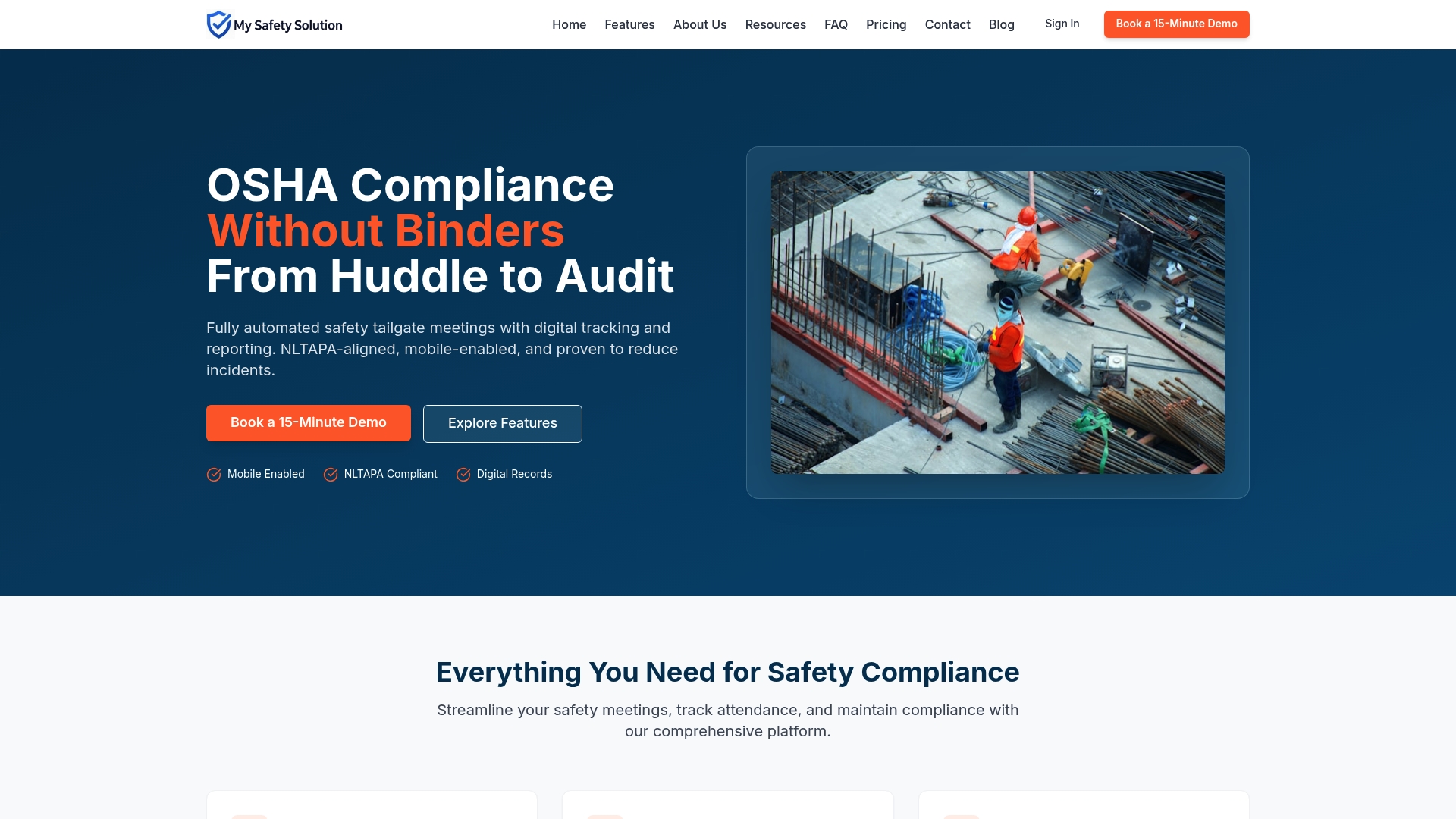
The platform’s AI-powered content generation produces safety topics tailored to your site’s specific hazards, keeping meetings substantive rather than routine. Digital attendance tracking with signatures and timestamps creates the kind of unambiguous compliance record that OSHA inspectors and incident investigators require. For general contractors managing multiple subcontractors, the multi-company dashboard gives a consolidated view of safety meeting completion across every employer on site, with role-based permissions that keep each party’s data appropriately separated.
My Safety Solution is NLTAPA-aligned and mobile-enabled, meaning field supervisors can run and document meetings from a phone or tablet without returning to an office. Training scheduling with automated reminders reduces the missed meetings that create compliance gaps during subcontractor turnover. Safety consultants working across multiple client sites can push topics and manage compliance reporting from a single account.
If your current system relies on paper sign-in sheets, emailed PDFs, or manually compiled spreadsheets, the gaps in your compliance record are likely larger than you realize. Start a free trial and see what a complete, verifiable audit trail looks like for your multiemployer site.
Key Takeaways
Effective multiemployer site safety compliance requires documented, active enforcement across all four employer roles, supported by consistent training, hazard tracking, and a verifiable audit trail that holds up under OSHA scrutiny.
| Point | Details |
|---|---|
| OSHA’s two-step citation process | OSHA first identifies employer role (creating, exposing, correcting, controlling), then assesses whether actions met that role’s obligations. |
| Controlling employer standard | Reasonable care requires a graduated discipline system and documented safety meetings, not necessarily frequent hands-on inspections. |
| ANSI/ASSP A10.33-2020 | This standard mandates role clarity and standardized hazard assessment across all entities on multiemployer construction projects. |
| Documentation is the compliance proof | Signed attendance records, completed JHAs, corrective action logs, and incident reports are what OSHA inspectors weigh most heavily. |
| My Safety Solution | Automates safety meeting management, digital attendance tracking, and compliance reporting for multiemployer sites across construction, utilities, and manufacturing. |