
Improving safety compliance in public works comes down to six high-impact actions: designate and document competent persons for every hazard class on site, digitize training records and attendance, prequalify contractors on safety history and credentials, implement a written traffic management plan before crews mobilize, close training gaps with OSHA 10/30 and task-specific certifications, and run quarterly internal audits. Do those six things consistently, and you will have a defensible program when an inspector walks onto your project.
Here is the priority checklist, with owners and immediate next steps:
- Designate competent persons in writing (Owner: Safety Manager) — Name individuals for excavation, fall protection, and confined space today; file credentials in a central location accessible on site.
- Digitize training records and attendance (Owner: Safety Manager / IT) — Replace paper sign-in sheets with timestamped digital records tied to each worker’s credential file.
- Prequalify contractors before award (Owner: Procurement / Safety Manager) — Require OSHA 30 cards, current EMR, and a written safety plan as conditions of bid eligibility.
- Implement TMP/TCP before mobilization (Owner: Project Manager / Safety Officer) — Submit and get approval for your traffic management plan and work-zone traffic control plan before the first crew arrives.
- Close training gaps (Owner: Safety Manager) — Audit current certifications against task assignments; schedule retraining for any expired or missing credentials within 30 days.
- Run quarterly internal audits (Owner: Safety Officer) — Use a standardized checklist and document corrective actions with closure dates.
Pro Tip: The single fastest way to shift an inspection’s tone is to hand the OSHA compliance officer a binder or digital report that contains your dated written safety program, named competent persons, and their current credentials within the first two minutes. Inspectors who see organized documentation spend less time on paperwork citations and more time on physical conditions — which is exactly where you want the conversation.
Table of Contents
- Which laws, standards, and agencies govern U.S. public works projects?
- What does compliance actually look like on a public works job site?
- What are the core elements of an effective safety management system?
- How do you design contractor prequalification and oversight to close compliance gaps?
- Which certifications and training cadences keep public works crews compliant?
- What does a compliant work-zone traffic control plan require?
- What records do you need, and how do you prove sustained compliance?
- How does digitizing records and meetings close the compliance gaps that paper misses?
- What is a realistic 6-step implementation plan with timeline and costs?
- How long does it take and what does it cost to build a stronger compliance program?
- Who is responsible for what? A roles and responsibilities matrix
- A step-by-step action plan for starting or improving compliance
- How does safety compliance fit into public works project management?
- What do successful public works safety programs actually look like?
- What are the legal and financial consequences of non-compliance?
- Key Takeaways
- The compliance gap that no checklist fixes
- My Safety Solution makes public works compliance defensible
- Authoritative resources for further reading
Which laws, standards, and agencies govern U.S. public works projects?
The legal backbone of any public works safety program is 29 CFR 1926, OSHA’s construction standards. These cover excavation, fall protection, scaffolding, electrical, personal protective equipment, and dozens of other hazard categories that appear on road, utility, and infrastructure projects. Where work crosses into maintenance or operations rather than construction, 29 CFR 1910 general industry standards may apply concurrently.
State-plan states add another layer. Many states and territories operate their own OSHA-approved plans, and many of them set standards that are at least as stringent as federal OSHA — sometimes more so. Municipal and county employees are often covered only by state plans, not federal OSHA directly, so confirming your jurisdiction’s coverage is not optional. Where public employees fall outside formal federal mandates, voluntarily adopting OSHA standards as internal policy creates a defensible, consistent program regardless of the legal technicality.
For road and transportation projects, the Manual on Uniform Traffic Control Devices (MUTCD) governs work-zone signage and traffic control device placement. Federally funded projects add FHWA and state DOT requirements, including designated safety coordinator roles and pre-construction safety submittals. OSHA’s proactive safety management approach — built around management commitment, worker participation, hazard identification, training, and program evaluation — provides the program architecture tying all of these standards together.
OSHA’s Site-Specific Targeting program uses injury and illness data to rank high-hazard worksites for programmed inspections, and municipal projects have moved up that priority list. The practical implication: even small public works contracts now carry a realistic inspection probability, making inspection-ready documentation a baseline operational requirement, not a contingency plan.
What does compliance actually look like on a public works job site?
Compliance is not a policy document sitting in a filing cabinet. It is a set of visible, verifiable conditions that an inspector can confirm within the first hour on site. The documents and designations below are what they look for.

Daily and site-level items include a current site safety plan specific to the project, a signed and approved TMP/TCP, toolbox talk logs with dates and attendee signatures, job hazard analyses (JHAs) for high-risk tasks, and permit-required confined space documentation where applicable. These are not one-time submittals. They are living records that should reflect current site conditions.
Personnel documentation is where many agencies stumble. Named competent persons must be identified in writing for excavation, fall protection, scaffolding, and confined space entry. OSHA 10 cards are a minimum for workers on many public contracts; supervisors should hold OSHA 30. Equipment operator certifications — crane, aerial lift, heavy equipment — must be on file and producible on request. A competent person designation that expired six months ago is treated the same as no designation at all.
Equipment and PPE records round out the picture. Inspection logs for tools and equipment, lockout/tagout (LOTO) procedures with documented employee training, and respirator fit-test records where respiratory hazards exist are all common inspection targets on public works sites. The pattern is consistent: agencies that treat recordkeeping as an administrative burden rather than a compliance control get cited for paperwork as often as for physical hazards.
What are the core elements of an effective safety management system?
OSHA’s recommended practices identify seven foundational pillars for a safety management system. For public works, each pillar maps directly to the mixed-hazard environment of road work, trenching, confined space, and fleet operations.
- Management commitment — Leadership sets the safety budget, approves the written program, and signs off on corrective actions. Without visible executive support, field crews treat safety as optional.
- Worker participation — Crews who report near misses and contribute to JHAs identify hazards that supervisors miss. Non-punitive reporting channels are the mechanism.
- Hazard identification and JHA — Every high-risk task type (excavation, confined space entry, overhead work, traffic exposure) needs a written JHA reviewed before the task begins, not after.
- Hazard prevention and control — Engineering controls first, then administrative, then PPE. For public works, this means proper shoring before workers enter a trench, not just hard hats.
- Training and competency — Certifications must be current and matched to task assignments. A worker with an expired flagger certification assigned to traffic control is a citation and a liability.
- Program evaluation — Track JHA completion rates, training currency percentages, near-miss reporting rates, and corrective action close times. What gets measured gets managed.
- Documentation and audit trail — Every element above generates a record. Those records are the difference between a warning and a willful citation.
For public works specifically, a risk-scoring framework adapted from ISO 31000 principles — scoring hazards by likelihood and consequence, then prioritizing mitigation — pairs well with dashboard monitoring to keep leadership informed without requiring manual report compilation.
Pro Tip: Tie safety KPIs directly to supervisor performance reviews and present near-miss trends and TRIR data at budget conversations. When leadership sees that a lower incident rate correlates with reduced workers’ compensation costs and fewer project delays, sustained resource allocation for safety becomes a financial argument, not just a moral one.
How do you design contractor prequalification and oversight to close compliance gaps?
Subcontractor safety failures become your liability on a public works project. The time to address them is before contract award, not after an incident.
Prequalification criteria should include at minimum: three-year OSHA recordable incident history, current Experience Modification Rate (EMR) with a defined threshold (many agencies use 1.0 or below as a hard cutoff), proof of OSHA 30 for all supervisors, CHST certification for designated safety coordinators on larger contracts, and a written safety program specific to the work type. Request these as bid documents, not post-award submittals.
- Contract clause: site safety plan submission — Require a project-specific safety plan within five business days of award, naming the on-site safety coordinator with contact information.
- Contract clause: corrective action timelines — Define response windows: immediate correction for imminent danger, 24 hours for serious hazards, five business days for other violations.
- Contract clause: right-to-audit and stop-work authority — Reserve the right to conduct unannounced safety audits and to issue a stop-work order for uncorrected serious hazards, with cost consequences for delays caused by contractor non-compliance.
- Field oversight: orientation and first-day checks — Every worker completes a site-specific orientation before starting work. Orientation records confirm credential review. Workers whose certifications do not match their assigned tasks are reassigned or removed from site before the shift begins.
- Field oversight: daily toolbox verification — The safety officer or designated lead confirms that a toolbox talk occurred, that attendance was recorded, and that the topic matched the day’s high-risk tasks.
- Field oversight: random audits tied to procurement — Document audit findings and share them with procurement. Contractors with repeat violations face bid disqualification on future projects.
For underground work and hydrovac or HDD operations, prequalification should also verify utility locate procedures and confined space entry protocols, since these tasks carry compounding hazards that standard construction prequalification criteria often underweight.

Which certifications and training cadences keep public works crews compliant?
Training currency is one of the most common compliance gaps on public works projects, and it is entirely preventable with a structured tracking system.
Core credentials by role:
- All workers: OSHA 10-hour construction (minimum for most public contracts)
- Supervisors and foremen: OSHA 30-hour construction
- Excavation competent person: Formal competent person training with soil classification documentation
- Fall protection competent person: Designated and documented per 29 CFR 1926.502
- Flaggers and traffic control: State-specific flagger certification (requirements vary by state DOT)
- Confined space entrants and attendants: OSHA-compliant confined space training per 29 CFR 1926.1209
- LOTO-authorized employees: Equipment-specific LOTO training with documented annual review
- HAZWOPER: 40-hour initial or 8-hour refresher where hazardous materials exposure is possible
Retraining triggers matter as much as initial certification. Regular refresher training is the baseline, but retraining is also required after any incident involving the relevant hazard, after a process or equipment change, and when observation suggests a worker is not following established procedures. Documenting the trigger for retraining is as important as documenting the training itself.
Linking certification currency to work-order assignment is the operational control that prevents non-qualified labor from reaching high-risk tasks. When a digital system auto-alerts before a certification expires and blocks assignment until renewal is confirmed, the gap closes automatically rather than relying on a supervisor’s memory.
Sample onboarding and recurring training timeline:
- Day 1: Site orientation, hazard communication, emergency procedures, PPE issuance
- Days 1–5: Task-specific JHA review, equipment-specific LOTO training, confined space briefing if applicable
- Day 30: Supervisor check-in on training completion; any gaps scheduled for correction
- Day 90: First toolbox talk audit; verify attendance records are complete and signed
- Annually: Refresher training for all credential categories; update competent person designations
A public works crew that completes this sequence and maintains the records is inspection-ready on day one of any audit cycle.
What does a compliant work-zone traffic control plan require?
Work-zone traffic control is where public works projects face their highest combined risk: workers exposed to live traffic, equipment moving in tight corridors, and public vehicles navigating unfamiliar lane configurations. Getting the plan right before crews arrive is not procedural — it is the primary life-safety control.
Two distinct components are required. The traffic management plan (TMP) addresses public vehicle flow: detour routes, public notifications, coordination with local agencies, and temporary signal timing changes. The work-zone traffic control plan (TCP) addresses on-site worker and equipment movement: signage placement, temporary lane closures, speed control measures, flagging positions, and equipment staging zones. Both must be prepared and approved before mobilization.
MUTCD compliance governs device placement, sign sequencing, and taper lengths. For federally funded projects, state DOT approval of the TCP is typically required before work begins, and the approved plan must be kept on site and available for inspection. When conditions change — a lane closure extends beyond the planned window, a detour route becomes congested, or a shift handover occurs — the TCP must be updated and re-briefed.
Coordinating flaggers, traffic control vendors, and police or agency notifications at shift handovers is where gaps most often appear. A written handover protocol that confirms flagger positions, active signage, and radio communication channels before the outgoing crew leaves eliminates the most common cause of work-zone exposure incidents.
What records do you need, and how do you prove sustained compliance?
Recordkeeping is the audit trail that separates a defensible program from a citation-generating one. The table below defines the minimum record set, retention guidance, and ownership for public works operations.
| Record Type | Retention Guidance | Owner |
|---|---|---|
| Written safety program | Current version on site; retain prior versions 5 years | Safety Manager |
| JHAs (by task type) | Retain for project duration plus 5 years | Safety Officer |
| Toolbox talk logs (signed) | Retain 3 years minimum | Supervisor / Safety Officer |
| Training records and certifications | Duration of employment plus 3 years | Safety Manager / HR |
| Equipment inspection logs | Retain for equipment life plus 3 years | Supervisor / Fleet Manager |
| Incident and near-miss reports | 5 years (OSHA 300 logs: 5 years) | Safety Manager |
| Corrective action closure evidence | Retain with associated incident or audit record | Safety Officer |
| Fit-test records (respirator) | Duration of employment | Safety Manager |
Leading and lagging metrics to report to leadership:
- Near-miss to recordable incident ratio — A healthy program generates multiple near-miss reports for every recordable incident. A low ratio typically signals under-reporting, not a safe site.
- JHA completion rate — Percentage of high-risk tasks that have a completed, signed JHA before work begins. Target complete coverage; significant shortfalls warrant immediate investigation.
- Training currency percentage — Percentage of workers whose required certifications are current. Track by crew and by credential type.
- TRIR (Total Recordable Incident Rate) and DART rate — Lagging indicators reported to OSHA and used in contractor prequalification decisions.
For quarterly internal audits, the pre-inspection “grab bag” should include: the current written safety program, a list of named competent persons with credentials, the last three months of toolbox talk logs, open corrective actions with status, and the most recent equipment inspection records. Assembling this package in advance means an inspector’s arrival triggers a confident response, not a scramble.
Digitized workflows generate corrective work orders automatically from near-miss reports, close out actions faster, and provide the evidence organizations need for both internal and external audits.
How does digitizing records and meetings close the compliance gaps that paper misses?
Paper-based safety programs have a structural weakness: they rely on individuals to file, retrieve, and cross-reference records under field pressure. When a certification expires and no one notices, a non-qualified worker gets assigned to a high-risk task. When a near-miss report sits in a supervisor’s truck, the corrective action never happens. Digital systems close these gaps by making compliance automatic rather than discretionary.
The operational mechanics matter. When JHAs are attached to work orders in a digital system, the work order cannot be released until the JHA is confirmed complete. When certifications are linked to worker profiles and the system auto-alerts 30 days before expiry, the renewal conversation happens before the credential lapses, not after an inspector finds it. When near-miss reports are submitted via mobile with photos and generate corrective work orders automatically, the corrective action loop closes in hours rather than weeks.
My Safety Solution is built around exactly this workflow. The platform provides timestamped attendance with digital signatures for every safety meeting, automated certification expiry alerts tied to worker profiles, photo-enabled near-miss reporting that generates corrective work orders, and exportable audit reports formatted for inspection response. For public works teams managing multiple crews across multiple sites, the multi-company dashboard and role-based permissions mean safety managers see the full compliance picture without chasing individual supervisors for updates.
Pro Tip: Roll out digital tools starting with your highest-risk task types and the crews that perform them most frequently. Excavation, confined space, and traffic control crews generate the most documentation and carry the most inspection risk. Getting those crews onto a digital workflow first produces the fastest compliance improvement and the clearest ROI to present to leadership.
The construction safety management field guide on My Safety Solution’s site walks through how to link JHAs, checklists, and work orders in a structured digital workflow — a practical starting point for teams moving off spreadsheets.
What is a realistic 6-step implementation plan with timeline and costs?
A compliance program does not get built in a week, but the highest-impact actions can be completed in the first 30 days. The sequence below is ordered by impact and ease, with quick wins first.
-
Fix documentation gaps immediately (Days 1–14) — Owner: Safety Manager. Audit the written safety program for currency (dated within 12 months), named competent persons, and task-specific JHAs. Print or digitize what exists; identify what is missing and assign authorship with a two-week deadline.
-
Designate and document competent persons (Days 1–30) — Owner: Safety Manager. Confirm credentials for excavation, fall protection, confined space, and LOTO. Issue written designations. File credentials centrally.
-
Digitize training records and attendance (Days 30–90) — Owner: Safety Manager / IT. Implement a digital platform for safety meetings and training records. Import existing certification data. Configure expiry alerts.
-
Implement contractor prequalification (Days 60–120) — Owner: Procurement / Safety Manager. Draft prequalification criteria and required submittals. Integrate into bid documents for all new contracts. Develop a corrective action clause template.
-
Standardize TMP/TCP process (Days 90–180) — Owner: Project Manager / Safety Officer. Create a standard TMP/TCP template for common project types. Train project managers on submission and approval requirements. Build TCP briefing into the pre-mobilization checklist.
-
Establish quarterly audit cadence (Day 180 onward) — Owner: Safety Officer. Develop a standardized audit checklist. Schedule Q1 audit. Report findings and corrective action status to leadership monthly.
A risk-scoring dashboard aligned with ISO 31000 principles supports the ongoing governance phase, giving leadership a real-time view of compliance status without requiring manual report compilation.
Cost considerations: In-house implementation using existing staff time is the lowest-cost entry point but carries the highest risk of gaps when staff are pulled to field operations. A safety consultant on a project retainer typically runs several thousand dollars per month depending on scope and crew size. Subscription safety software scales with employee count and generally costs a fraction of a single OSHA citation. The decision factor is not cost alone — it is whether your current staffing can maintain documentation quality under field pressure without a system enforcing it.
How long does it take and what does it cost to build a stronger compliance program?
The honest answer is that the timeline depends more on organizational will than on technical complexity. The documentation fixes in Steps 1 and 2 above cost almost nothing and can be completed in two weeks with existing staff. The contractor prequalification process requires procurement involvement and typically takes one to two bid cycles to fully operationalize. A digital training and attendance system can be deployed in 30 to 60 days for most public works organizations.
Budget conversations with leadership go better when framed around avoided costs rather than program costs. A single serious OSHA citation carries a maximum penalty of $16,550 per violation under current federal guidelines, with willful or repeat violations reaching $165,514. Workers’ compensation costs, project delays from stop-work orders, and reputational damage in future bid competitions compound the financial exposure. A compliance program that costs a few hundred dollars per month per crew is not an expense — it is risk transfer.
The 90-day milestone is the most useful checkpoint for leadership reporting. By day 90, a well-run implementation should show: a current written safety program, named and documented competent persons, digitized training records with no expired certifications in active assignments, and at least one completed internal audit with documented corrective actions.
Who is responsible for what? A roles and responsibilities matrix
Safety compliance does not belong to one person. It requires clear ownership at every level, and gaps in that ownership are where violations originate.
| Level | Role | Core Safety Responsibilities |
|---|---|---|
| Leadership / Agency Director | Set policy, approve safety budget, review TRIR and incident trends quarterly | Resource allocation, corrective action authority, contractor prequalification sign-off |
| Safety Manager / Compliance Officer | Own the written program, manage audits, track training currency, lead incident investigations | Program maintenance, inspector liaison, corrective action tracking |
| Project Manager / Superintendent | Enforce TMP/TCP, confirm daily toolbox talks, verify contractor compliance on site | Pre-mobilization safety checklist, contractor orientation, stop-work authority |
| Safety Officer (field) | Conduct daily site inspections, verify JHAs before high-risk tasks, document near misses | Inspection records, corrective action initiation, toolbox talk verification |
| Contractors / Subcontractors | Submit safety plans, maintain crew credentials, conduct their own toolbox talks | Credential currency, incident reporting, compliance with contract safety clauses |
| Workers | Follow JHAs, use required PPE, report near misses and hazards | Participation in toolbox talks, hazard reporting, compliance with site safety rules |
The most common ownership gap is between the safety manager and the project manager. Safety managers own the program; project managers own the schedule. When those two priorities conflict under field pressure, safety documentation is what gets deferred. Assigning a field safety officer with explicit authority to halt work and document findings — independent of the project manager’s schedule pressure — closes that gap structurally.
A step-by-step action plan for starting or improving compliance
If you are starting from a weak baseline, the sequence below gives you a defensible program faster than trying to build everything simultaneously.
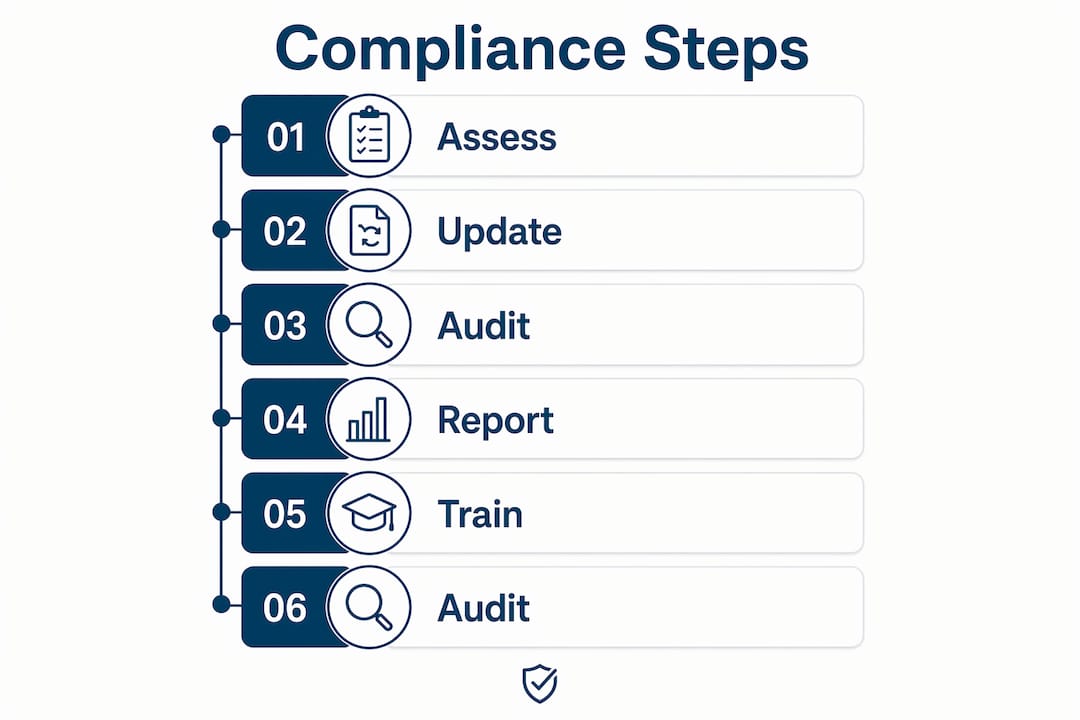
Step 1: Assess your current state. Pull your last three OSHA 300 logs, your most recent inspection report if one exists, and your current written safety program. Identify the three most common citation categories and the three most common near-miss types. That intersection is your highest-priority hazard profile.
Step 2: Fix the written program. Update it to reflect current operations, name competent persons, and date it. This single document is the first thing an inspector requests and the fastest way to establish credibility or generate citations.
Step 3: Audit training currency. Cross-reference every active worker’s certifications against their current task assignments. Any mismatch is a compliance gap. Resolve mismatches before the next shift, not the next quarter.
Step 4: Implement a near-miss reporting system. If workers are not reporting near misses, you are flying blind. A non-punitive, mobile-enabled reporting process that generates corrective actions is the fastest way to make hazards visible before they become incidents.
Step 5: Standardize toolbox talks. Daily toolbox talks with signed attendance are one of the most defensible compliance demonstrations available. They show ongoing worker engagement, topic-specific hazard awareness, and consistent supervisor accountability.
Step 6: Build the audit cadence. Quarterly internal audits with a standardized checklist and documented corrective actions create the continuous improvement loop that separates compliant programs from paper-compliant ones.
How does safety compliance fit into public works project management?
Safety compliance and project management share the same operational calendar. Pre-construction is when the TMP/TCP gets approved, contractor prequalification is confirmed, and the site safety plan is submitted. Mobilization is when orientation records are generated and competent person designations are confirmed on site. Active construction is when daily toolbox talks, JHA reviews, and equipment inspections happen. Closeout is when incident reports are finalized, training records are archived, and lessons learned feed the next project’s safety plan.
The integration point that most agencies miss is the work-order level. When a work order for a confined space entry or an excavation deeper than five feet is issued without a linked JHA and confirmed competent person designation, the compliance gap is created at the project management level, not the safety level. Building safety checkpoints into the work-order approval workflow — so that a supervisor cannot release a high-risk work order without confirming the required documentation — moves compliance from a safety department function to an operational one.
Safety meeting software for public works that integrates with project workflows makes this connection automatic, flagging missing documentation before work begins rather than after an incident surfaces the gap.
What do successful public works safety programs actually look like?
The programs that consistently pass inspections and maintain low incident rates share a few structural characteristics that go beyond having the right paperwork.
First, they treat near-miss reporting as a leading performance indicator, not an administrative burden. Agencies that generate consistent near-miss reports relative to their recordable incident count are actively surfacing hazards before they escalate. Agencies with very few near-miss reports and a moderate recordable rate are almost certainly under-reporting.
Second, they have a named, reachable safety contact for every active project. Not a corporate safety director who is available by appointment, but a designated person who can be reached by field crews and inspectors during working hours and who has the authority to stop work. This single structural feature eliminates the most common field-level compliance breakdown: a hazardous condition that no one with authority is present to correct.
Third, they run their safety program the same way whether or not an inspection is scheduled. The agencies that scramble to assemble documentation when an inspector arrives are the ones whose programs exist primarily on paper. The agencies that hand over a current, organized audit package within minutes are the ones whose programs are operational.
The FHWA worker safety guidance for drainage and maintenance work illustrates this principle: the safety procedures it outlines — PPE verification, utility locates before excavation, confined space compliance, work-zone traffic control — are not inspection checklists. They are the sequence of actions a competent crew performs before every shift, documented as a matter of course.
What are the legal and financial consequences of non-compliance?
Non-compliance in public works carries layered liability that extends well beyond OSHA citations. At the federal level, serious violations carry penalties up to the federal maximum amounts for serious, willful, or repeat violations as specified by OSHA guidelines. State-plan states set their own penalty schedules, and some exceed federal levels.
Beyond OSHA penalties, public agencies face civil liability exposure when a worker or member of the public is injured on a non-compliant site. Government immunity protections vary significantly by state and do not uniformly shield agencies from negligence claims arising from documented safety failures. A written record of known hazards that were not corrected is the most damaging evidence in a civil proceeding.
Contract-level consequences are equally significant. Contractors with poor safety records face bid disqualification on future public contracts. Agencies that cannot demonstrate a functioning safety program risk losing federal funding eligibility on transportation and infrastructure projects. And the reputational cost of a high-profile incident on a public works project — one that generates media coverage and public scrutiny — is difficult to quantify but real.
The practical implication is that the cost of a compliance program is always lower than the cost of a single serious incident. The calculation is not whether you can afford to invest in safety compliance. It is whether you can afford not to.
This article provides general safety and compliance information for educational purposes. Confirm current OSHA standards, state-plan requirements, and applicable regulations with OSHA directly or a qualified safety professional for your specific situation.
Key Takeaways
Improving safety compliance in public works requires designating competent persons in writing, digitizing training records, prequalifying contractors, implementing TMP/TCP before mobilization, and running quarterly audits — all tracked against near-miss ratios, training currency, and TRIR.
| Point | Details |
|---|---|
| Designate competent persons first | Name and document individuals for excavation, fall protection, and confined space before any crew mobilizes. |
| Digitize training and attendance | Timestamped digital records with signatures prevent non-qualified assignments and create an inspection-ready audit trail. |
| Prequalify contractors on safety | Require OSHA 30, current EMR, and a written safety plan as bid eligibility conditions, not post-award submittals. |
| Track leading indicators | Monitor near-miss reporting rates, JHA completion percentage, and training currency alongside TRIR to catch gaps before incidents occur. |
| My Safety Solution | Automates attendance, certification alerts, near-miss reporting, and exportable audit reports for public works compliance programs. |
The compliance gap that no checklist fixes
Safety compliance in public works is not a documentation problem. It is a culture problem that documentation reveals.
The agencies that struggle most with compliance are not the ones that lack written programs. They are the ones where the written program and the field reality have diverged so far that no one on the crew could tell you what the site safety plan actually says. The toolbox talk log is signed, but the talk lasted 90 seconds and covered nothing specific to the day’s hazards. The competent person is named, but they are in the office and unreachable when the excavation crew hits groundwater and needs a soil reclassification decision.
What actually works is closing the distance between the program and the work. That means short, specific daily briefings tied to the actual tasks on the schedule that day. It means a near-miss reporting process so fast and non-punitive that workers use it without being asked. It means supervisors whose performance reviews include safety metrics, so that cutting corners on documentation has a personal cost, not just an organizational one.
The retaliation risk under OSHA Section 11© is real and often underestimated. Disciplinary procedures must be documented, consistently applied, and clearly separated from any protected safety activity — reporting a hazard, filing a near-miss report, or cooperating with an inspection. An agency that disciplines a worker for reporting a near miss and cannot produce documented, consistently applied disciplinary criteria for the same behavior in other contexts is exposed to a whistleblower complaint that will cost more than any citation.
The practical fix is simpler than it sounds: write down what you do, do what you wrote down, and document the gap when reality diverges from the plan. That discipline, applied consistently, is what makes a safety program defensible.
My Safety Solution makes public works compliance defensible
Public works safety managers carry a documentation burden that paper and spreadsheets cannot reliably sustain. Missing a certification expiry, losing a toolbox talk log, or failing to generate a corrective action from a near-miss report are the gaps that turn an inspection into a citation event.
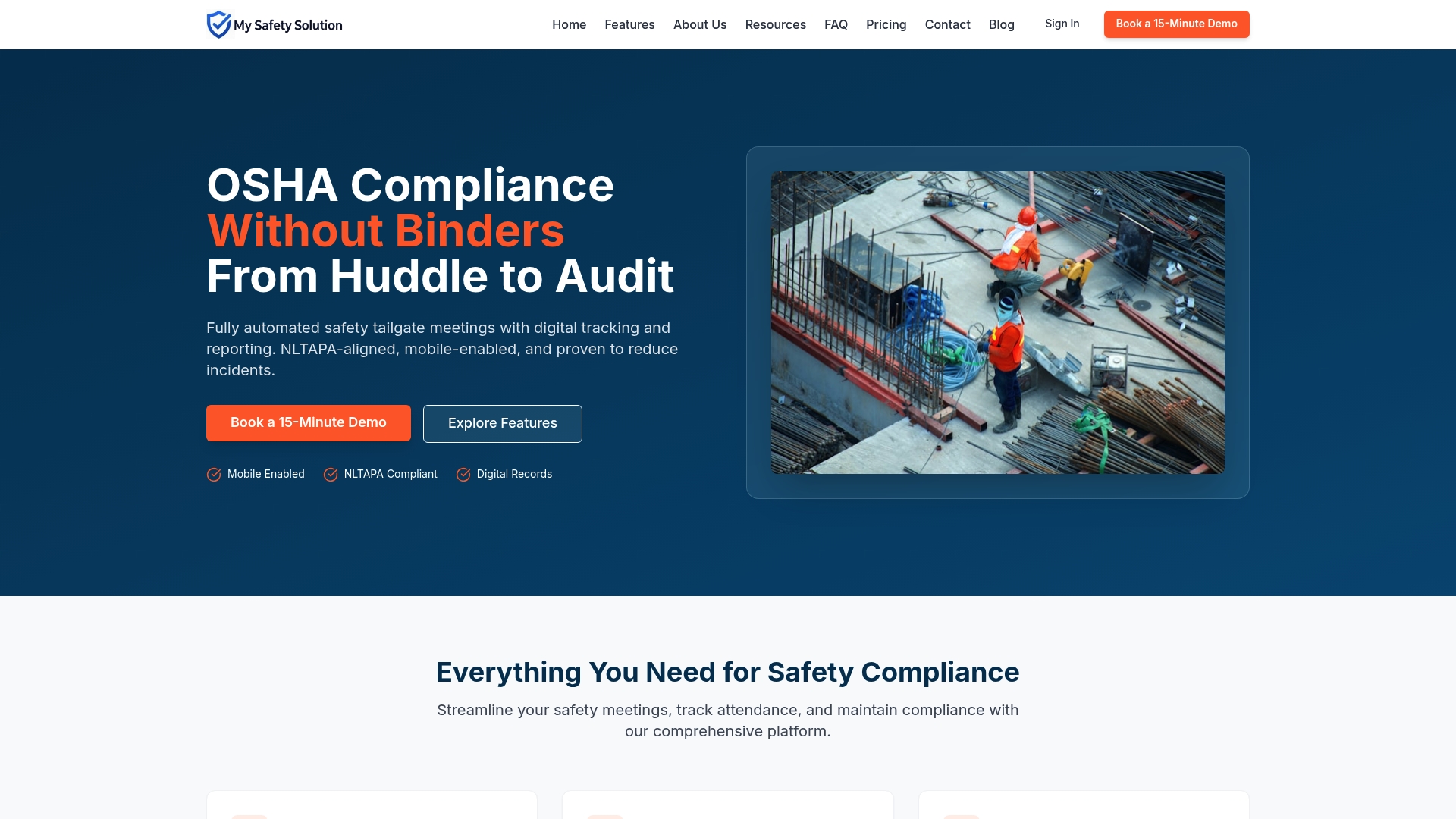
My Safety Solution eliminates those gaps with automated attendance tracking and digital signatures, certification expiry alerts tied to worker profiles, photo-enabled near-miss reporting that generates corrective work orders, and exportable audit reports you can hand to an inspector in minutes. The platform is built for deskless, high-risk workforces — the exact environment public works crews operate in. Multi-site managers get a consolidated compliance dashboard; field supervisors get a mobile-first interface that takes less time than a paper sign-in sheet.
For public works teams ready to move off patchwork recordkeeping, start with a free trial or contact us to see how the platform maps to your specific compliance requirements.
Authoritative resources for further reading
-
OSHA Safety Management Recommended Practices — The primary source for program architecture: management commitment, hazard ID, training, and evaluation pillars. Includes free templates and a step-by-step implementation guide for small and medium employers.
-
29 CFR 1926 Construction Standards — The governing standard for public works construction. Use this to confirm competent person definitions, excavation requirements, fall protection thresholds, and PPE mandates.
-
FHWA Worker Safety Guidance — Federal Highway Administration guidance on worker safety for drainage and maintenance work, including traffic control plan layouts and excavation safety procedures.
-
Indiana DOT Work Zone Traffic Control Standards — A representative state DOT document illustrating TMP/TCP structure and pre-mobilization requirements. Use as a template reference alongside your own state DOT’s current standards.
-
OSHA Whistleblower Protection Program — Authoritative source on Section 11© anti-retaliation protections. Review before drafting disciplinary procedures to confirm your documentation practices are defensible.
-
Regulations.gov — OSHA Active Rulemaking — Track active OSHA rulemaking that may affect public works standards, including proposed changes to excavation, silica, and heat illness prevention rules.
-
Regional OSHA offices — Contact your regional OSHA office directly for state-plan clarifications, free on-site consultation (available to employers without triggering enforcement), and jurisdiction-specific guidance on municipal employee coverage. The OSHA website’s area office locator provides direct contact information by state.