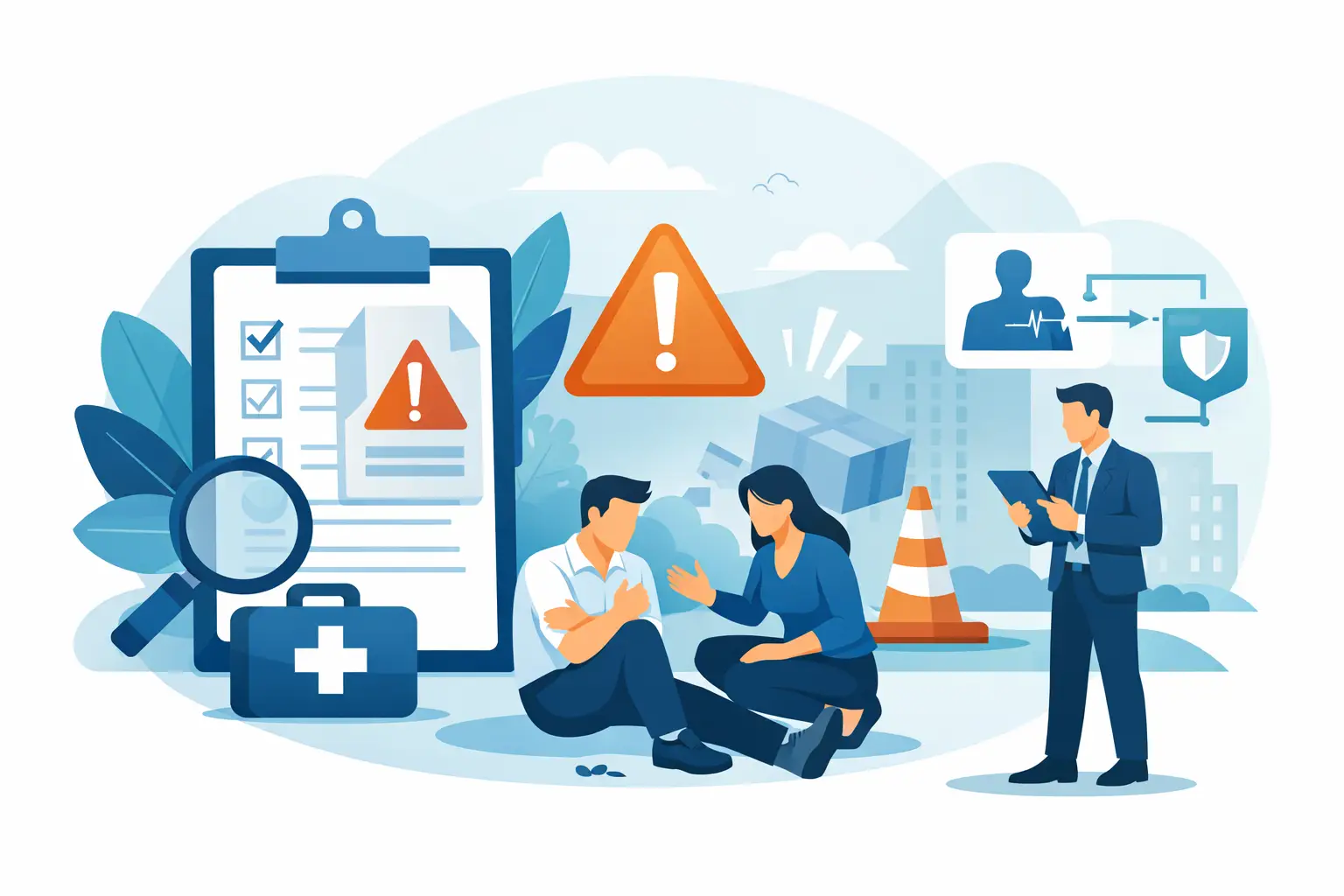
When a supervisor hears about an injury hours after it happened, or learns that a near miss was never documented, the problem is rarely the event alone. The real failure is the lack of a clear incident and accident reporting procedure. Without one, organizations lose time, facts, accountability, and often their ability to respond in a controlled, compliant way.
For safety leaders, operations managers, HR teams, and business owners, reporting is not just paperwork after something goes wrong. It is the first operational step in containment, investigation, corrective action, and regulatory readiness. If the procedure is vague, delayed, or inconsistent across locations, every downstream safety process becomes harder to manage.
What an incident and accident reporting procedure needs to do
A strong procedure creates structure in the first minutes and hours after an event. That structure matters because reporting often happens under pressure. People are trying to get medical attention, keep work moving, preserve evidence, and decide who needs to be informed. If the process depends on memory, personal judgment, or informal communication, details get lost quickly.
At a minimum, the procedure should define what must be reported, who reports it, when reporting must occur, how it is documented, who reviews it, and what happens next. That sounds straightforward, but many organizations still leave critical gaps. Some require reports for injuries but not near misses. Others define reporting timelines loosely, which creates delays and inconsistent records. In multi-site operations, one facility may follow the process closely while another relies on text messages and verbal updates.
The best procedures reduce that variability. They make expectations clear enough that a frontline employee, a field supervisor, and a corporate safety manager all understand the same workflow.
Incident vs. accident: define the scope clearly
One of the first problems to solve is terminology. In practice, companies often use incident and accident interchangeably, but your reporting procedure should not rely on assumptions. If employees are unsure what counts as reportable, underreporting follows.
In most operations, an accident usually refers to an event that results in injury, illness, property damage, or equipment loss. An incident can be broader and may include near misses, unsafe conditions, environmental releases, vehicle events, and other unplanned occurrences that had the potential for harm.
That broader definition is usually the better operational standard. If your procedure only captures events after someone is hurt or property is damaged, you miss the warning signs that could prevent a more serious outcome later. Near miss reporting, in particular, gives organizations a chance to act before the next event carries a higher cost.
Core steps in the incident and accident reporting procedure
The procedure itself should be simple enough to use in real time but detailed enough to support compliance and investigation. In most organizations, the sequence starts with immediate response.
1. Stabilize the situation first
Before any form is opened, the priority is medical care, emergency response, and scene control. Employees need to know that reporting does not come before treatment. Supervisors also need clear direction on when to stop work, isolate equipment, or restrict access to preserve the area.
This step should also address escalation thresholds. A minor first-aid case does not require the same level of response as a hospitalization, vehicle collision, chemical exposure, or serious equipment event. The procedure should remove guesswork by stating exactly when management, safety personnel, HR, and executive stakeholders must be notified.
2. Report the event immediately
Timeliness is one of the biggest differences between a usable report and a weak one. Witness memories change fast. Conditions at the scene shift. Photos, equipment status, and worksite details become harder to verify.
For that reason, the reporting timeline should be specific. Terms like promptly or as soon as possible are too open to interpretation. A better standard is immediate verbal notification followed by formal documentation within a defined period, such as before the end of shift or within 24 hours, depending on the event type.
Employees should also know their reporting path. In some organizations that means notifying a supervisor first. In others, the report may go directly into a centralized system with automatic alerts to safety and management. Either approach can work, but the route needs to be consistent.
3. Capture complete and usable information
A report is only valuable if it gives the organization enough detail to act. At minimum, documentation should capture who was involved, where the event occurred, when it happened, what activity was taking place, what conditions existed, and what immediate actions were taken.
The report should also distinguish facts from assumptions. Statements like employee was careless do not help. Specific observations do. For example, machine guard removed during adjustment, forklift aisle partially blocked, or worker slipped on wet surface near loading area gives the investigation team something concrete to evaluate.
Photos, witness statements, supervisor notes, and equipment information should be attached when relevant. The more standardized the data collection, the easier it is to compare trends across jobs, facilities, and business units.
Why paper-based reporting breaks down
Many companies still rely on handwritten forms, email chains, or spreadsheets to manage incident reporting. That may work at low volume or in a single location, but it becomes unreliable as operations scale.
Paper forms get delayed. Emails stay in individual inboxes. Spreadsheets create version control issues. Most importantly, fragmented reporting makes it difficult to see patterns across the organization. A repeat hand injury in one facility and a similar near miss in another may never be connected if the records live in separate places.
This is where process design matters as much as policy. A reporting procedure should not end at form completion. It should move information into a centralized workflow where records are visible, reviewable, and tied to follow-up actions. For companies managing multiple sites, contractors, drivers, or field teams, that level of control is hard to achieve manually.
Investigation and corrective action are part of reporting
An incident and accident reporting procedure should not stop once the initial report is submitted. Reporting is the trigger for investigation, root cause analysis, and corrective action tracking. If those pieces are disconnected, the organization ends up documenting events without learning from them.
Build clear ownership after the initial report
Someone needs to review the report, verify facts, determine severity, and assign next steps. In smaller organizations, that may be one safety manager or operations leader. In larger teams, ownership may vary by event type, site, or department. What matters is that the handoff is defined.
The procedure should also set expectations for investigation timing. A low-risk near miss may require a shorter review, while a serious injury or equipment event may require formal analysis, documented interviews, and leadership review. Not every case needs the same depth, but every report should lead to an explicit decision.
Track corrective actions to closure
One of the most common weaknesses in safety programs is incomplete follow-through. The event gets reported. An investigation is started. Recommendations are discussed. Then actions remain open for weeks because no one owns the deadline.
Corrective action tracking should be embedded in the procedure. That means assigning responsibility, due dates, verification steps, and closure documentation. It also means validating whether the action addressed the actual cause or only the immediate symptom. Retraining may be appropriate in some cases, but if the underlying issue is poor guarding, unclear procedures, or recurring housekeeping failures, training alone will not solve it.
Compliance matters, but operational consistency matters more
Regulatory obligations are a major reason organizations formalize reporting, and rightly so. Serious events may trigger OSHA recordkeeping, reporting deadlines, workers' compensation processes, insurance notifications, or customer requirements. A weak reporting system increases the risk of missed deadlines and incomplete records.
Still, compliance should not be the only lens. The more practical reason to standardize reporting is operational control. A company with a disciplined reporting process can identify repeat hazards faster, compare incident types across locations, and see where supervisors are consistently late in reporting or corrective actions are stalling. That level of visibility supports better decisions, not just better files.
For distributed organizations, this is especially important. One job site may be highly responsive while another has reporting gaps that do not surface until an audit, claim, or serious event. Standardization exposes those differences early enough to address them.
How to strengthen adoption across teams
Even a well-written procedure can fail if the workforce sees reporting as burdensome or punitive. Adoption improves when the process is easy to access, simple to follow, and tied to visible action.
Employees are more likely to report when they know what happens after submission. Supervisors are more likely to enforce timelines when expectations are measurable. Leadership is more likely to support the process when data can be used to spot trends, allocate resources, and reduce repeat incidents.
Technology can help here, but only if it supports the workflow instead of adding friction. A platform such as My Safety Solution can centralize reports, standardize required fields, trigger notifications, and track corrective actions across locations. The value is not just digitization. It is process control.
Build the procedure around reality, not theory
The most effective reporting procedures reflect how work actually happens. A warehouse team, a field service crew, and a construction operation do not report incidents in the same environment or under the same constraints. Mobile access, offline capability, supervisor escalation paths, and role-based approvals may matter more in one setting than another.
That is why procedure design should start with the operational question, not just the policy question. Who is on site when an event happens? How quickly can information reach decision-makers? Where do delays usually occur? What evidence is most often missed? The right procedure answers those realities directly.
A reporting process should create discipline without creating confusion. When it does, the organization responds faster, investigates better, and puts itself in a stronger position before the next event tests the system.